








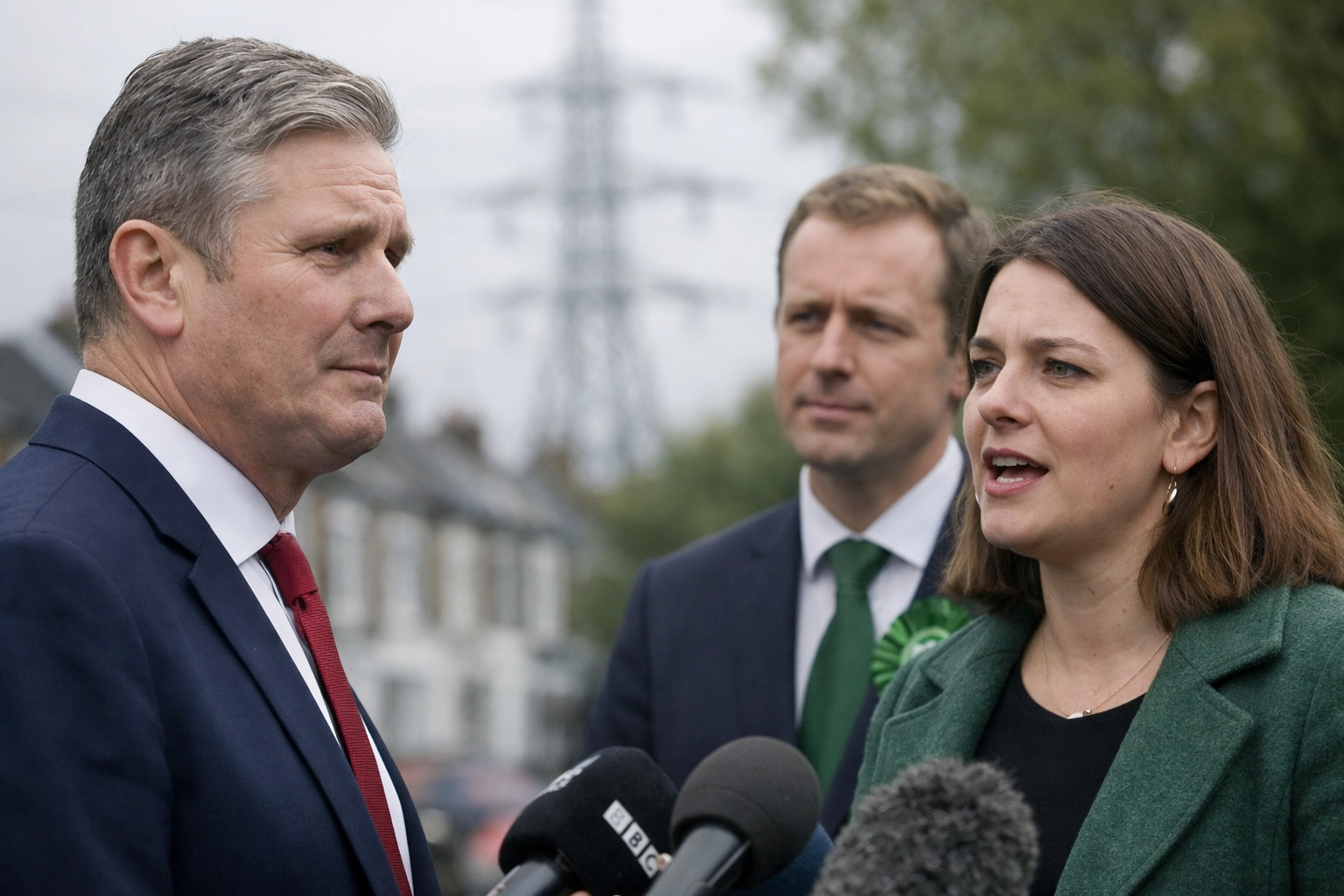
Keir Starmer faces mounting pressure from the Green Party over the adequacy of new energy support measures as households continue to grapple with high living costs.
The Prime Minister recently confirmed a series of interventions aimed at lowering domestic costs, but critics argue the steps fall short of what is required for the country’s most vulnerable.
Zack Polanski, deputy leader of the Green Party, has been vocal in his critique of the current administration’s approach to the energy crisis.
The debate arrives as the government attempts to balance immediate financial relief with long-term structural changes to the UK’s energy grid.
While the Labour government has prioritised a "clean British energy" transition, the immediate reality for many remains one of financial strain and uncertainty.
Recent data suggests that despite a cooling of global gas prices, the cost of heating a home remains significantly higher than pre-2021 levels.
This ongoing pressure has placed the government's energy policy at the centre of uk political news this week.
The Rural Energy Gap and the Green Party Response
Zack Polanski has specifically targeted the government’s handling of households that rely on heating oil, a demographic often overlooked in standard energy price cap discussions.
Approximately 1.5 million homes in the UK are not connected to the national gas grid, relying instead on tank-delivered heating oil or liquid petroleum gas.
Polanski argues that the government’s recently announced £53 million support package for these households is a "sticking plaster on a gaping wound."
The Green Party asserts that rural communities are being disproportionately affected by price volatility in the global oil market.
Polanski’s critique focuses on the fact that heating oil users do not benefit from the same regulatory protections as those on the main gas and electricity grids.
He has called for a more comprehensive "wealth tax" to fund a national insulation programme that would reduce the overall energy demand of the UK’s aging housing stock.
According to the Green Party, the current focus on short-term subsidies ignores the systemic issue of energy inefficiency in British homes.
Real life stories news reports from across the UK highlight families in rural areas forced to choose between heating and other essentials as oil prices fluctuate.
The Green Party’s stance is that Starmer’s government is "timid" in its confrontation with energy suppliers and fuel giants.
Polanski has suggested that without a radical shift in how energy is priced and distributed, the UK will remain trapped in a cycle of fuel poverty.
He argues that the current £53 million package, when divided among the millions of affected households, offers negligible relief against the backdrop of rising inflation.
The Green Party’s alternative involves a massive scale-up of renewable energy investment, funded by higher taxes on North Sea oil and gas profits.
Starmer, however, maintains that his government’s approach is the only responsible way to manage the transition while maintaining fiscal stability.
The friction between the two parties underscores a broader ideological divide on how to achieve net-zero targets while protecting the economy.
Government Intervention and the £53 Million Package
In response to the criticism, the government has defended its record, pointing to the £117 annual reduction in the energy price cap effective from April.
Ministers claim that this reduction, driven by recent budget interventions, will save the average household significant sums over the coming year.
The £53 million support package specifically for heating oil users is intended to bridge the gap for those who fall outside the traditional price cap protections.
Starmer has issued legal directions to energy companies, demanding they pass on wholesale savings to their customers immediately.
The Prime Minister has also threatened legal action against fuel suppliers found to be engaged in "price gouging" at the expense of the consumer.
Downing Street maintains that helping households with the cost of living is the administration's "first priority."
However, the Prime Minister acknowledged during a recent briefing that "there is more to do" to ensure long-term stability.
The government’s strategy also includes a £90 billion investment plan for clean British energy, with a significant emphasis on expanding the nuclear sector.
This long-term plan is designed to decouple the UK’s energy prices from volatile international gas markets.
Starmer argues that the only way to permanently lower bills is to become an "energy superpower" through domestic production.
The £90 billion plan has been met with mixed reviews, with some economists questioning the timeline for delivery.
While the government looks toward 2030, the Green Party continues to demand immediate action for those struggling in the present.
The current administration's focus on nuclear energy is another point of contention for Polanski and his colleagues.
The Greens argue that wind and solar are faster and cheaper to deploy than the nuclear projects favoured by Starmer.
This debate remains a primary driver of uk political news as the government prepares for its next major environmental policy announcement.
Real life stories news continues to track the impact of these policies on the ground, where many feel the "headline" savings are not reaching their bank accounts.
Market Volatility and the Path to Energy Security
The global context of the UK’s energy crisis cannot be ignored, with Keir Starmer highlighting the importance of international stability.
The Prime Minister recently stated that the reopening and security of the Strait of Hormuz is vital for market stability.
Disruptions in international shipping lanes have historically led to spikes in the price of imported fuels, affecting every UK household.
Starmer’s government is positioning its foreign policy as an extension of its domestic energy strategy.
By seeking to ensure global supply chain security, the government hopes to prevent the "shocks" that have defined the last three years.
Critics, including the Green Party, argue that this reliance on global supply chains is exactly why the UK should be moving faster toward total energy independence.
Polanski maintains that as long as the UK depends on global markets for its fuel, British citizens will be at the mercy of international conflicts.
The government’s Energy Price Cap, while currently trending downwards, remains a focal point for public anxiety.
Industry experts suggest that while the £117 reduction is welcome, it does not compensate for the loss of previous winter fuel subsidies for many pensioners.
The removal of certain support payments has become a significant talking point for opposition parties across the political spectrum.
Starmer has defended these decisions as "tough choices" necessary to repair the national finances.
The Green Party, however, dismisses this narrative, suggesting that the money exists but is being "misallocated" toward corporate interests.
The conversation around energy bills is no longer just about the cost of electricity; it is a debate about the very structure of the British economy.
As the government moves forward with its clean energy transition, the pressure from the Greens ensures that the social impact remains in the spotlight.
The outcome of this political tug-of-war will likely determine the financial wellbeing of millions of households over the next decade.
For now, many Britons remain in a state of watchful waiting, hoping that the promised savings will eventually outweigh the rising costs.
The debate over Starmer’s energy legacy is far from settled, with both sides digging in for a long-term political battle.