





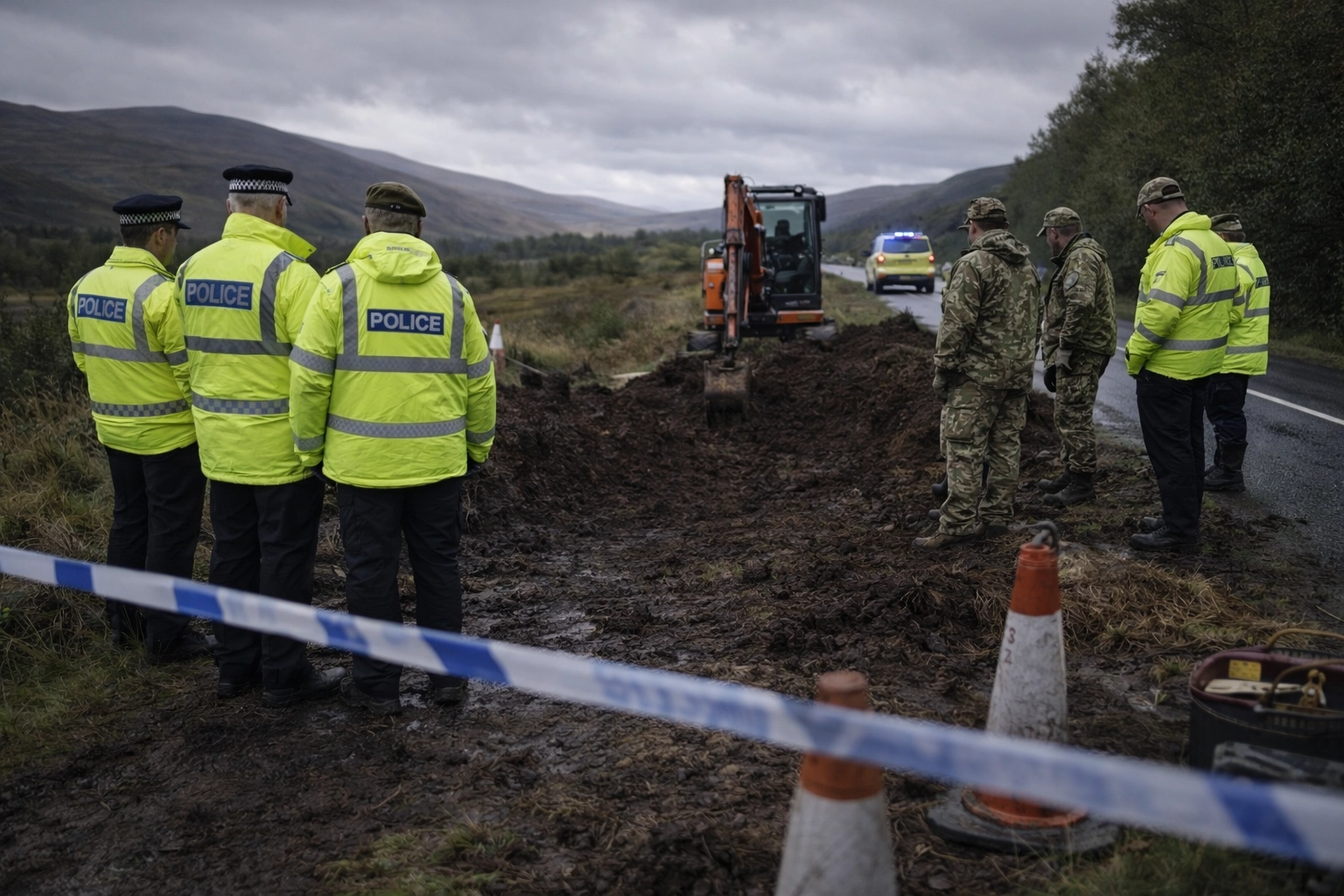
Military personnel have been mobilised to assist Police Scotland in a significant new push to locate the remains of Renee MacRae and her three-year-old son, Andrew. The pair vanished nearly half a century ago in one of the UK's most enduring and haunting mysteries. Specialists from the British Army are now on the ground in the Scottish Highlands, providing technical expertise and manpower to help excavate remote areas that have long been suspected as potential burial sites.
The disappearance of the 36-year-old mother and her young child on a rainy November night in 1976 triggered one of the largest missing persons investigations in British history. Despite decades of searching and a high-profile murder conviction in 2022, their bodies have never been recovered. The current deployment of military assets marks a determined effort by the Major Investigation Team to finally provide closure to a family that has waited fifty years for answers.
Ground-penetrating radar and specialised digging equipment are being utilised in the latest phase of the operation. This intervention comes after fresh forensic reviews suggested that certain terrains previously deemed too difficult to search may hold the key to the mystery. The involvement of the Army underscores the scale of the task, as the Scottish landscape: characterised by deep peat bogs and dense woodland: continues to pose a formidable challenge to investigators.
The Burning BMW and the Disappearance
On the evening of 12 November 1976, Renee MacRae left her home in Inverness with her son, Andrew. She told her husband she was travelling to visit her sister in Kilmarnock, but it later emerged she was actually planning a weekend away with her secret lover, William MacDowell. The meeting never took place. Late that night, her BMW was discovered engulfed in flames in a lonely lay-by on the A9 near Dalmagarry. When police arrived, the vehicle was empty, save for a few personal items. There was no sign of Renee or Andrew.
The initial investigation was hampered by the complexities of Renee’s personal life and the geographic isolation of the Highland roads. For years, the case remained a source of intense local speculation and national intrigue. Searches were conducted across vast swathes of the Highlands, focusing on quarries, forests, and stretches of the A9 that were undergoing construction at the time. Despite the discovery of bloodstains in the boot of the burnt-out car, the lack of bodies meant that no one was initially charged with the crime.
As the years turned into decades, the MacRae case became a symbol of unresolved justice. Every few years, new leads would emerge: a tip-off about a specific patch of earth or a modernised forensic technique that could re-examine old evidence. Yet, each attempt to find the pair ended in frustration. The mystery deepens when considering the climate and soil conditions of the area; the acidic nature of the Highland peat can preserve organic material for centuries, yet it can also make the task of identifying disturbed ground nearly impossible without sophisticated military-grade equipment.
Military Precision in the Highlands Search
The decision to bring in the Army represents a tactical shift in the search strategy. Military engineers and search teams bring a level of precision and heavy-duty capability that civilian police forces often lack for long-term, large-scale excavations. The focus of the current operation is believed to be centred on Leanach Quarry, as well as several smaller, undisclosed sites along the A9 corridor. These locations were identified through a combination of historical witness statements and modern data mapping that reconstructs the movements of vehicles on the night of the disappearance.
The Army’s role involves more than just manual labour. Personnel are trained in "forensic archaeology," a discipline that combines traditional excavation techniques with an understanding of how soil layers and biological remains change over decades. By using advanced thermal imaging and satellite data, the teams can identify "anomalies" beneath the surface that might indicate where the earth was disturbed fifty years ago. This level of technical scrutiny is essential, as the passage of time has allowed forests to grow and landscapes to shift, hiding any obvious signs of a shallow grave.
Police Scotland has emphasised that this is a meticulous process. Every cubic metre of earth removed from the target sites is being sifted for evidence, including fragments of clothing or bone. The logistical challenge is immense, requiring temporary infrastructure to be built in remote locations to support the troops and forensic specialists. While the public interest in the case remains high, the authorities have maintained a strict perimeter around the search zones to preserve the integrity of any potential discovery.
The Legacy of Silence and the Quest for Closure
For many, the conviction of William MacDowell in 2022 brought a sense of legal justice, but it failed to provide the ultimate answer. MacDowell, who was Renee’s lover and the father of young Andrew, was found guilty of their murders following a trial at the High Court in Inverness. The prosecution argued that MacDowell killed the pair to prevent his affair from being exposed and to protect his own lifestyle. However, MacDowell took the secret of their final resting place to his grave, dying in prison in early 2023 at the age of 82.
His death was a significant blow to the family, specifically Renee's sister, Morag Govans, who has campaigned tirelessly for five decades. The "legacy of silence" left by MacDowell has meant that the search must rely entirely on physical evidence and forensic ingenuity. The current military-assisted search is not just about gathering evidence for a trial that has already concluded; it is about the fundamental human right to a proper burial and the moral obligation to recover the remains of a child and his mother.
As the Army continues its work in the Highlands, the community watches with a mixture of hope and trepidation. The MacRae case is woven into the fabric of Inverness history, a dark chapter that many wish to see closed. If the remains are found, it will mark the end of one of the longest-running search operations in the history of global policing. Until then, the specialists on the ground continue their patient work, sifting through the layers of Highland earth in the hope of finding the truth that has been hidden since 1976.
The investigation remains active, and while the military involvement is scheduled for a specific duration, Police Scotland has stated that they will follow the evidence wherever it leads. The pursuit of Renee and Andrew MacRae is a testament to the fact that in the eyes of the law and the hearts of the bereaved, no case is ever truly closed until the lost are brought home.