





An eighteen-year-old woman has admitted to a frenzied axe attack on a stranger in Bristol, an incident that has sent shockwaves through the community and highlighted the growing threat of youth radicalisation within far-right circles. Alina Burns, who was seventeen at the time of the assault, appeared at Bristol Crown Court to enter a guilty plea for attempted murder. The court heard how the teenager, described by some who encountered her rhetoric as an "embodiment of hell," targeted her victim based purely on his ethnicity and her own extremist ideological convictions.
The attack occurred on 2 August 2025, in the Bedminster area of Bristol. The victim, Mohammed Mahmoodi, a twenty-seven-year-old Iranian Kurd, was standing outside a barber’s shop when Burns approached him from behind. Without warning or provocation, she produced an axe and swung it toward his neck. Mr Mahmoodi, through a combination of luck and quick reflexes, managed to evade the full force of the initial blow. He then engaged in a desperate struggle to disarm the teenager as she attempted a second strike. Despite the violence of the encounter, Mr Mahmoodi escaped with relatively minor physical injuries, though the psychological impact remains profound.
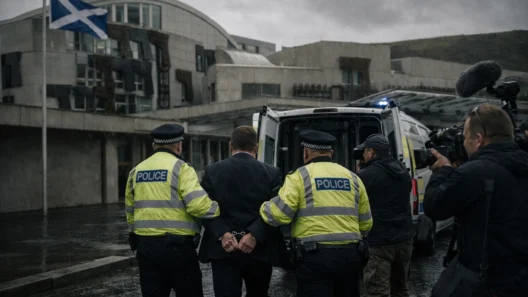
Police officers patrolling the area were alerted by the commotion and the sight of the struggle. They apprehended Burns at the scene, where she was found in possession of several other weapons, including a scalpel and a set of darts. Upon her arrest, the teenager’s chilling lack of remorse became immediately apparent. When questioned by officers about her intentions, she reportedly stated with cold precision: "I wanted to cut his neck." This admission formed a cornerstone of the prosecution's case, painting a picture of a calculated attempt at extrajudicial execution driven by racial animus.
The Radicalisation of an Eighteen Year Old Extremist
The investigation into Alina Burns’ background revealed a deeply disturbing descent into the world of neo-Nazi extremism. Detectives found that Burns was an active member of Patriotic Alternative, a far-right organisation known for its white nationalist rhetoric and anti-immigrant stance. Her digital footprint provided a roadmap of her radicalisation, showing a rapid escalation from fringe political interest to the active planning of a violent atrocity.
In the months leading up to the attack, Burns’ online presence was defined by vitriolic hatred. Messages recovered from encrypted platforms showed her calling for the "death of all Jews and Muslims in Britain." She didn't just consume hate speech; she became a vocal proponent of it, advocating for a racially homogeneous England and suggesting that violence was the only "necessary path" to achieving this goal. Her peers in these online spaces were part of a global network of extremists who lionise historical fascist figures and share tactical advice on how to carry out lone-actor attacks.
Evidence presented to the court showed that the attack in Bedminster was far from a spontaneous outburst. Burns had spent the days prior researching the most effective ways to kill with an axe. Her search history included instructional videos on how to aim for the carotid artery and where to purchase tools that would not trigger immediate suspicion. On the morning of 2 August, she visited a local hardware store to purchase the axe used in the attack.
Perhaps the most damning piece of evidence was an email she drafted titled "The dawn of civil war." In this document, she outlined her belief that she was a soldier in a coming racial conflict. She expressed a desire to instill fear in minority communities to "protect her homeland" and claimed that her actions would serve as a catalyst for others to follow. This manifesto-style writing is a hallmark of modern extremist violence, designed to justify individual acts of terror through a lens of perceived existential threat.
CCTV and Evidence of a Premeditated Execution Attempt
The prosecution played CCTV footage of the attack during the hearing, providing a harrowing visual record of the events in Bedminster. The video shows Burns dressed in dark clothing, lingering near the barber’s shop for several minutes before Mr Mahmoodi appears. She can be seen observing him, waiting for a moment when his back is turned and he is distracted by his mobile phone. The deliberate nature of her movements suggested a predator stalking prey, rather than a confused or mentally unstable individual acting on impulse.
When the moment arrived, the footage shows Burns pulling the axe from a concealed bag and swinging it in a wide, powerful arc aimed directly at the victim's head and neck. The speed of the attack was such that Mr Mahmoodi only noticed her at the very last second. His instinctive move to duck and raise his arm likely saved his life. The struggle that followed lasted nearly a minute, with Mr Mahmoodi eventually managing to pin Burns against a wall until the police arrived.
During the police interviews that followed, Burns remained eerily calm. She detailed her selection process, admitting that she had walked through several neighbourhoods looking for a target that "looked like they didn't belong." Her criteria were based entirely on skin colour and perceived religion. She told investigators that she felt "proud" of her decision to act, even if she had failed to kill her target. This lack of empathy and the clinical way she described her desire to end a human life led investigators to describe her as one of the most hardened young extremists they had ever encountered.
The presence of additional weapons: the scalpel and the darts: suggested that Burns had prepared for a prolonged confrontation or intended to target multiple people if the initial attack went differently. Forensic analysis of her phone also revealed that she had been monitoring local news reports about small boat crossings and "migrant hotels," using these current events to fuel her personal grievances and justify her shift toward militant action.
The Legal Threshold for Sentencing a Terrorist Act
While Alina Burns has pleaded guilty to attempted murder and the possession of bladed articles, a significant legal debate remains regarding the motivation behind the attack. Burns and her legal team have denied that the incident constitutes an act of terrorism. This distinction is crucial, as a "terrorist connection" under UK law can significantly increase the minimum term of a sentence and affect the conditions of imprisonment and eventual parole.
Under the Terrorism Act 2000, for an act to be classified as terrorism, it must be designed to influence the government or intimidate the public and be made for the purpose of advancing a political, religious, racial, or ideological cause. The prosecution argues that Burns' manifesto, her membership in Patriotic Alternative, and her stated goal of inciting a "civil war" clearly meet these criteria. Her defence, however, is expected to argue that her age and potential psychological vulnerabilities should mitigate the classification of the crime.
The judge in the case, who will deliver the sentence in May, must now weigh these factors. The sentencing will be a landmark moment for the British justice system, which is increasingly dealing with radicalised minors who have bypassed traditional social structures in favour of online extremist echo chambers. The "embodiment of hell" label, used to describe the sheer malice of the intent, will likely feature in the judge's closing remarks as they determine whether Burns poses a lifelong danger to the public.
As the legal proceedings continue, the community in Bristol is left to grapple with the reality of the attack. For Mr Mahmoodi, the physical scars are minor, but the knowledge that he was targeted for death simply for existing is a burden that will last a lifetime. The case serves as a stark reminder of the lethal potential of far-right radicalisation and the speed with which online hate can translate into real-world violence on British streets. The sentencing in May will not only provide a measure of justice for the victim but will also set a precedent for how the state handles the emerging threat of teenage extremists.