




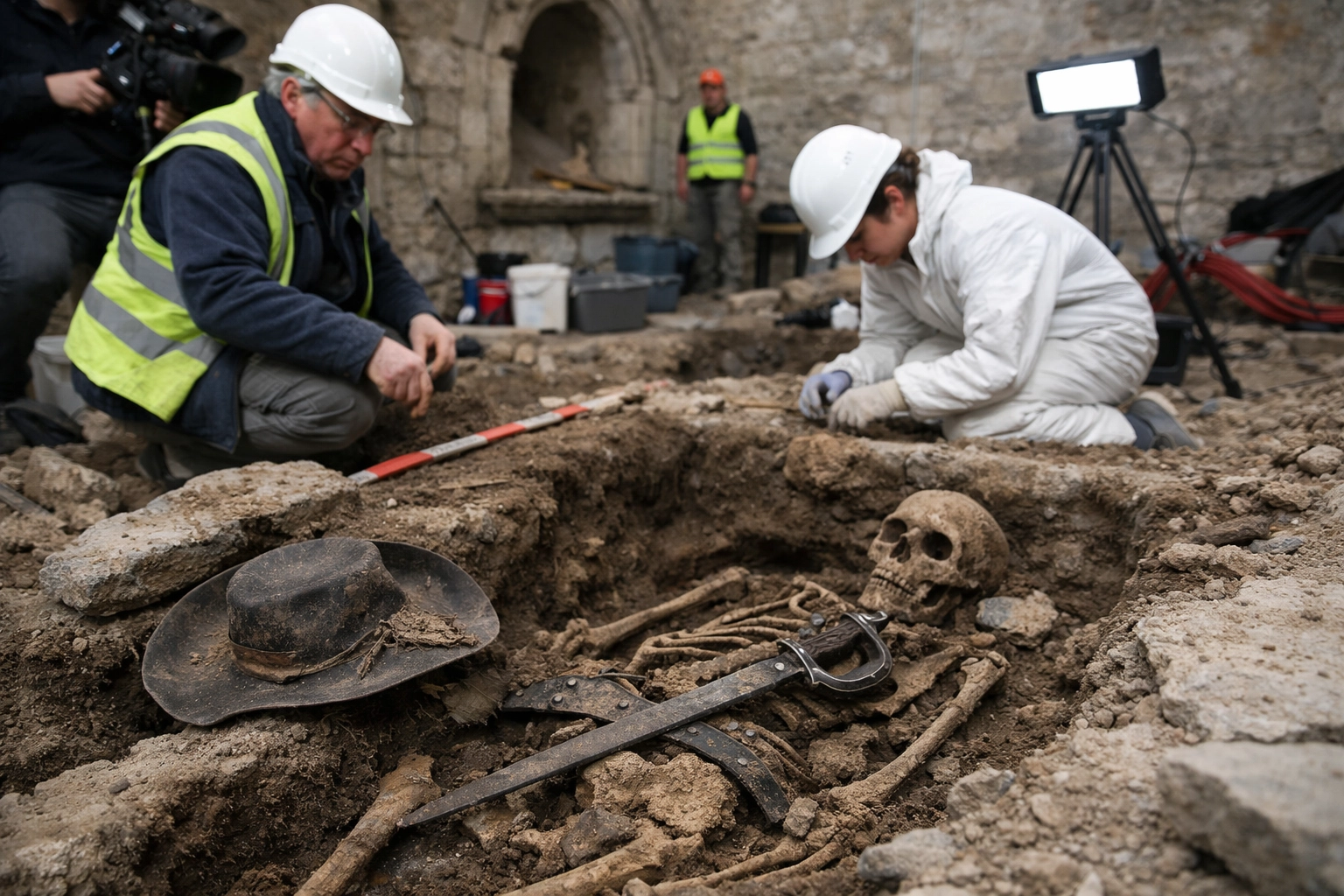
Archaeologists in the Netherlands believe they have discovered the final resting place of Charles de Batz de Castelmore d'Artagnan, the historical figure who inspired Alexandre Dumas' most famous literary creation. The discovery was made in February 2026 following the subsidence of a floor section during routine renovation work at the St Peter and Paul Church in Maastricht. The remains, which were found in a consecrated area of the building, have become the focus of an international forensic investigation involving DNA analysis and historical mapping.
For over 350 years, the exact location of d'Artagnan’s grave remained one of Europe’s most enduring historical mysteries. While it was well-documented that the captain-lieutenant of the Musketeers of the Guard fell during the Siege of Maastricht in 1673, the chaos of the French military campaign meant his burial site was never officially marked for posterity. The recent findings suggest that the soldier was afforded a high-status burial consistent with his rank and personal relationship with King Louis XIV.
The Archaeological Breakthrough in Maastricht
The breakthrough occurred unexpectedly when contractors working on the interior of the St Peter and Paul Church noticed a significant dip in the stone flooring near the altar. Upon excavation, a team of archaeologists led by Wim Dijkman uncovered a skeleton buried in a manner reserved for high-ranking individuals of the 17th century. Dijkman, who has dedicated more than two decades to locating the musketeer's remains, noted that the positioning of the body within holy ground aligns with contemporary letters suggesting d’Artagnan was buried with full religious honours.
Physical evidence recovered from the site provides a compelling link to the historical events of June 1673. Scientists identified a lead musket ball located at the chest level of the remains, corresponding with historical accounts that d’Artagnan was killed by a projectile wound to the throat or upper torso. Additionally, a French coin dated 1660 was found in close proximity to the skeleton, placing the burial firmly within the era of the Sun King’s expansionist wars.
The location of the church itself is historically significant to the theory. During the siege of 1673, the French army established a camp nearby, and the St Peter and Paul Church would have served as one of the few consecrated sites available to the invading force for the burial of their fallen officers. The presence of a high-status grave in this specific location supports the narrative that the French military took great care to protect the remains of one of their most celebrated commanders.
Behind the Legend of Charles de Batz
While the name d’Artagnan is synonymous with the swashbuckling adventures found in Dumas’ 1844 novel, the real Charles de Batz de Castelmore was a career soldier of formidable reputation. Born in Gascony between 1611 and 1615, he rose through the ranks of the French military during a period of intense European conflict. Unlike the fictional version of the character, who is often portrayed as a hot-headed youth, the historical d’Artagnan was an older, seasoned veteran by the time of his death, serving as a trusted agent and spy for King Louis XIV.
His career was defined by his loyalty to the crown during the civil unrest of the Fronde and his subsequent rise to the position of captain-lieutenant of the Musketeers. This was the highest rank achievable within the elite unit, as the King himself held the title of Captain. D’Artagnan was responsible for high-profile arrests, including that of the disgraced finance minister Nicolas Fouquet, and was eventually appointed the governor of Lille. His death at Maastricht was seen as a significant blow to the French military hierarchy of the time.
The distinction between the man and the myth is central to the current investigation. While the literary d’Artagnan represents the ideal of chivalry and bravado, the historical figure was a pragmatic military leader operating within the complex political landscape of 17th-century Europe. The discovery of his remains offers a rare opportunity to strip away the romanticised layers of fiction and examine the physical reality of a soldier who lived through one of the most transformative eras in French history.
The Science of Identification
The investigation has now moved into a sophisticated laboratory phase to achieve scientific certainty. Forensic experts have successfully extracted DNA from a jawbone found at the Maastricht site. This genetic material is currently being compared against DNA samples from known living descendants of the de Batz de Castelmore family line. This process, while time-consuming, is considered the gold standard for historical identification and will either confirm or refute the skeletal remains as those of the famous musketeer.
In addition to genetic testing, the remains are undergoing isotopic analysis to determine the diet and geographical origins of the individual. As d’Artagnan was born in the southwest of France and spent much of his life in the military camps of Paris and across various European battlefields, the chemical signatures in the bones should reflect such a lifestyle. The wear and tear on the skeleton, including evidence of previous combat injuries, will also be cross-referenced with what is known of d’Artagnan’s long and violent military career.
The findings have sparked renewed interest in the 1673 Siege of Maastricht, a pivotal moment in the Franco-Dutch War. If confirmed, the grave will likely become a site of significant cultural and historical importance, drawing scholars and enthusiasts from across the globe. For now, the skeleton remains under the protection of the Dutch archaeological authorities as they await the final results of the DNA sequencing. The investigation continues to bridge the gap between 17th-century records and 21st-century science, potentially closing the final chapter on one of history's most storied soldiers.