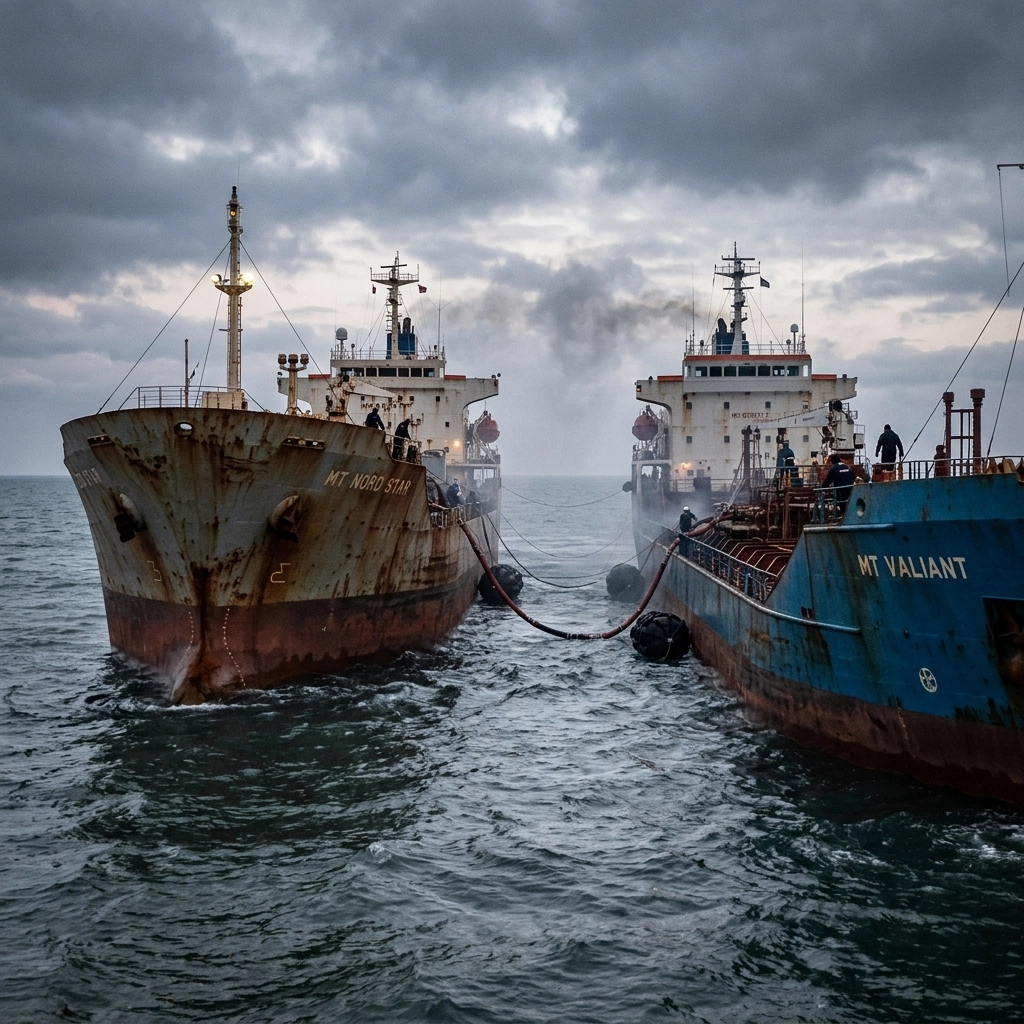
A clandestine network of ageing tankers is currently navigating the volatile waters of the North Sea, operating outside the boundaries of international maritime law. This "shadow fleet," an armada of over 1,000 vessels, has become the primary artery for Russian oil exports, successfully bypassing Western sanctions through a sophisticated web of deception. Investigative journalism in the UK has recently highlighted the scale of this operation, revealing how these ghost ships facilitate a trade worth an estimated $100 billion annually.
The North Sea, traditionally a hub for regulated European trade, has seen a sharp increase in AIS (Automatic Identification System) "dark" periods. Tankers frequently disable their tracking systems as they approach European coastlines, effectively vanishing from global monitoring screens. This tactic allows for ship-to-ship transfers of crude oil in international waters, away from the prying eyes of port authorities and regulatory bodies.
By March 2026, the economic impact of this fleet has become impossible to ignore. Approximately 3.7 million barrels of oil are transported daily through these illicit channels, representing 65 per cent of Russia’s seaborne energy trade. The sheer volume of traffic poses not only a geopolitical challenge but a significant security threat to the United Kingdom and its Nordic neighbours.
The Mechanics of Maritime Deception
The operation of the shadow fleet relies on a series of logistical workarounds designed to mask the origin and ownership of the cargo. Vessels are often owned by shell companies based in jurisdictions with lax oversight, such as the Marshall Islands or Liberia. These companies exist only on paper, making it nearly impossible for international investigators to hold anyone accountable for sanctions violations or maritime accidents.
Ship identity switching has become a common occurrence in the North Sea. Investigations have tracked vessels like the tanker Bella-1, which was abruptly reflagged as the Marinera mid-voyage. By changing names, flags, and registration documents, these ships can confuse port authorities and bypass the digital red flags that would normally trigger a boarding or inspection.
Flag manipulation is another critical component of this strategy. Vessels frequently "hop" between national registries, often choosing flags of convenience that do not participate in Western-led sanctions regimes. This constant movement creates a legal fog, where the jurisdiction responsible for the ship's safety and conduct is always in question. The G7 Shadow Fleet Task Force has identified this as a primary hurdle in enforcing the global oil price cap.
Insurance circumvention is perhaps the most dangerous aspect of the shadow fleet's activities. Traditional maritime insurance, primarily provided by Western P&I (Protection and Indemnity) clubs, is unavailable to ships carrying sanctioned oil above the price cap. In response, the ghost fleet operates with fraudulent or "grey market" documentation. These vessels lack the robust coverage required to manage the financial fallout of a major oil spill or collision, leaving coastal nations to bear the potential risk.
The logistical complexity extends to the age of the vessels involved. Many of the tankers in the shadow fleet are over 20 years old, an age where most reputable shipping lines would move them toward decommissioning. Instead, these "zombie ships" are kept in service to maximise profit, often skipping essential maintenance and safety checks. The result is a high-stakes game of maritime roulette played out daily off the British coast.
The 2026 Enforcement Crackdown
As of early 2026, Western powers have significantly intensified their efforts to dismantle this clandestine network. The European Union’s 20th sanctions package, introduced in January, specifically designated 43 additional shadow fleet vessels for immediate restrictions. This move was designed to strip them of any remaining insurance coverage and legal standing, effectively immobilising them in international waters.
In a landmark operation in January 2026, the U.S. Navy and Coast Guard seized the Marinera in the North Atlantic. The vessel had been shadowed for weeks as it attempted to transit from the Baltic Sea toward South America. This seizure marked a pivot toward real-time, cross-jurisdictional enforcement, signaling that the days of passive monitoring are over.
The enforcement has also moved into the realm of kinetic action. Recent reports indicate that the sanctioned Russian LNG carrier Arctic Metagaz was disabled following an alleged drone attack in the Black Sea. While the North Sea has not yet seen this level of military targeting, the escalation suggests that the "ghost fleet" is no longer viewed merely as a trade issue, but as a legitimate military target in the context of the ongoing conflict in Ukraine.
Financially, the crackdown has led to over $800 million in asset impairment for the companies operating these vessels. By targeting the financial infrastructure that supports the fleet: specifically the banks and payment processors that handle the $100 billion in annual revenue: the G7 task force aims to make the operation of shadow tankers prohibitively expensive. This strategy of "financial strangulation" is intended to force the elderly vessels into scrap yards.
Open-source intelligence (OSINT) has played a vital role in these enforcement efforts. Investigative journalists and independent maritime analysts use satellite imagery and historical data to track "dark" vessels. By cross-referencing shipping manifests with satellite pings, investigators can identify the exact moment a ship-to-ship transfer occurs. This alternative journalism has provided the evidence necessary for governments to take formal legal action against previously untraceable ships.
Environmental Risks and Legal Grey Zones
The presence of hundreds of uninsured, poorly maintained tankers in the North Sea has raised alarms among environmental groups and coastal governments. Unlike the professional shipping industry, which adheres to strict environmental standards, the shadow fleet operates in a legal vacuum. A single mechanical failure or collision could result in an ecological catastrophe that would devastate the UK's fishing industry and coastal ecosystems.
Under the United Nations Convention on the Law of the Sea (UNCLOS), the authority to seize or board ships in international waters is strictly limited. Historically, such actions were reserved for cases of piracy or the transport of illicit drugs. However, legal scholars are now exploring whether "environmental negligence" could be used as a justification for increased intervention against the shadow fleet.
The lack of valid P&I insurance means that in the event of a spill, there is no clear path for compensation. The shell companies that own these ships are designed to disappear the moment a liability arises. This leaves taxpayers in countries like the UK, Norway, and Denmark to cover the billions of pounds required for cleanup and restoration efforts. The environmental risk is not just a side effect of the shadow fleet; it is a structural reality of its existence.
Diplomatic pressure is being applied to "neutral" shipping hubs that continue to provide services to these vessels. Nations that offer bunkering, repairs, and crew changes to shadow tankers are finding themselves under increased scrutiny from the G7. The goal is to create a "cordon sanitaire" around the fleet, making it impossible for them to find safe harbour or technical support anywhere in the North Atlantic or North Sea regions.
As we move further into 2026, the battle for the North Sea continues. The shadow fleet represents a direct challenge to the rules-based international order, using the very tools of global trade: flags, insurance, and maritime law: to undermine global security. While the recent enforcement actions have caused significant disruption, the high price of oil and the desperation of the sanctioned state mean that the ghost ships are likely to continue their haunting of the world's busiest shipping lanes for the foreseeable future.