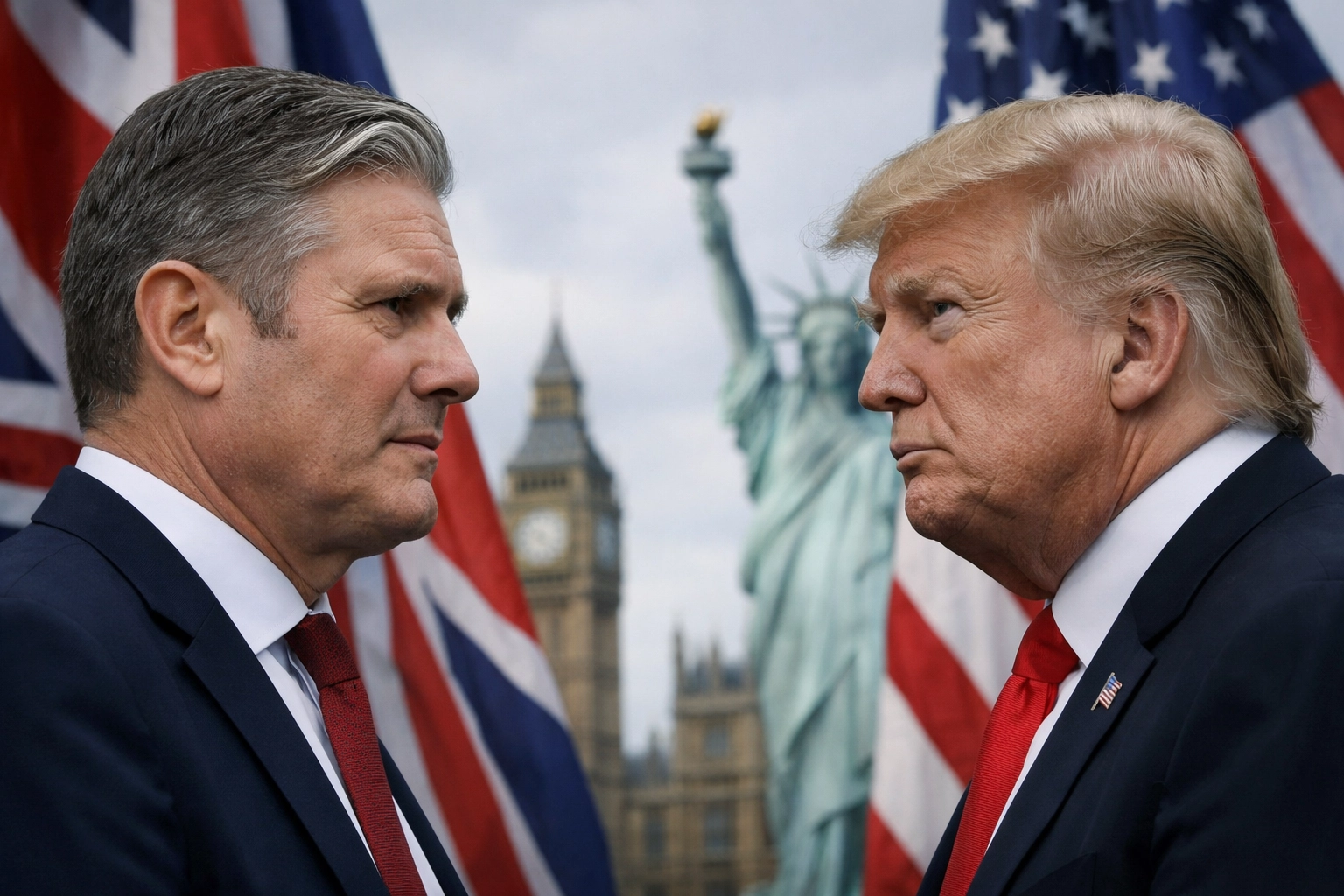
The diplomatic bond between London and Washington is facing its most significant challenge in decades as the spring of 2026 brings a sharp escalation in tensions.
Prime Minister Keir Starmer and Donald Trump are locked in a public dispute that threatens to reshape the Atlantic alliance.
The friction is centred on a deteriorating security situation in the Middle East, specifically regarding the ongoing Iran conflict.
As of March 2026, the diplomatic language usually reserved for adversaries is now being exchanged between the two leaders.
Donald Trump has intensified his rhetoric, launching personal attacks against the British Prime Minister during a series of high-profile appearances.
The former president has characterised Starmer’s approach to Tehran as a "betrayal of Western security."
These comments follow the UK’s decision to pursue a strategy of "de-escalatory engagement" rather than the "maximum pressure" tactics advocated by the Trump camp.
In London, the Prime Minister has remained resolute, asserting that British foreign policy is determined in Westminster, not Washington.
However, the pressure is mounting as the international community watches the fallout.
The rift comes at a delicate time for global markets and energy security, with the Iran conflict already impacting shipping lanes.
Observers suggest this is no longer just a policy disagreement but a fundamental clash of political ideologies.
The "Special Relationship," a cornerstone of post-war diplomacy, is now under the microscope of global analysts.
Diplomatic friction over Middle East policy
The core of the dispute lies in the divergent paths chosen to address the Iranian nuclear programme and its regional influence.
In early March 2026, the UK government refused to join a renewed maritime blockade proposed by American strategists.
Prime Minister Starmer argued that a blockade would lead to an irreversible escalation and potentially a broader regional war.
Donald Trump reacted swiftly, using his media platform to label the Prime Minister "weak" and "dangerously out of his depth."
The attacks have moved beyond policy, with Trump targeting Starmer’s leadership style and his background as a human rights lawyer.
Trump claimed that the UK is becoming "a secondary power" under Starmer’s stewardship.
The British Foreign Office has issued a neutral but firm rebuttal, stating that the UK remains committed to its allies but prioritises regional stability.
The Iran conflict has reached a critical juncture, with intelligence reports suggesting increased enrichment activity.
The US position, heavily influenced by Trump’s "America First" doctrine, demands immediate and punitive military-grade sanctions.
Starmer has instead sought to build a coalition with European partners to maintain a diplomatic corridor.
This has led to accusations from the Trump circle that the UK is "pivoting away" from its traditional intelligence partners.
The rhetoric has caused jitters in the City of London, where traders fear the impact of a formal diplomatic breakdown.
Leadership under fire in Westminster
While navigating the international storm, Keir Starmer is also battling significant internal pressures within the Labour Party.
A faction of backbench MPs has voiced concerns that the Prime Minister is being drawn into a conflict he cannot control.
Others have criticised him for not being forceful enough in his condemnation of Trump’s personal insults.
Despite these domestic distractions, Starmer has used the final week of March 2026 to reaffirm his leadership.
In a speech to the House of Commons, he stated that the UK’s foreign policy would be guided by "rationality, not rhetoric."
He addressed the internal party pressure directly, suggesting that unity is the country’s strongest asset in times of global volatility.
The Prime Minister’s approval ratings have seen a slight uptick as he adopts a "statesman-like" posture against Trump’s populism.
However, the "Socialist Campaign Group" and other left-leaning elements of his party remain wary of any military alignment.
Starmer has had to balance the need for a strong defence posture with the pacifist leanings of his party’s core.
The situation is complicated by the economic backdrop of 2026, where the UK is still managing the tail-end of inflationary pressures.
Defence spending has become a major talking point, with critics arguing that the UK cannot afford to alienate its largest trading partner.
Starmer has maintained that the UK’s sovereignty is not for sale, even in exchange for a trade deal.
This domestic balancing act is being watched closely by the White House and Trump’s advisers.
The narrative of a "divided Britain" is one that Trump has sought to exploit in his recent speeches.
The strategic cost of a fractured alliance
The long-term implications of this personal and political feud extend far beyond the immediate Iran crisis.
The Five Eyes intelligence-sharing agreement: comprising the US, UK, Canada, Australia, and New Zealand: is at risk of operational friction.
Senior defence officials have hinted that intelligence flows could be throttled if trust between the two leaders continues to erode.
The economic dimension is equally significant, as negotiations for a comprehensive UK-US trade deal have effectively stalled.
Without a cohesive strategy, both nations face increased competition from rising economic blocs in the East.
The 2026 security landscape is further complicated by the ongoing technological race in artificial intelligence and cyber-defence.
Cooperation in these fields requires a level of bilateral trust that is currently absent.
Trump’s protectionist stance on technology exports has already created hurdles for British tech firms.
Meanwhile, the UK’s commitment to NATO is being questioned by those in the US who believe the alliance is outdated.
Starmer has consistently defended NATO, but the personal animosity with Trump makes a unified front difficult.
As March 2026 draws to a close, the "Special Relationship" appears more transactional than ever before.
The days of shared values and unquestioned loyalty are being replaced by a more pragmatic, and often hostile, interaction.
The Iran conflict remains the immediate flashpoint, but the underlying issues are structural and deep-seated.
World leaders are now preparing for a period of prolonged instability in Atlantic relations.
The outcome of this "battle" will likely define the geopolitical order for the remainder of the decade.
Whether Starmer can maintain his course without losing the support of his party or the respect of his allies remains to be seen.
The situation continues to evolve, with further high-stakes meetings scheduled for the coming month.