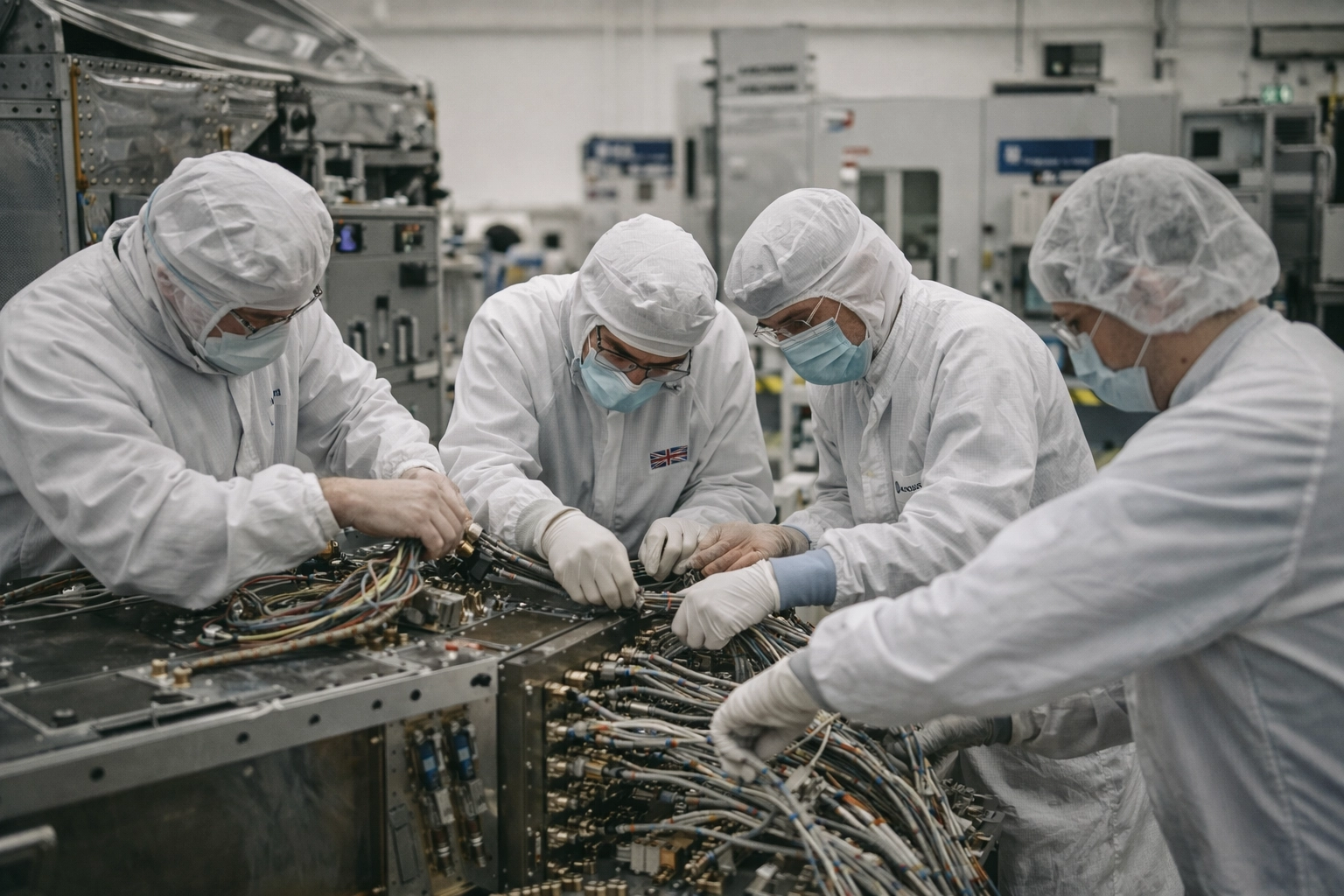
Artemis II is edging closer, and the UK is baked into some of the mission’s most important bits as March 2026 wraps up. NASA will get most of the launch-day spotlight at Kennedy Space Center, but a lot of the real work sits in UK labs, factories and control rooms.
If you follow independent news uk, this is one of those stories where the “big moment” depends on loads of smaller calls: who wins the contracts, what gets built where, and how government decides to back space as an industry. It is also where investigative journalism uk often earns its keep — following the money, the timelines, and what gets delivered versus what gets announced.
Artemis II is expected to take four astronauts around the Moon, the first crewed mission beyond Earth orbit since Apollo in 1972. The untold stories are in places like Stevenage and Harwell, where teams are working on the systems that help keep Orion powered, breathable and able to bring its crew back safely. The UK is not just watching; it is a key part of the European Space Agency (ESA) contribution to Artemis.
The Artemis II Mission and Britain’s Scientific Footprint
The European Service Module (ESM) is the workhorse behind Orion. It provides electricity, water, oxygen and nitrogen, and it carries the main engines used to manoeuvre the spacecraft, including when it swings behind the Moon.
Airbus teams in Stevenage have been central to the design and integration. It is not the kind of engineering that trends on launch day, but it is exactly the stuff that keeps the mission running when the cameras have moved on.
The UK is also linked to Lunar Gateway infrastructure, including communications and in-orbit support systems designed to keep a lunar station operating reliably. The UK Space Agency has indicated British firms are working on refuelling and telecoms modules to support that autonomy.
The UK’s Tier 1 role in the Artemis Accords is also part of the picture, because the rulebook is being written as the technology comes online. That includes standards around resource activity, debris management and long-term governance. For investigative journalism uk, it is a busy overlap of engineering, law, procurement and accountability — and it is where plenty of untold stories tend to sit.
From Satellites to Service: The £500m UK Space Gamble
Away from the Moon headlines, the UK is also trying to make space pay in a more down-to-earth way. From 1 April, the UK Space Agency is set to merge into the Department for Science, Innovation and Technology (DSIT), with government saying it will speed up delivery and cut admin friction.
The big number attached to that plan is a £500 million investment package announced earlier this year. About £105 million is earmarked for In-Orbit Servicing, Assembly, and Manufacturing (ISAM) — basically, building the tools to service satellites in space rather than writing them off when something fails.
If that works, it could reduce debris and extend the life of expensive spacecraft. It is also pitched as a commercial opportunity, with forecasts pointing to a fast-growing market through the rest of the decade. For independent news uk audiences, the test is simple: do these announcements turn into working systems, real contracts and long-term jobs?
Funding also covers the National Space Operations Centre, with £85 million aimed at managing a more crowded Low Earth Orbit. Mega-constellations have pushed collision risk higher, and UK teams are developing space domain awareness using radar and AI to track debris — sometimes smaller than a tennis ball.
And then there is the longer game: sovereignty and sustainability. The UK’s "Plan for Space", expected later in 2026, puts "space sovereignty" front and centre — being able to launch, track and maintain hardware without being totally reliant on other governments or a handful of private operators. That is why launch ambitions in Scotland and Cornwall still matter, even after setbacks.
Greener propulsion is part of that push too, with work moving away from hydrazine towards less hazardous alternatives. Research and testing across the UK, including Bristol and Belfast, is looking at propulsion concepts that cut toxicity and improve efficiency.
Taken together, Artemis work, satellite servicing, and orbit management show what the UK is really trying to do: stay relevant by owning high-value parts of the supply chain. For investigative journalism uk, this remains a watch-this-space story, because budgets, contracts, safety rules and international standards will keep shifting as the Moon economy takes shape — with more untold stories likely to surface as it goes.
The Next Steps in Investigative Journalism UK
For readers following the space economy, the next set of UK questions is fairly practical: which suppliers actually deliver on schedule, which contracts get reshaped after headlines fade, and how risk is priced when missions move from prototypes to routine operations.
Scrutiny is also likely to shift towards oversight as DSIT takes on a bigger role, including how performance is measured, how safety and debris standards are enforced, and whether “sovereignty” claims match up with launch access, tracking capacity, and industrial resilience.
The underlying story is still moving, and the paper trail will keep growing as Artemis milestones land and the UK’s 2026 space strategy takes shape.