The high walls and barbed wire of HMP Manchester, formerly known as Strangeways, have stood for over a century as a symbol of confinement and security. For generations, the biggest concern for prison officers was what might be smuggled in through a hollowed-out book, hidden in a visitor’s clothing, or tossed over a wall in a desperate, manual "throw-over." But as we move further into the 2020s, the battle for prison security has moved from the ground to the sky.
If you happen to be walking near the perimeter of a major UK prison late at night, you might hear a faint, high-pitched hum. To the untrained ear, it sounds like a large insect. To the prison staff on duty, it is the sound of a modern security nightmare. Drones have officially moved from being hobbyist gadgets to becoming the primary logistical arm of organised crime within the penal system. As an independent news uk outlet, we are seeing a significant shift in how these untold stories of technological warfare are playing out behind bars.
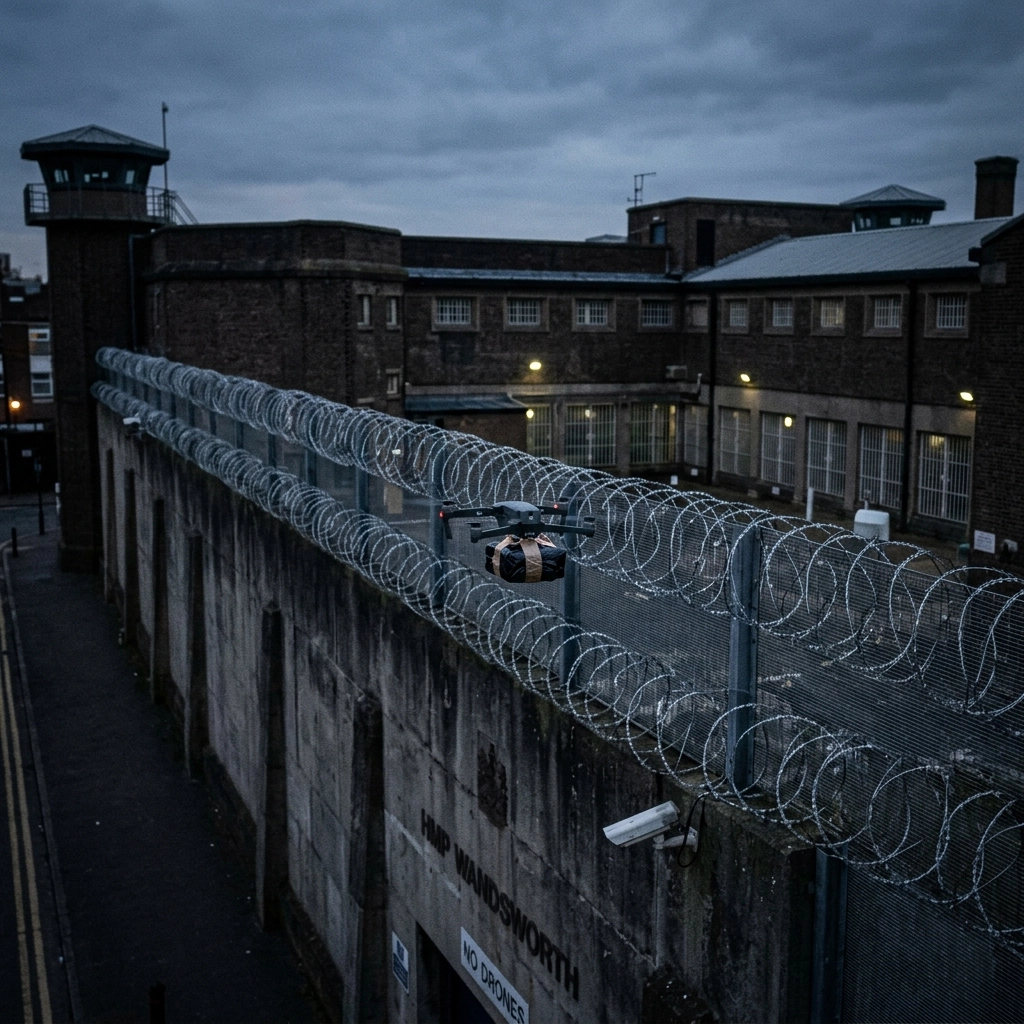
The sheer scale of the drone problem at HMP Manchester is staggering. In recent months, the frequency of these incursions has reached a boiling point. Criminal gangs are no longer relying on luck; they are using sophisticated GPS-guided quadcopters to deliver "packages" directly to specific cell windows. This isn’t just about a bit of tobacco or a cheeky mobile phone anymore. We are talking about heavy-duty deliveries of Class A drugs, synthetic cannabinoids like "Spice," and even lethal weapons, all bypassing the multi-million pound security systems installed at the gates.
The Sky-High Smuggling Boom at HMP Manchester
HMP Manchester is a particularly difficult environment to secure. Located in a densely populated urban area, it provides the perfect cover for drone operators. A pilot can sit in a parked car or a nearby flat, launch a drone, fly it over the wall in under sixty seconds, and be gone before the first security camera even registers the movement. This "delivery service" has become so streamlined that some inmates refer to it with the same casualness one might use for a takeaway app.
The primary cargo driving this boom is synthetic marijuana, commonly known as Spice. In the confined environment of a prison, the demand for these substances is high, and the profit margins for smugglers are astronomical. A small bag of Spice that might cost a few pounds on the street can be worth hundreds inside the walls. When you factor in that a single drone can carry several hundred grams of the stuff, along with a few "burners" (cheap mobile phones) and some SIM cards, a single successful flight can net a gang thousands of pounds in profit.
But it is the introduction of weapons that has prison staff truly on edge. Reports from inside indicate that drones have been used to fly in "shanks" and even small firearms. The delivery of weapons fundamentally changes the power dynamics within the wings. It creates an environment of fear not just for the inmates, but for the staff who are tasked with maintaining order. When contraband was limited to what could be physically thrown over a wall, the volume was manageable. With drones, the sky is quite literally the limit. We frequently cover these untold stories because the public rarely hears about the technical sophistication required to pull off these drops.
From Stealth Tech to Gourmet Deliveries
While HMP Manchester is a focal point for the UK, this is a global phenomenon that is evolving in bizarre and unexpected ways. To understand the future of prison drones, we only have to look at what is happening across the Atlantic. In South Carolina, at the Lee Correctional Institution, officers recently intercepted a drone that wasn't just carrying the usual drugs and phones. Instead, it was loaded with a gourmet feast: steak, crab legs, Old Bay seasoning, and premium cigarettes.
This shift toward "luxury" contraband highlights a terrifying reality for prison administrators: the drones are getting bigger and more powerful. They are no longer limited to the small, plastic toys you see in high street shops. Criminal organisations are investing in heavy-lift agricultural drones and custom-built rigs that can carry payloads of several kilograms. In upstate New York, at the Marcy Correctional Facility, a drone was found carrying two 8-inch knives and over half a kilogram of synthetic marijuana labelled with names like "Candy Crush."
The level of planning involved is industrial. Pilots often use thermal imaging cameras to spot where guards are patrolling, ensuring they drop the package in a blind spot. Some drones are even equipped with "claws" or electromagnetic release mechanisms that drop the bag the moment a certain GPS coordinate is reached. This removes the need for the pilot to even see the recipient. It is a clinical, efficient, and highly profitable enterprise that makes traditional smuggling look prehistoric.
The impact on the prison population is profound. When drones bring in large quantities of drugs, it leads to increased debt, violence, and medical emergencies. The "zombie" effect of Spice is well-documented, but seeing it play out on a mass scale inside a high-security facility like Manchester is a different story altogether. It undermines rehabilitation efforts and turns the prison into a volatile marketplace. We have explored similar themes of systemic failure in our coverage of Glasgow’s Beastie House, where the environment itself becomes a barrier to reform.
The Tech Race to Secure the Skies
So, how do you stop a tiny, fast-moving object in the middle of the night? The Ministry of Justice and prison services worldwide are currently locked in a technological arms race with the smugglers. The first line of defence has traditionally been physical: netting over exercise yards and reinforced windows. However, drones are now being flown with such precision that they can hover inches away from a window bar, allowing an inmate to reach out and grab the package with a makeshift hook.
The next step is electronic warfare. "Geo-fencing" is a common tool, where drone manufacturers program "no-fly zones" into their software. The problem? Organised crime groups are experts at "jailbreaking" drone firmware, removing these restrictions entirely. Prisons are now turning to sophisticated signal-jamming technology and "Acoustic Detection Systems" that can identify the unique frequency of a drone’s motors from miles away.
There are also more aggressive countermeasures being tested. These include "drone-killing" radio frequency guns that can force a drone to land or return to its pilot, and even trained birds of prey: though the latter has proved more of a PR stunt than a practical solution. The real challenge is legal and safety-related. You cannot simply jam all frequencies in a city like Manchester without potentially interfering with emergency services, mobile phone networks, or legitimate commercial air traffic.
The cost of this security is immense. Every pound spent on drone detection is a pound taken away from education, mental health support, and rehabilitation programmes. Yet, without these defences, the very concept of a secure prison becomes a myth. The drone is the ultimate disruptor; it has effectively turned prison walls into nothing more than a suggestion. As we continue to provide independent news uk, we will keep a close eye on whether the authorities can ever truly regain control of their airspace.
The situation at HMP Manchester is a microcosm of a much larger struggle. It is a battle between the slow-moving bureaucracy of the state and the agile, tech-savvy world of modern organised crime. As drones become cheaper, faster, and more capable of carrying heavier loads, the traditional model of incarceration is being forced to adapt. The era of the "unreachable" prisoner is over; as long as there is a clear view of the sky, there is a way in.
The rise of drone-delivered contraband represents a fundamental shift in the security landscape of the correctional system. While technology offers new tools for detection and prevention, the ingenuity of those seeking to bypass these measures continues to evolve at a rapid pace. The ongoing "sky-war" at facilities like HMP Manchester serves as a stark reminder that in the digital age, physical barriers are only one part of the security equation. The challenge for the future lies in balancing technological intervention with the essential human elements of prison management and rehabilitation.