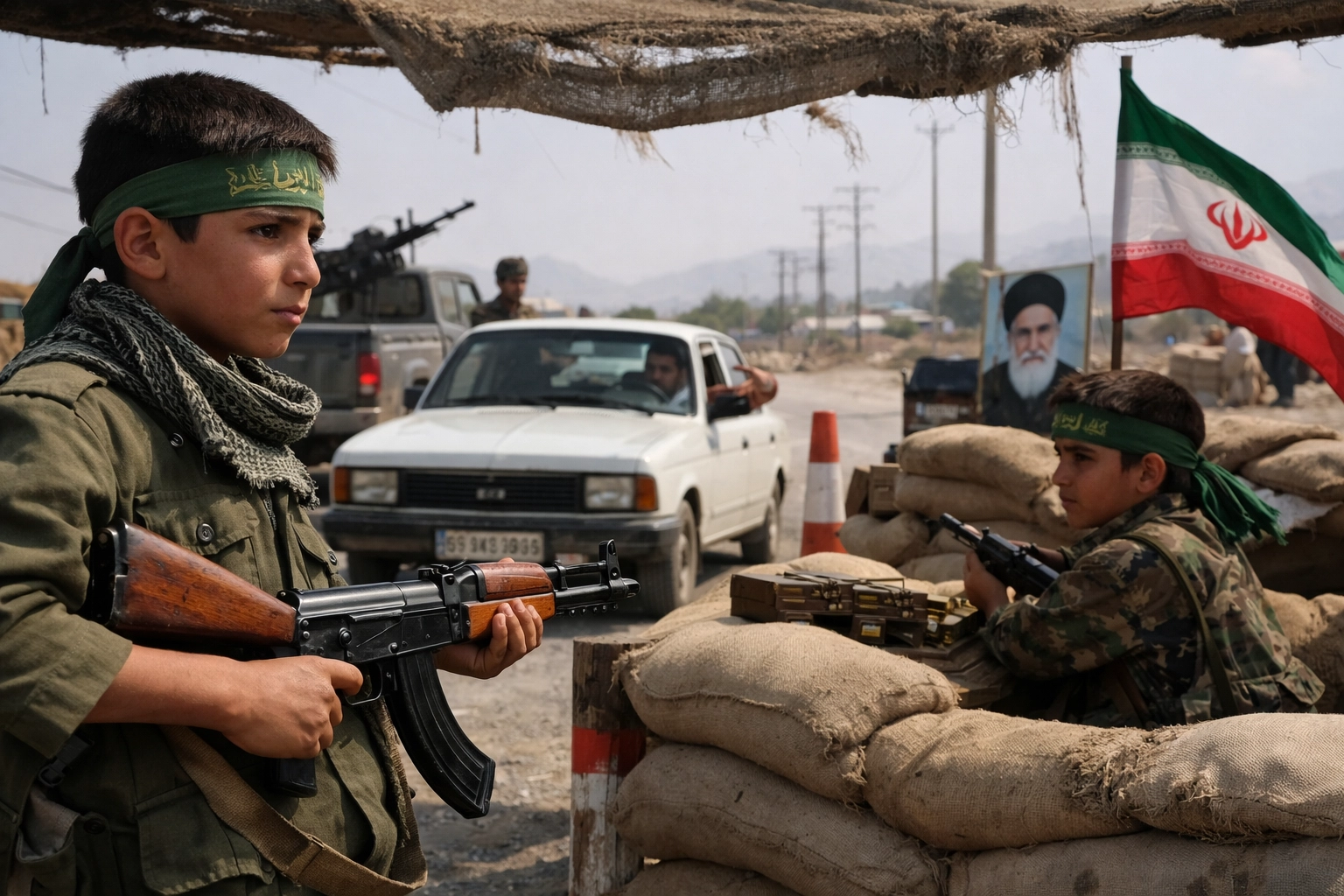
It is a sight that is becoming increasingly common on the streets of Tehran and Karaj, yet it remains one of the most jarring images of modern conflict. Young boys, some with voices that haven't yet broken and moustaches that haven't even begun to grow, are standing at security checkpoints. They aren’t there as bystanders; they are there with a purpose, often clutching equipment that looks far too heavy for their small frames.
As we look into the shifting landscape of global security, some of the most harrowing accounts are the untold stories of children being pulled into roles that should be reserved for adults. In Iran, the lines between civilian life and military service are blurring for a younger generation. Recent investigative findings have highlighted a concerning trend: the Iranian government is officially lowering the age of participation for security duties, placing children as young as 11 and 12 on the front lines of domestic checkpoints and intelligence operations.
This isn’t just a matter of local policy; it’s a situation that demands a closer look through the lens of independent news uk audiences can trust. When we talk about the safety of children, the conversation usually revolves around education and play. But for many in the Islamic Republic, childhood is being redirected toward the service of the state, often with tragic consequences.
When Childhood is Put on Hold
Walking through the busy intersections of Tehran lately feels different. Witnesses on the ground have described a palpable shift in who is manning the checkpoints that dot the city. It’s no longer just seasoned soldiers or the typical Revolutionary Guard members. Instead, people are reporting sightings of teenagers: and some who look even younger: searching vehicles and standing guard.
One resident in Karaj recalled seeing a boy at a checkpoint who couldn't have been more than 13. He was holding a Kalashnikov, a weapon nearly half his height. These aren't isolated incidents. The presence of these young "guards" is part of a broader strategy to maintain a visible security presence across the country, especially during times of heightened tension. These untold stories from those living in these neighbourhoods reveal a sense of unease. It is one thing to see a soldier in uniform; it is quite another to see a child with a weapon, tasked with making life-or-death decisions about who gets to pass through a barrier.
The atmosphere at these checkpoints is often tense. For the children involved, the pressure is immense. They are expected to project authority and loyalty to the state, often with very little training. This lack of experience doesn't just put the public at risk; it places the children themselves in the crosshairs of potential violence. When security forces are comprised of minors, the risk of accidental escalation or mismanagement of a situation increases exponentially. This reality is a far cry from the typical childhood experiences we value, and it highlights a desperate move by authorities to fill gaps in their security apparatus.
A Systematic Recruitment Drive
The deployment of children isn't an accident or a local oversight; it is a calculated, top-down initiative. To understand how this happened, we have to look at the Data & Forensics findings regarding the Basij, the paramilitary volunteer wing of the Islamic Revolutionary Guard Corps (IRGC). The Basij has long been a tool for internal security and moral policing, but recent data shows a concerted effort to target younger recruits than ever before.
In March 2026, official statements from the IRGC’s cultural deputies confirmed a new recruitment campaign. Known as the "For Iran" or "Homeland-Defending Combatants for Iran" programme, this initiative explicitly lowered the age for participation to just 12 years old. The reasoning given by officials was that there was a natural desire among 12- and 13-year-olds to "take part in this space." By opening the doors to children, the state is effectively creating a pipeline of loyalty that starts in early adolescence.
The recruitment doesn't happen in a vacuum. It is heavily promoted through local mosques and Basij bases, which serve as community hubs. In these spaces, young boys are often promised a sense of belonging, purpose, and even religious merit. They are told they are the defenders of the nation, a narrative that can be incredibly persuasive to a child looking for an identity. For those seeking independent news uk perspectives on international security, the scale of this recruitment is a significant indicator of the internal pressures facing the Iranian leadership. They are willing to mobilise the youngest members of society to ensure the survival of the current order.
Furthermore, the Data & Forensics analysis suggests that these children are being used to fill "personnel shortages." Whether due to burnout among older forces or the need to spread resources thin across multiple security fronts, the use of 11- and 12-year-olds is a clear sign of a strained system. These kids are being integrated into patrols, intelligence gathering, and, most visibly, the checkpoints that monitor the daily movement of Iranian citizens.
The High Stakes of International Law
The tragedy of this policy was brought into sharp focus by the story of Alireza Jafari. Alireza was just 11 years old when he was killed at a checkpoint in Tehran. His death occurred during a period of high-intensity drone strikes targeting IRGC facilities. According to accounts from his family, Alireza’s father had taken him and his nine-year-old brother to the checkpoint, believing they needed to be prepared for the "days ahead."
Alireza wasn't just a bystander; he was officially described as "serving" at the checkpoint when he lost his life. This case serves as a heartbreaking reminder of the physical danger these children face. When IRGC facilities or checkpoints are targeted by international adversaries like the United States or Israel, the children stationed there are just as vulnerable as the seasoned military personnel beside them. The state’s decision to place them there effectively uses them as human shields in a high-stakes geopolitical conflict.
From a legal standpoint, the situation is even more dire. International bodies, including Human Rights Watch and Amnesty International, are clear on this: the recruitment and use of children under the age of 15 in military or security roles is a war crime. By officially lowering the recruitment age and deploying 11- and 12-year-olds to active security posts, the Iranian authorities are operating in direct defiance of international humanitarian law.
The long-term impact on these children is hard to quantify. Beyond the immediate physical risk, there is the psychological trauma of being placed in a combat or security environment at such a developmental stage. They are being taught to see their fellow citizens as potential threats and to rely on the power of a weapon rather than the strength of community. As these untold stories continue to surface, it becomes clear that the cost of this policy will be felt for generations. The international community continues to watch closely, as the deployment of child soldiers remains one of the most significant and distressing human rights violations in the region today.
The use of children at Iranian checkpoints represents a significant shift in the country's domestic security strategy, moving from adult-led forces to a model that relies on the radicalisation and mobilisation of minors. As the "For Iran" campaign continues to draw in young recruits, the boundary between childhood and combat continues to fade, leaving many to wonder what the future holds for a generation raised at the end of a rifle.