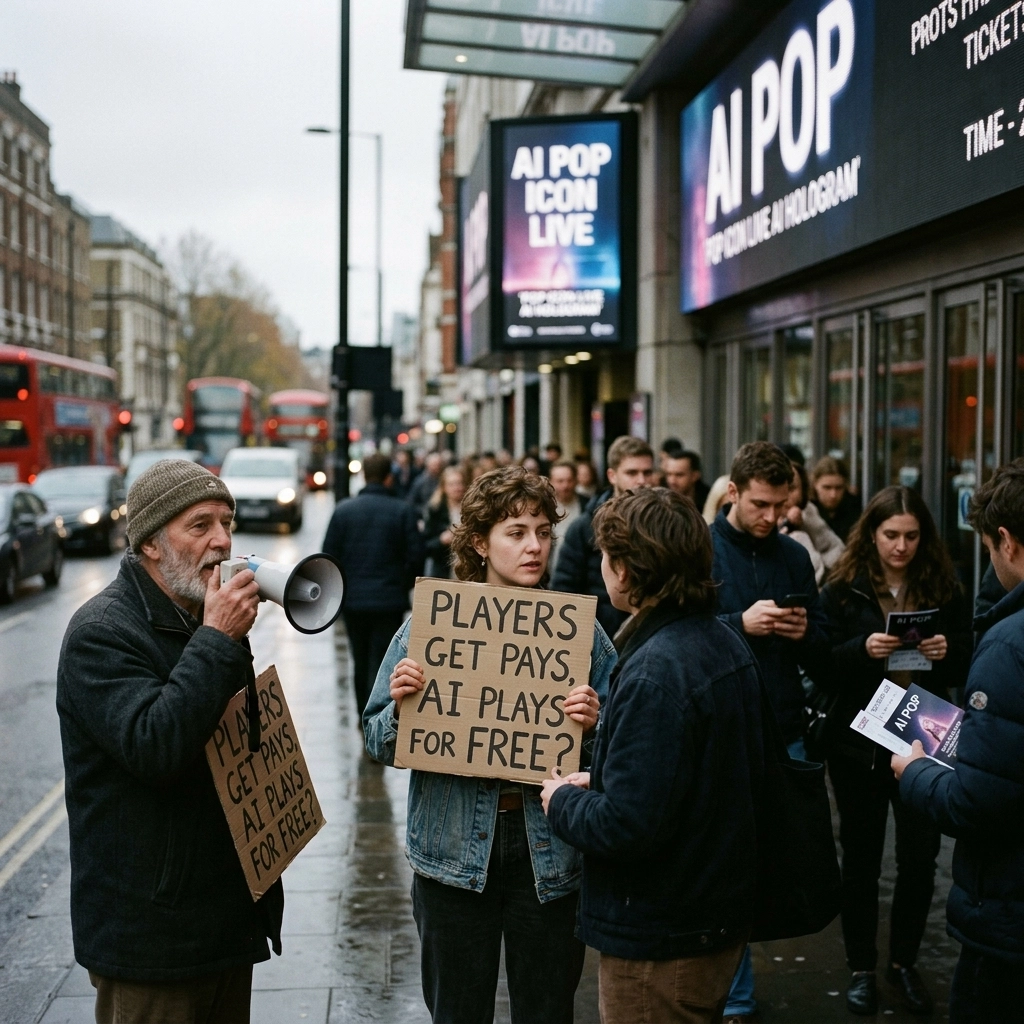
Imagine, for a second, a world where the next chart-topping sensation isn't a brooding teenager in a bedroom or a seasoned rock veteran with a story to tell. Instead, it is a series of lines of code titled something as utterly nonsensical as "Calm Baseball" or "Camel Edible." It sounds like the plot of a particularly cynical episode of a tech-dystopia series, but in the reality of 2026, it has become one of the most audacious financial heists in the history of the creative arts. This is not just a story about technology getting ahead of itself; it is a story about how the digital pickpockets of the twenty-first century are siphoning millions from the pockets of genuine creators.
The sheer scale of the operation is enough to make any independent artist in the UK wince. While local bands are lugging amplifiers into the back of battered vans and praying for a few thousand streams to cover their petrol costs, a massive fraud has been unfolding in the shadows. The culprit at the centre of this particular storm, a man from North Carolina named Michael Smith, allegedly managed to orchestrate a scheme that siphoned off roughly $10 million in royalties. His secret weapon? A massive army of AI-generated songs and an even larger legion of automated bot accounts.
It is a classic tale of untold stories being unearthed in the digital age. For years, the industry suspected that the numbers weren't quite adding up. Streaming platforms have always been a bit of a black box, but the level of artificial inflation discovered here suggests that the very foundation of how we value music is being undermined. This wasn't a case of a single viral hit being boosted; it was a systematic, industrial-scale extraction of wealth from the global royalty pool.
The Alchemy of the Algorithmic Grift
The mechanics of this hustle are as fascinating as they are frustrating. To pull off a scam of this magnitude, you can’t just upload one song and hope for the best. Platforms have fraud detection systems designed to spot suspicious spikes in activity. If a single track suddenly gets a million plays from the same IP address, the red flags go up immediately. Smith, however, appeared to understand the "slow and low" approach to digital crime. Instead of one hit, he utilised hundreds of thousands of AI-generated tracks.
By spreading the fraud across a vast catalogue of music, the individual play counts for each song remained relatively low, flying just under the radar of the automated sentries. Each song might only earn a few pennies, but when you have a library the size of a small country's output, those pennies turn into a flood. To ensure these songs actually got played, Smith allegedly deployed over 1,000 bot accounts. These weren't just simple scripts; they were sophisticated programmes designed to mimic human listening patterns, skipping tracks occasionally and "listening" to playlists around the clock.
At its peak, this operation was generating more than 660,000 streams every single day. If you do the maths, that adds up to annual royalties exceeding $1.2 million. The tragedy is that this money doesn't come out of thin air. It comes from the "pro-rata" pool: the giant pot of money that streaming services distribute to artists based on their share of total plays. When a bot streams "Calm Baseball" for the ten-thousandth time, it is effectively taking a fraction of a penny away from every legitimate artist on the platform, from the busker in Manchester to the jazz ensemble in London.
A Zero-Sum Game for Real Talent
The impact on the UK’s independent news and arts scene is profound. We often hear about the "death of the middle-class musician," and this type of fraud is a primary cause. The streaming economy is already a difficult landscape for those who aren't global superstars. For an independent artist, every stream is a hard-won victory. It represents a listener who found their music through word of mouth, a live gig, or a local radio station. To have that effort devalued by a machine that can "write" a song in seconds and "listen" to it a billion times is a slap in the face to the concept of human creativity.
This isn't just about one man in North Carolina. The investigation revealed a wider network, including the CEO of an AI music company and various promoters who allegedly facilitated the creation of this "slop" content. It exposes a loophole in the current "creator economy" where volume is often rewarded over quality. When platforms incentivise the sheer quantity of content, they inadvertently roll out the red carpet for those who can automate production.
For the independent news UK audience, this story is a wake-up call regarding the lack of transparency in the tech-music industrial complex. We are told that AI will democratise art, but in this instance, it has merely served as a high-tech crowbar used to break into the industry's communal cash box. The victims aren't the multi-billion-pound record labels, who have the legal teams to fight back. The victims are the grassroots creators who find their already meagre royalty cheques getting smaller as the "bot-pool" expands.
The Great Digital Arms Race
What happens next will define the future of the music industry for the next decade. The arrest and subsequent charges of wire fraud and money laundering signify that the authorities are finally taking "digital shoplifting" seriously. However, as quickly as one loophole is closed, another is usually found. The technology used to generate music is becoming more sophisticated by the hour. We are moving past the era of random gibberish titles and entering a phase where AI can mimic the style, tone, and emotional resonance of human artists with startling accuracy.
The streaming platforms are now locked in an arms race. They are investing millions in "acoustic fingerprinting" and behavioural analysis to distinguish between a student in a flat in Leeds listening to a lo-fi hip-hop playlist and a server farm in a basement pumping out artificial plays. But as Smith’s case shows, if the fraud is distributed widely enough, it becomes incredibly difficult to excise. The legal ramifications are equally complex. How do you prosecute the "owner" of a bot when the bot is behaving exactly like a paying subscriber is supposed to behave?
This situation also raises uncomfortable questions for the platforms themselves. If a platform boasts about its "growth" and "active users," is it truly motivated to purge the millions of bots that are helping to inflate those very statistics? The industry needs a fundamental shift in how royalties are calculated. Moving away from a pure pro-rata model to a more "user-centric" model: where your subscription fee only goes to the artists you actually listen to: could be the only way to kill the bot-farm business model for good.
The saga of the AI pop con is a stark reminder that in the digital age, if something can be gamed, it will be. While the legal system catches up with the likes of Michael Smith, the music industry must grapple with the fact that its greatest asset: human connection: is being commodified and forged by algorithms. For those of us who value the untold stories of real musicians, the fight to keep the "human" in the humanities has never been more urgent.
The legal proceedings against those involved in the North Carolina scheme are ongoing, with potential sentences of up to 20 years for the charges of wire fraud and money laundering. As the music industry continues to integrate AI into its legitimate creative processes, the distinction between a tool for artists and a tool for fraudsters will remain a central point of contention. Protecting the integrity of the royalty system is essential for the survival of independent music globally.