








For decades, the journey to fatherhood has been a silent struggle for millions of men worldwide. While much of the public discourse surrounding fertility focuses on maternal health, the reality is that male factors contribute to roughly half of all infertility cases. Among the most challenging diagnoses is non-obstructive azoospermia (NOA), a condition where no sperm is found in the semen. For these men, the only hope of having a biological child often rests on a surgical procedure to find a "needle in a haystack": a few viable sperm cells hidden within a vast landscape of testicular tissue.
Enter the 'Star' system, an AI-powered innovation that is transforming this painstaking search from an eight-hour marathon of human endurance into a lightning-fast digital scan. This is one of those untold stories that highlights how technology is finally catching up with the complexities of human biology. In the landscape of independent news uk, we are seeing a shift toward reporting on these technological miracles that offer more than just data: they offer a future.
What exactly is the 'Star' system and why is it making headlines?
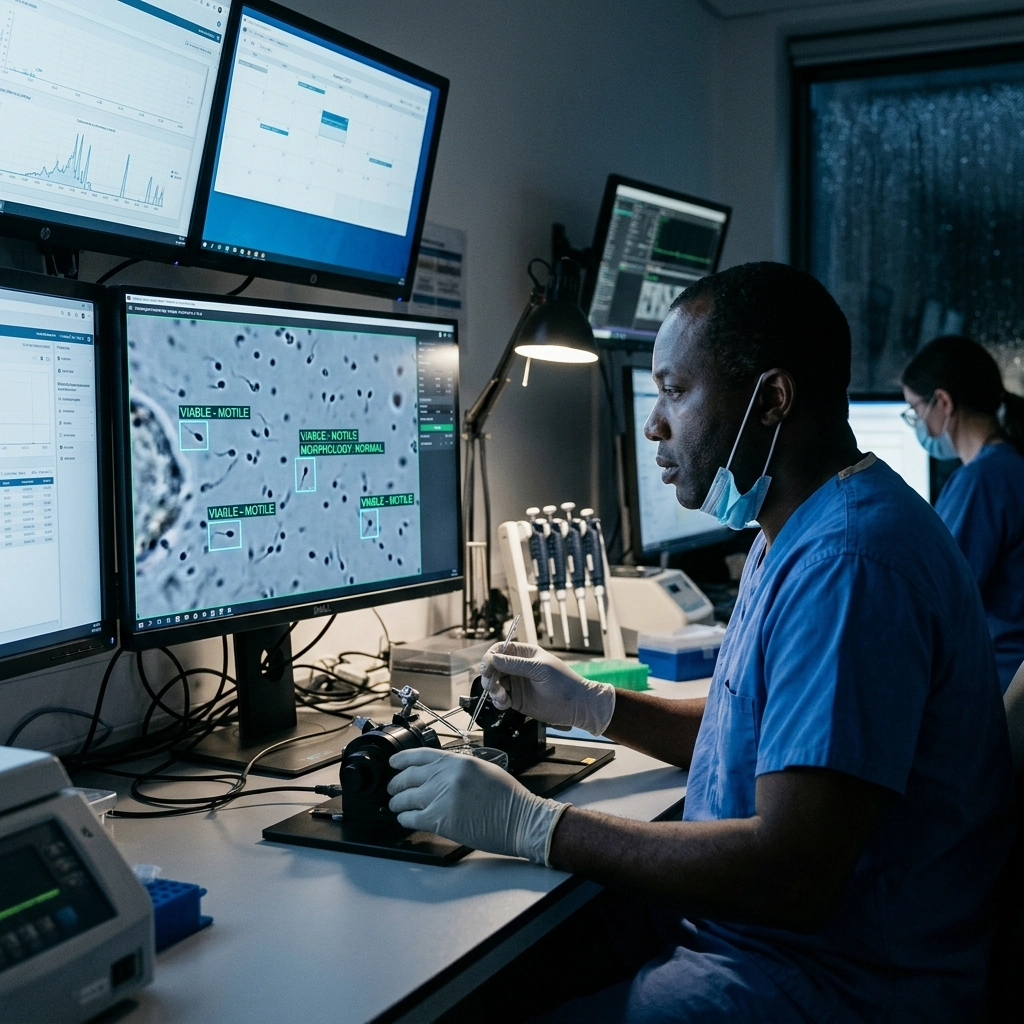
The 'Star' system, or Sperm Search, is an artificial intelligence algorithm designed specifically to assist embryologists in identifying sperm cells in samples retrieved from patients with severe male infertility. In cases of NOA, surgeons perform a micro-TESE (microsurgical testicular sperm extraction), removing small pieces of tissue. Embryologists then spend hours under a microscope, manually shredding this tissue and searching for sperm. It is a gruelling process that requires intense concentration. The Star system automates this by scanning the samples and flagging potential sperm cells in seconds, allowing the human expert to make the final confirmation.
Why is male infertility described as "finding a needle in a haystack"?
To understand the scale of the challenge, one must realise that a single biopsy sample can contain millions of cells, but only a handful of sperm: if any at all. For an embryologist, this means staring at a screen for up to six or eight hours, looking for a specific shape or a tiny twitch of movement. Fatigue is a real factor. When a human is tired, they might miss the one cell that could lead to a successful pregnancy. The AI doesn't get tired. It processes every frame with the same level of precision at 5:00 PM as it does at 9:00 AM, ensuring that no potential "needle" is left behind in the haystack of cellular debris.
Understanding the Struggle of Male Infertility
How does the AI actually distinguish a sperm cell from everything else?
The 'Star' system was trained using thousands of images of sperm and non-sperm cells. Through machine learning, it has "learnt" the specific morphological features of a human sperm: the oval head, the midsection, and the tail. What makes it particularly impressive is its ability to spot sperm that are non-motile (not moving). While a human eye is naturally drawn to movement, it can easily overlook a stationary sperm cell that is still perfectly viable for Intracytoplasmic Sperm Injection (ICSI). The AI uses pattern recognition to identify these stationary cells based on their structure alone, significantly increasing the chances of finding a usable cell in a "dormant" sample.
Is this technology meant to replace embryologists entirely?
Absolutely not. The creators of the Star system and clinical experts agree that this is a tool for augmentation, not replacement. The AI acts as a highly specialised scout. It identifies "points of interest" and presents them to the embryologist. The final decision to use a specific sperm cell for fertilisation remains firmly in the hands of the human professional. This partnership reduces the cognitive load on the staff and allows them to focus their expertise on the most critical part of the process: the delicate handling and injection of the sperm into the egg. It turns a manual search into a verified selection process.
What does this mean for the success rates of IVF treatments?
While the AI itself doesn't change the biological quality of the sperm, it vastly improves the efficiency of the search. In many cases, if sperm aren't found within a certain timeframe, the search is called off. By speeding up the process, the AI ensures that every part of the sample is thoroughly vetted. For men who might have previously been told that no sperm were found, this technology could be the difference between a "no" and a "yes." Early trials have shown that the AI can find sperm that humans missed, which directly correlates to a higher chance of proceeding to the fertilisation stage of IVF.
How the Star System Changes the Game
How does this reflect the current state of independent news uk reporting?
In the realm of independent news uk, there is an increasing appetite for stories that delve into the intersection of ethics, technology, and human experience. The Star system isn't just a gadget; it represents a shift in how we approach reproductive rights and health equity for men. By bringing these untold stories to the forefront, we highlight that infertility is not just a "woman's issue." It is a human issue, and the technological solutions being developed are as much about psychological relief as they are about clinical success. Reporting on these breakthroughs provides a counter-narrative to the often-bleak outlook on global fertility rates.
What are the emotional implications for men undergoing these procedures?
The psychological weight of NOA is immense. Many men feel a sense of inadequacy or "brokenness" when they receive this diagnosis. The surgical search for sperm is often the final roll of the dice. Knowing that an AI is being used to ensure the most exhaustive search possible can provide a significant sense of comfort. It mitigates the fear that a human error: a simple blink at the wrong time: could cost them their chance at fatherhood. This technology validates their struggle by applying the highest level of modern science to their specific condition.
Are there any ethical concerns regarding AI in the fertility lab?
As with any AI application in healthcare, data privacy and "black box" algorithms are points of discussion. It is vital that the datasets used to train these systems are diverse and representative of different populations. Furthermore, there is the question of access. Will this technology be available to everyone, or only those at high-end private clinics? Ensuring that such miracles of science are distributed equitably is a conversation that must happen alongside the technical development. However, because the final "go/no-go" decision rests with a clinician, many of the traditional fears about autonomous AI are tempered in this specific context.
Looking Ahead to a High-Tech Fertility Future
When will the Star system be available in clinics across the UK?
The system has been undergoing rigorous clinical testing and pilot programmes. While it is not yet a standard fixture in every NHS fertility clinic, the momentum is building. Regulatory approvals are the next hurdle, ensuring the software meets the stringent safety and efficacy standards required for medical devices in the UK. Experts predict that within the next few years, AI-assisted sperm searching will become the gold standard for treating severe male infertility, moving from a "miracle" to a routine part of laboratory protocol.
Could this technology be applied to other areas of reproductive medicine?
The potential is vast. The same principles of image recognition and pattern detection could be used to select the best embryos for implantation or to monitor egg quality. We are entering an era of "Precision Embryology," where every variable is optimised by a combination of human intuition and algorithmic precision. The Star system is just the beginning of a broader movement to use AI to de-risk the entire process of assisted reproduction.
The arrival of the Star system marks a pivotal moment in reproductive science. By solving a problem that has long frustrated clinicians and devastated patients, it proves that the most effective uses of AI are often the ones that solve the most human of problems. As we continue to uncover these untold stories, it becomes clear that the future of fertility is not just about biology, but about the incredible ways we are learning to navigate it. The needle in the haystack is still there, but for the first time, we have a magnet powerful enough to find it.
In the coming years, the integration of such systems will likely become a benchmark for excellence in fertility care. The focus will remain on refining these algorithms to ensure they are as accurate as possible across diverse patient profiles. This evolution in medical technology reinforces the importance of supporting independent research and reporting that keeps the public informed about the breakthroughs that truly matter. The story of AI in male infertility is a testament to human ingenuity and the persistent hope of those looking to start a family.