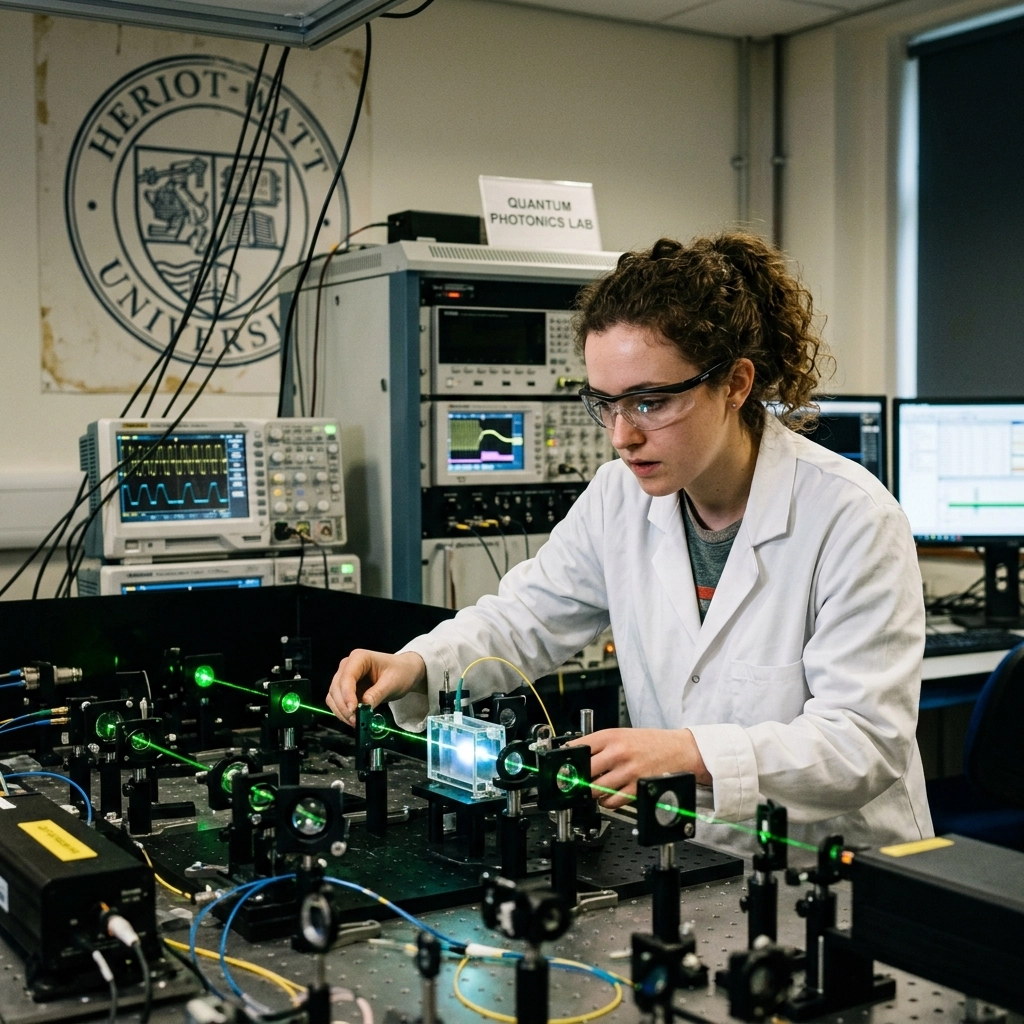
Imagine, for a second, that your internet connection wasn’t just a series of pulses travelling through a glass cable buried under your street. Imagine instead that your data was being beamed down from the heavens, protected not by a complex password that a clever teenager could eventually crack, but by the literal, unbreakable laws of physics. It sounds like the opening crawl of a science fiction epic, but in the laboratories of Heriot-Watt University in Edinburgh, this isn’t fiction. It’s the daily grind.
While most of us were worrying about the battery life of our phones or the speed of our home Wi-Fi over the last year, a team of researchers in Scotland has been quietly orchestrating a revolution. This is one of those untold stories that rarely makes the front pages of the tabloids, but at NowPWR, we’re committed to providing the kind of independent news UK readers deserve: the kind that looks at the future and asks, "How did they actually do that?"
The breakthrough isn’t just about speed; it’s about a fundamental shift in how we handle information. We’ve reached the limits of traditional fiber optics. We’re stuffing more and more data into cables that are increasingly vulnerable to interference and interception. The team at Heriot-Watt decided that the best way to move forward was to look up. Way up.
Breaking the Chains of Traditional Fiber
For decades, the "gold standard" of secure communication has been encryption. You scramble a message, send it, and the person on the other end unscrambles it. The problem is that computers are getting faster. Quantum computers: those mythical beasts of the processing world: threaten to make our current encryption look like a "Keep Out" sign written in crayon. If a quantum computer can solve the math behind our security in seconds, the entire digital economy collapses.
The scientists at Heriot-Watt aren’t interested in better math. They’re interested in quantum entanglement. This is what Albert Einstein famously called "spooky action at a distance." It’s the idea that two particles can be linked so that whatever happens to one instantly happens to the other, no matter how far apart they are. If you try to eavesdrop on a quantum signal, the very act of looking at it changes the signal. You can’t steal the data because the moment you touch it, the data vanishes or alters, alerting the sender.
However, doing this in a lab is one thing. Doing it over 79 kilometres of fiber optic cable: or, even more impressively, between a satellite and a ground station: is another beast entirely. The atmosphere is messy. It’s full of "noise": light from the sun, heat, clouds, and general atmospheric chaos. Traditionally, quantum signals are delicate. They’re like a single candle flame trying to survive a hurricane. One gust of "noise" and the entanglement is broken.
This is where the Heriot-Watt team pulled off their first major trick. They didn’t just use standard qubits (the quantum version of a bit, which can be a 0 or a 1). Instead, they moved into the world of high-dimensional entanglement. They started working with "qudits." Think of a standard qubit as a light switch that can be on or off. A qudit is more like a high-end dimmer switch with 53 different levels of intensity. By using these 53-dimensional states, they found that the signal became incredibly robust. They proved that entanglement could survive even when 36% of the signal was pure white noise. That’s like trying to have a whisper-quiet conversation in the middle of a heavy metal concert and actually being heard.
The Power of 53-Dimensional Reality
Why does 53 dimensions matter? It sounds like something out of a comic book multiverse, but in the context of quantum physics, it’s a game-changer for reliability. When you send a simple 0 or 1, and the signal gets fuzzy, the receiver has no way of knowing if that 0 was supposed to be a 1. But when you use a 53-dimensional state, you build in a massive amount of redundancy and "steering" capability.
The researchers demonstrated that this high-dimensional approach allows quantum steering to persist even across distances equivalent to nearly 80 kilometres of fiber. This was the "quantum leap" the industry had been waiting for. It proved that we don’t need a perfectly sterile, vacuum-sealed environment to make quantum networking work. We can do it in the real, messy world.
This breakthrough set the stage for the launch of the SPOQC (Satellite Platform for Optical Quantum Communications) CubeSat. On March 30, 2026, a SpaceX rocket carried this tiny, UK-built powerhouse into orbit. Its mission is simple but audacious: to prove that we can transmit these complex quantum signals from space back down to Earth.
Space is actually a better medium for quantum signals than glass cables. In a fiber optic cable, the glass eventually absorbs the light. After about 100 kilometres, the signal is gone. But in the vacuum of space, light can travel thousands of miles without losing its "quantumness." The only tricky part is getting it through the last few miles of the Earth’s atmosphere. Thanks to the high-dimensional research conducted in Edinburgh, the SPOQC satellite is equipped to handle that atmospheric turbulence. It’s essentially the first step toward a global quantum internet: a network that is physically impossible to hack.
From Edinburgh to the Stars
While the satellite is doing its work in orbit, the team back on the ground isn’t just sitting around waiting for a signal. In May 2025, Heriot-Watt opened the HOGS (Hub Optical Ground Station). This £2.5 million facility, located at the university’s Research Park, is the UK’s premier "quantum ear." It’s designed to track satellites moving at thousands of miles per hour and catch the individual photons they beam down.
The precision required here is staggering. Imagine trying to hit a moving penny with a laser pointer from three miles away: while the penny is also spinning and you're standing on a vibrating platform. That’s the level of accuracy the HOGS facility achieves every day. By using lasers instead of traditional radio waves, they can transmit data at much higher rates with significantly lower power requirements.
This isn't just an academic exercise. A spin-out company called Intertangle is already working on taking this hardware out of the lab and into the field. They’ve conducted real-world tests showing that entanglement hardware can survive the bumps and bruises of the outside world. This means that in the near future, we could see "quantum hubs" appearing in cities across the UK, creating a sovereign, secure communications backbone that keeps our national infrastructure safe from foreign interference.
The significance of this work cannot be overstated. We live in an era where data is more valuable than oil. Protecting that data is the ultimate challenge of the 21st century. By combining space-based satellites with high-dimensional quantum physics, Heriot-Watt has positioned the UK at the very forefront of this "Warp Speed" light revolution. It’s a story of Scottish ingenuity, British investment, and a global vision for a more secure digital future.
As we move further into 2026, the data from the SPOQC mission will continue to trickle down to the HOGS ground station. Each successful transmission is another nail in the coffin of traditional, vulnerable encryption. We are witnessing the birth of a new era of connectivity: one where the stars themselves are the routers, and the laws of physics are our digital bodyguards. This is the future of communication, and it’s happening right here, one photon at a time.
Heriot-Watt University has proved that when it comes to the limits of light, the only way to go is beyond them. The "quantum leap" isn't just a catchy title; it’s a reality that will redefine how every single person on this planet interacts with the digital world. The untold stories of today are the infrastructure of tomorrow, and this Edinburgh-born breakthrough is leading the charge into the unknown.
The transition from lab experiments to satellite-based communication marks a pivotal moment in our technological history. It represents a move away from the fragile systems of the past toward a robust, physics-based security model. As the SPOQC satellite continues its orbit, it serves as a silent guardian of our digital potential, proving that even the most complex problems can be solved with a bit of Scottish brilliance and a very, very fast laser.