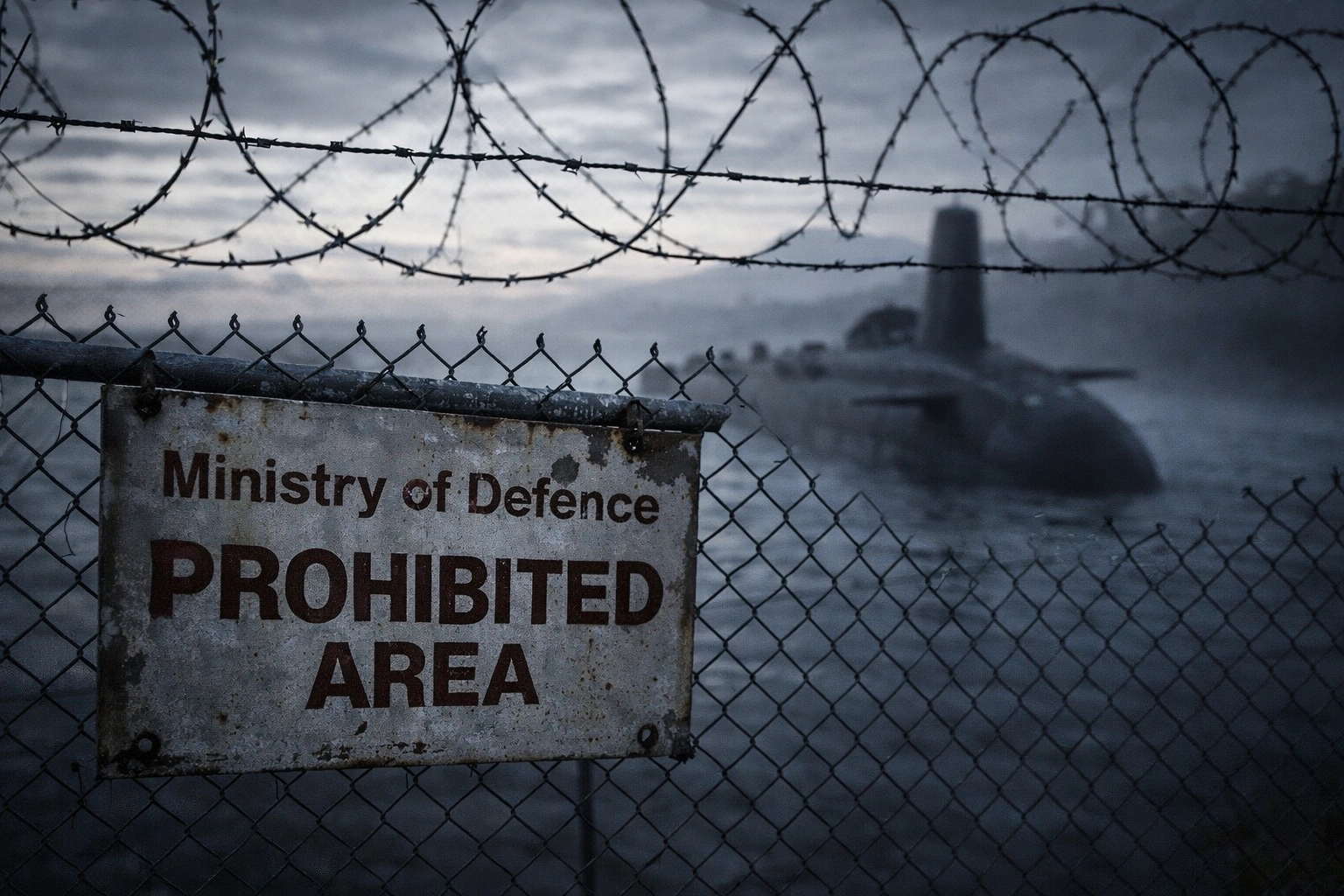
Two foreign nationals were detained after trying to get past the gates at HM Naval Base Clyde, the site that hosts the UK’s nuclear deterrent, and it’s raised a blunt question inside defence circles: was this a simple, clumsy misstep — or a small probe that exposed bigger pressure points?
Police Scotland said a 34-year-old Iranian man and a 31-year-old Romanian woman were arrested after an attempted unauthorised entry at the Faslane site on Thursday, 19 March 2026. The incident was reported at around 17:00, prompting an immediate security response at the perimeter.
Officials have said there was no breach of the inner secure area. Even so, turning up at one of Britain’s most sensitive bases without authorisation is not the sort of thing that gets brushed off as a harmless wrong turn, especially given the base’s role in Continuous At-Sea Deterrence.
A midnight run at the Vanguard-class gates
Faslane’s front gate is not a tourist checkpoint. It is a working choke point for military personnel, civilian contractors, deliveries, and tightly scheduled movements linked to the submarine programme — and it runs on routine and recognition.
That’s why any deviation stands out fast. Investigators are now piecing together exactly how the pair travelled to the area, what they did in the minutes before they reached the gate, and whether they appeared to be following directions, testing reactions, or simply panicking once challenged.
The response was quick. Witnesses around Gare Loch reported a noticeable surge in police activity in the early evening, including unmarked vehicles and heightened security posture. CCTV and the base’s surveillance coverage are expected to be central to establishing a minute-by-minute timeline.
Crucially, even a “failed” attempt can still be useful to someone watching. Response times, procedures at the first barrier, what gets said, what gets logged, and how quickly different units converge — it all forms a picture of how the perimeter behaves under pressure.
The Iranian-Romanian connection: Espionage or error?
The two suspects have been charged and are due to appear at Dumbarton Sheriff Court on Monday, 23 March. The alleged conduct falls under laws governing protected sites, where entering — or trying to enter — without lawful authority is a criminal offence.
For now, the motive is the big blank space. Police have not set out any detail about why the pair approached the base, whether they had equipment with them, or whether there is any link to a wider network. That silence is normal at this stage, but it also fuels speculation.
It is also a sensitive mix of nationalities for a story like this. Iran has been repeatedly cited by UK security bodies in recent years in the context of hostile state activity, while Romania is a close European partner and NATO ally. That contrast is exactly why this case is being watched so closely: it could be nothing more than coincidence, or it could be a sign of how messy and improvised modern intelligence collection can look on the ground.
There is another, less dramatic possibility investigators will have to rule out: confusion, poor judgement, or a personal plan that collided with a protected site. The challenge for authorities is to separate the bizarre from the deliberate, without missing the moment when a small incident points to a larger pattern.
Why our most sensitive bases are feeling the strain
Faslane is not just any naval base. It supports Vanguard-class submarines carrying Trident missiles and is being prepared for the Dreadnought-class replacement fleet. That means constant construction, constant movement, and constant reliance on layered security — people, barriers, cameras, and checks that all need to work in sync.
When the news breaks that two people got as far as the main gate without authorisation, it lands in a wider climate of stretched resources and rising threat complexity. Modern base security has to think about everything at once: physical intrusion, surveillance, insider risk, drones, and cyber disruption. The more moving parts you have, the more your weakest link matters.
The Ministry of Defence will be keen to show the system did what it was built to do: detect, challenge, stop. But the uncomfortable reality is that high-profile sites are magnets for curiosity, activism, and hostile interest — and they’re operating in an era when “testing the fence” can be as valuable as getting over it.
The court process should bring more clarity on intent and evidence. Until then, the incident sits as a nagging reminder that Britain’s nuclear heart depends not only on submarines and warheads, but on the everyday resilience of a gate line under strain.