




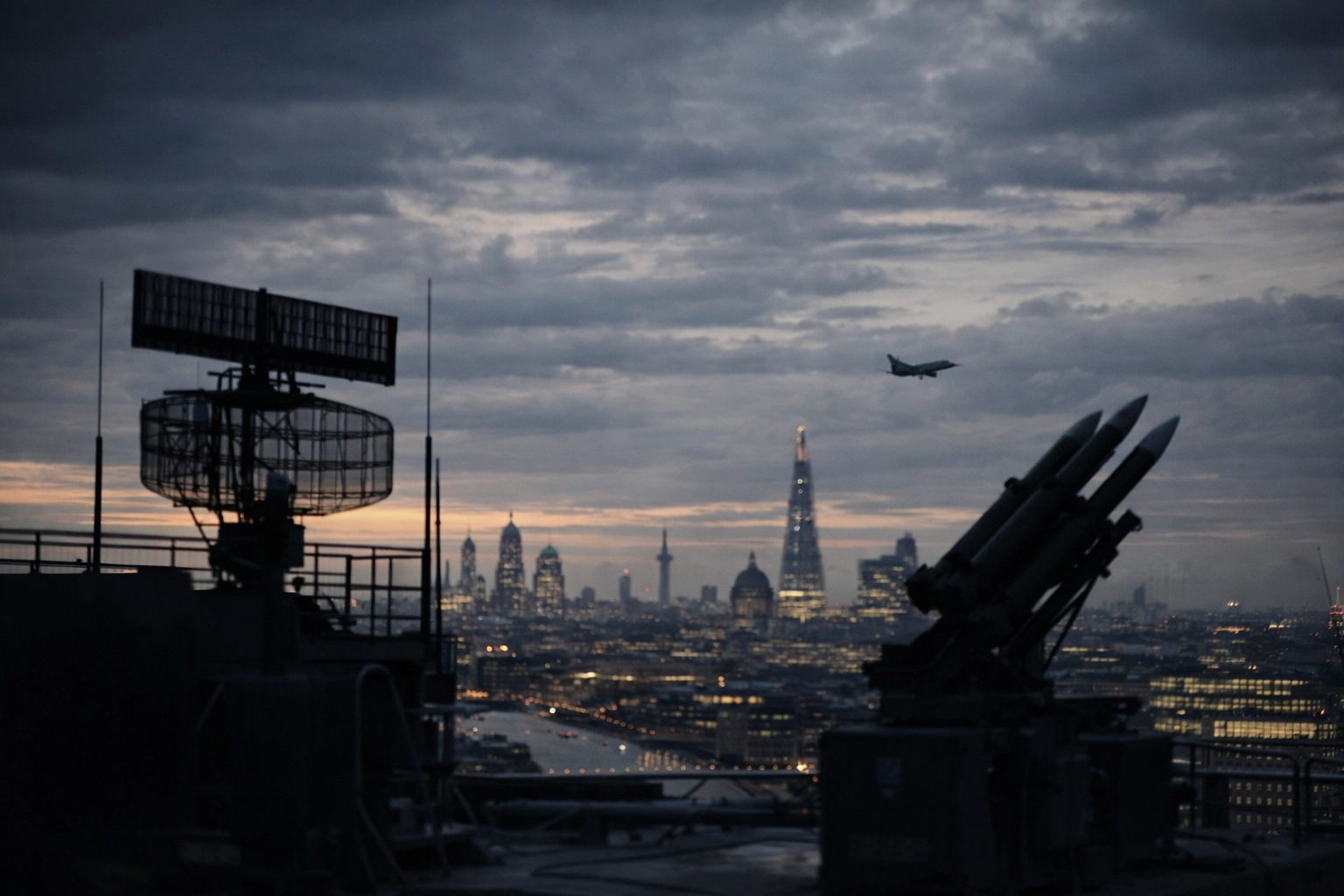
The United Kingdom is currently operating under a defensive delusion that would make a Victorian fortress look like a high-tech marvel.
While the British public remains comfortably nestled under the assumption that a sophisticated "shield" protects the realm from the whims of foreign adversaries, the reality is significantly more porous. General Sir Richard Barrons, the former Commander of Joint Forces Command, has spent the better part of the last few years ringing an alarm bell that the Ministry of Defence seems to have muted. According to Barrons, the UK is "naked" to long-range missile attacks, a vulnerability that has shifted from a theoretical strategic gap to an existential threat in an era of hypersonic munitions and swarming drone technology.
The General’s Verdict: A Nation Unprepared for Modern Skies
The discomforting truth, as outlined by senior military figures, is that the UK’s current air defence architecture is designed for a world that no longer exists. For decades, the British military has focused on expeditionary warfare: fighting small-scale conflicts in distant lands: while effectively outsourcing the protection of the home front to the geography of the English Channel and the might of the United States. This strategy worked when the primary threats were slow-moving bombers or rogue states with limited reach. However, in the 2020s, the emergence of ballistic missiles and Mach 5-plus hypersonic vehicles has rendered the "moat" of the Channel irrelevant.
Currently, the UK’s land-based air defence relies heavily on the Sky Sabre system. While Sky Sabre is an impressive piece of kit, utilizing Common Anti-Air Modular Missiles (CAMM), it is effectively a tactical tool. With a range of roughly 25 kilometres, it is designed to protect a localized battlefield or a specific point of interest from aircraft and cruise missiles. It is, quite literally, like trying to protect a manor house with a very expensive flyswatter. Against a high-altitude ballistic missile descending from space, Sky Sabre is a spectator. The RAF Fylingdales base in North Yorkshire provides a world-class early warning service, capable of tracking objects the size of a Coca-Cola can in deep space, but it possesses no kinetic capability to stop what it sees. It can tell you exactly where the missile will land, but it cannot prevent the impact.
This capability gap is not merely a matter of missing equipment; it is a fundamental shift in the nature of sovereignty. General Barrons has pointed out that the lack of a national integrated air and missile defence (IAMD) system means the UK cannot protect its critical national infrastructure: power stations, communication hubs, and government centres: from a concerted state-level strike. The "witty" irony here is that the UK spends billions on a continuous at-sea nuclear deterrent to prevent the unthinkable, yet lacks the basic conventional shielding to prevent a single conventional missile from switching off the lights in London. It is a strategic posture that is all "sword" and no "buckler."
The Dragon in the Dry Dock: When Hardware Fails the Mission
Nowhere is the UK’s defensive frailty more visible than in the saga of the Type 45 destroyers. These vessels, including the much-vaunted HMS Dragon, were marketed as the world’s premier air defence destroyers. On paper, they are formidable. Equipped with the Sea Viper system and the Sampson radar, a single Type 45 can theoretically track hundreds of targets and engage multiple threats simultaneously. They are the primary shield for the UK’s new aircraft carriers. However, a shield is only useful if you are actually carrying it, and for significant portions of the last decade, the UK’s shield has been stuck in the "repair shop" of Portsmouth and Birkenhead.
The "untold" reality of HMS Dragon and her sister ships is a comedy of engineering errors that has left the Royal Navy’s front line dangerously thin. The Type 45s were built with a revolutionary integrated electric propulsion system that turned out to be allergic to warm water. The Northrop Grumman intercoolers failed in the Persian Gulf, leading to total power failures: "going dark": in the middle of high-tension operational zones. The subsequent "Power Improvement Project" (PIP) has seen these ships spend years in dry dock having their engines literally cut out and replaced. HMS Dragon herself has been plagued by delays, meaning that during periods of heightened global tension, one of the UK’s few assets capable of intermediate missile defence was effectively a very expensive floating office.
This maintenance backlog creates a "thin red line" that is more of a dotted line. When you only have six of these destroyers, and two are undergoing engine transplants, two are in routine maintenance, and one is being used for training, you are left with exactly one ship to cover the entire globe. If that ship is in the Red Sea defending shipping lanes from Houthi drones, there is no Type 45 available to sit in the North Sea or the Atlantic to provide a radar umbrella for the British Isles. The delays in the PIP and the wider shipbuilding programme represent a systemic failure to align political ambition with industrial reality. We have built a fleet of Ferraris with the reliability of a 1970s Lada, and the result is a national defence posture that relies on hope as a primary strategy.
The Transatlantic Safety Net and the Cost of Autonomy
Because the UK lacks its own dedicated domestic ballistic missile defence, it is forced to live under the American Aegis umbrella. This dependence is not just a blow to national pride; it is a logistical gamble. Any interception of a long-range threat headed for British soil would likely be conducted by US Navy destroyers equipped with SM-3 interceptors or through the Aegis Ashore sites in Romania and Poland. The British role in this process is largely that of a data provider: tracking the threat through Fylingdales and passing the information to the Americans, who then decide whether to pull the trigger.
The research suggests that the SM-3 system has a success rate of somewhere between 50 and 80 percent in testing. In the chaotic reality of a multi-missile salvo or an attack involving sophisticated decoys, those odds become uncomfortably slim. Furthermore, there is no guarantee that a US asset will be in the correct position to protect a UK target if the Americans are simultaneously defending their own interests elsewhere. This creates a "sovereignty deficit" where the ultimate survival of the British state depends on the immediate availability and willingness of a foreign power’s hardware. While the "special relationship" is often touted in press releases, in the cold vacuum of a missile flight path, it is a precarious safety net.
Alternative solutions exist, but they come with a price tag that the Treasury seems unwilling to stomach. Lockheed Martin has consistently pitched the PAC-3 Missile Segment Enhancement and the THAAD (Terminal High Altitude Area Defense) system to the UK government. These systems would provide the layered defence that nations like Israel use to maintain a "normal" life under constant threat. THAAD, in particular, offers the ability to intercept threats at ranges exceeding 200 kilometres and altitudes that provide a genuine shield against ballistic weapons. However, procurement in the UK is a notoriously slow-moving beast. By the time the MoD decides on a system, signs the contract, and navigates the inevitable industrial disputes, the technology is often a generation behind. For now, the UK’s "invisible" defence remains exactly that: invisible, because it largely doesn’t exist. Until the gap between the rhetoric of "Global Britain" and the reality of HMS Dragon’s engine room is closed, the UK remains a high-value target with a low-value shield.