






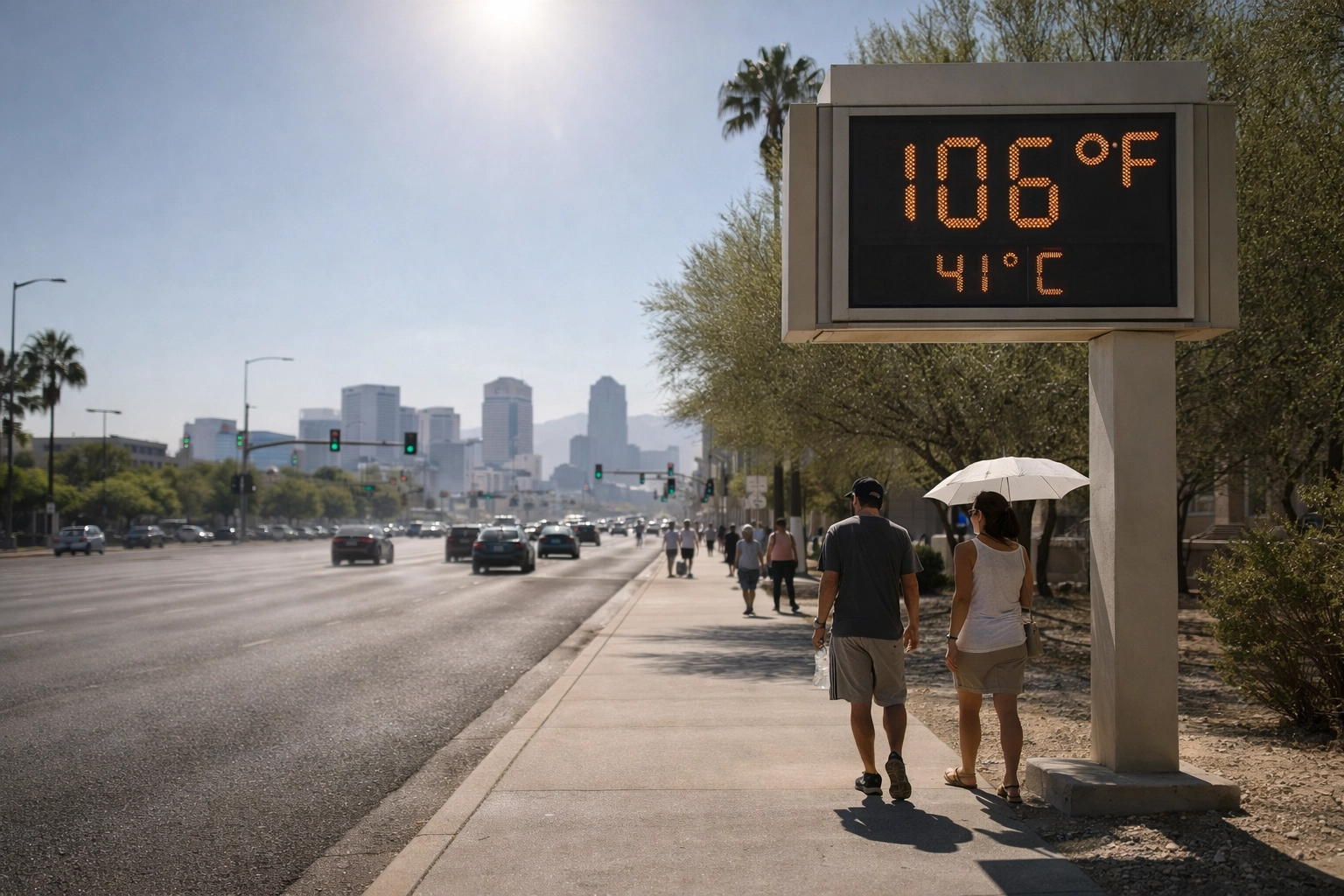
Phoenix, Arizona, has recorded its hottest March temperature in history as an intense and "virtually impossible" heatwave grips the south-western United States. Meteorologists confirmed that the city reached 41.1°C (106°F) during the mid-month peak, a figure that significantly exceeds the previous all-time March record of 37.7°C (100°F).
The extreme weather event, which spanned from 18 to 22 March 2026, saw maximum daily temperatures climb well above 30°C across the majority of the region. California and Nevada also reported record-breaking figures as a persistent high-pressure system trapped hot air over the desert landscape. Experts have described the event as a "thousand-year" occurrence, highlighting the statistical rarity of such temperatures occurring so early in the calendar year.
The scale of the heat has caught local authorities off guard. While the Southwest is accustomed to triple-digit temperatures in the summer months, a surge of this magnitude in March is unprecedented in the modern era of climate recording. The rapid onset of the heat has prompted immediate warnings from the National Weather Service, which noted that the lack of seasonal acclimatisation poses a significant risk to the public.
The mechanics of the record-breaking heat dome
The primary driver behind this record-shattering event is a phenomenon known as a "heat dome." This occurs when a strong, slow-moving high-pressure system settles over a large area, acting much like a lid on a boiling pot. The system compresses the air beneath it, warming it significantly through adiabatic heating while simultaneously pushing clouds away and allowing for maximum solar radiation.
In this instance, the heat dome remained stationary for five consecutive days, causing temperatures to soar between 11°C and 17°C above the seasonal average. In parts of California’s Inland Empire and the Coachella Valley, residents saw thermometers hit levels usually reserved for July. Death Valley and Palm Springs reported figures that rivalled mid-summer peaks, creating a dangerous environment for those unprepared for the sudden shift.
The stability of this atmospheric condition meant there was little to no wind to dissipate the accumulating heat. Compounding the issue was the lack of overnight cooling. In urban centres like Phoenix and Las Vegas, the "urban heat island" effect kept nighttime temperatures near 25°C. This prevents the human body and the environment from recovering from the daytime highs, leading to a cumulative heat stress that can be fatal for vulnerable populations.
Meteorologists noted that the heat dome was unusually robust for the spring season. Typically, the jet stream would move such systems along, but a "blocking pattern" in the upper atmosphere held the high pressure in place. This stagnation is a hallmark of recent extreme weather events observed globally, where traditional seasonal cycles are increasingly disrupted by erratic atmospheric behaviour.
The fingerprint of human-induced climate change
Scientific analysis of the mid-March heatwave has reached a stark conclusion: the event was virtually impossible without the influence of human-induced climate change. Observation-based data suggests that temperatures in Western North America have warmed by approximately 4°C for such March extremes compared to pre-industrial levels.
A rapid attribution study conducted following the peak of the heatwave estimated that the likelihood of such an event has increased by approximately 800 times. What would have once been a statistical impossibility is now becoming a tangible reality as the planet continues to warm. The study found that the warming rate in this specific region during the month of March is roughly triple the global average, with increases of 3.4°C to 4.4°C for an overall global warming of 1.3°C.
This accelerated warming in the Southwest is particularly concerning for climate scientists. As the region becomes more arid, the soil dries out, leaving less moisture to evaporate. Normally, evaporation provides a cooling effect; without it, the sun’s energy goes directly into heating the ground and the air above it. This creates a feedback loop where heat leads to dryness, which in turn leads to even more extreme heat.
The 2026 event serves as a critical data point for climate models. The return period for a heatwave of this intensity in a pre-industrial climate would have been well beyond the thousand-year mark. In the current climate, these events are not only becoming more frequent but also more intense, pushing the boundaries of what infrastructure and biological systems can withstand. The persistent nature of the heat dome also points toward a future where "stuck" weather patterns become the norm rather than the exception.
A growing threat to public health and infrastructure
Extreme heat remains the leading cause of weather-related fatalities in the United States, often outpacing the death tolls of hurricanes, tornadoes, and floods combined. The timing of this March heatwave has exacerbated the danger. Because it occurred so early in the year, the local population had not yet developed the physiological acclimatisation necessary to handle 40°C-plus temperatures.
Public health officials in Arizona and California reported a surge in heat-related hospital admissions during the five-day peak. Many cooling centres, which typically operate from June through September, were not yet fully operational when the records began to tumble. This left homeless populations and those without reliable air conditioning at severe risk. Furthermore, tourists visiting the region from cooler northern climates were caught unawares, leading to several emergency rescues on hiking trails in the Grand Canyon and Joshua Tree National Park.
The infrastructure strain has been equally notable. Power grids in the Southwest are designed to handle massive loads during the summer, but scheduled maintenance on power plants and transmission lines often takes place in the spring. The sudden spike in demand for air conditioning forced energy providers to scramble to ensure stability. While no major blackouts were reported, the event has prompted a review of how utility companies prepare for "shoulder season" extremes.
Agricultural sectors in the region are also bracing for the fallout. Early-season heat can cause crops to bolt or dry out before they are ready for harvest, potentially affecting supply chains and food prices. Water management also becomes a primary concern; high temperatures increase evaporation rates in critical reservoirs like Lake Mead and Lake Powell, which are already under long-term stress from decades of drought.
As the heat dome finally began to dissipate toward the end of March, the focus shifted to the long-term implications of this historic event. The records set in 2026 are not merely numbers in a ledger; they represent a fundamental shift in the climate reality of Western North America. With summer still months away, the early arrival of such extreme temperatures has left many wondering what the remainder of the year will hold for the American Southwest.