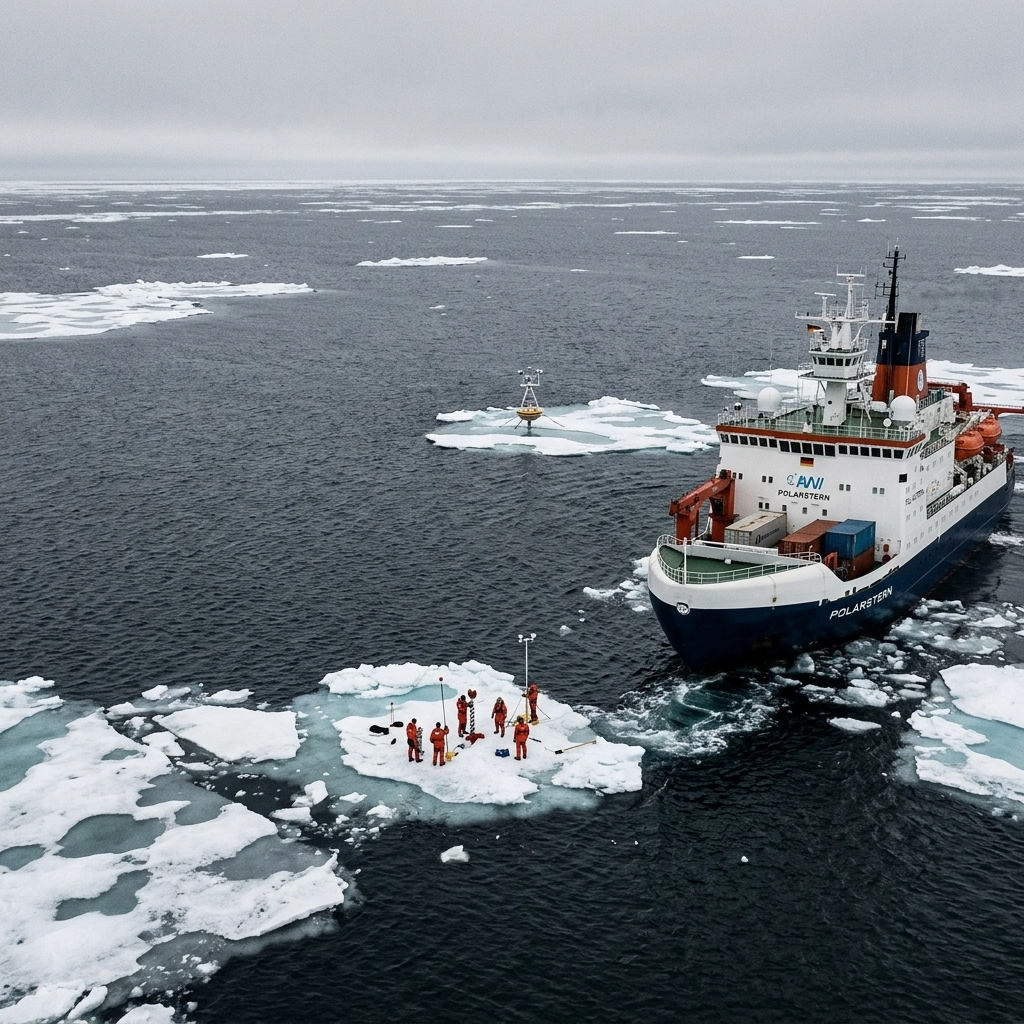
The environmental landscape of the North Pole is undergoing a significant transformation that has caught the attention of the global scientific community. Recent data indicates that Arctic sea ice has reached a record winter low for the second consecutive year. This development is not merely a statistical anomaly but a continuation of a decades-long trend that suggests the region is responding rapidly to shifting atmospheric conditions.
On 15 March 2026, measurements recorded by satellite monitoring systems showed the maximum extent of the ice at 14.29 million square kilometres. This figure is statistically tied with the record low established in 2025, which sat at 14.31 million square kilometres. The consistency of these lows over a two-year period provides a clear signal regarding the state of the polar environment.
Scientists who monitor these regions have noted that the 2026 winter peak was approximately 1.3 million square kilometres below the average recorded between 1981 and 2010. To put that into perspective, the missing ice covers an area roughly twice the size of Texas. This absence of ice during what should be the peak growth season highlights a shift in how the Arctic handles the transition between winter and summer.
The implications of this reduction are multifaceted, affecting everything from local ecosystems to global weather patterns. As the ice fails to reach its traditional boundaries, the open water absorbs more solar radiation, which in turn leads to further warming. This cycle is one of the most visible indicators of the changing climate and remains a primary focus for researchers worldwide.
Understanding the Dynamics of the 2026 Winter Peak
The measurement of sea ice extent is a critical tool for understanding the health of the Arctic. Every year, the ice expands through the autumn and winter, reaching its maximum extent in late February or March. Following this peak, it begins to melt as temperatures rise, reaching a minimum in September. The fact that the 2026 peak is so low suggests that the winter "growth" phase was severely hampered by environmental factors.
Throughout the past six months, the Arctic region has experienced unusually warm conditions. These temperatures have prevented the traditional formation of thick, expansive ice sheets. When the air and sea temperatures remain above historical averages, the sea ice simply cannot take hold in areas where it was once a permanent fixture of the winter landscape.
Satellite monitoring, which began in earnest in 1979, has provided a consistent record of these changes. Looking back over nearly fifty years of data, the downward trajectory is clear. While there are occasional years of slight recovery, the overall trend is one of steady decline. The 2026 results are particularly concerning because they reinforce the record-breaking lows of the previous year, suggesting that the "new normal" for the Arctic may be significantly lower than what was observed only a generation ago.
The National Snow and Ice Data Centre has been instrumental in tracking these developments. Experts from the centre have pointed out that as temperatures continue to rise, particularly in the polar regions, the opportunity for ice to grow is becoming increasingly limited. This isn't described as an abrupt "regime shift" by all scientists, but rather a persistent and steady erosion of the Arctic’s frozen defences.
The Structural Integrity of Thinning Ice Sheets
Beyond the sheer surface area or "extent" of the ice, researchers are deeply concerned about the quality and thickness of the ice that does remain. Recent data from NASA’s ICESat-2 satellite has provided a more granular look at the three-dimensional structure of the Arctic ice. The findings suggest that much of the ice is notably thinner and more fragile than it has been in previous decades.
The Barents Sea, located northeast of Greenland, and the Sea of Okhotsk, bordering northern Japan and Russia, have shown particularly high levels of thinning. In these regions, the ice is not just covering less area; it is also lacking the depth required to survive the upcoming summer melt season. When ice is thin, it is more susceptible to being broken up by storms and carried away by ocean currents into warmer waters.
Ice scientists describe the current state of the Arctic as "fragile." In the past, the Arctic was characterised by multi-year ice: thick layers that survived multiple summer melts and provided a sturdy foundation for new growth. Today, much of the Arctic is covered by "first-year ice," which is thinner and much more likely to vanish entirely when the sun returns for the summer months.
This lack of thickness creates a feedback loop. Thin ice melts faster, exposing dark ocean water earlier in the year. This water absorbs heat rather than reflecting it, as ice does, leading to warmer ocean temperatures that make it even harder for ice to form the following winter. This structural decline is perhaps even more telling than the extent measurements, as it speaks to the fundamental change in the Arctic’s physical composition.
Arctic Amplification and Future Climate Projections
The changes observed in the Arctic are part of a phenomenon known as Arctic amplification. This refers to the fact that the Arctic is warming at a rate significantly faster than the rest of the planet. As the "reflective shield" of white ice disappears, the region transitions from a cooling mechanism for the Earth to an area that actively contributes to heat absorption.
The record lows of 2025 and 2026 are seen by many as a warning of what is to come. If the current trend continues, the likelihood of ice-free summers in the Arctic increases. This would have profound effects on global jet streams and weather patterns in the Northern Hemisphere. The stability of our climate is closely linked to the temperature differential between the poles and the equator; as that gap narrows, weather becomes more unpredictable.
While the data for 2026 is sobering, it also provides an essential foundation for future planning and environmental policy. Understanding exactly how and where the ice is thinning allows for better models and predictions. This information is vital for coastal communities, the shipping industry, and conservationists who are working to protect the unique species that call the Arctic home.
Despite the steady decline, the scientific community remains focused on the precision of their measurements. Every satellite pass and sensor reading adds to a body of knowledge that helps us understand the complex interactions between the atmosphere and the cryosphere. The goal is to move beyond simply recording the loss and toward a deeper understanding of the mechanisms driving it.
The record-low winter peak of 2026 serves as a clear reminder of the ongoing shifts in our global environment. The Arctic is often described as the "canary in the coal mine" for the planet's climate, and the current signals suggest a system under considerable stress. As we move into the spring and summer months, all eyes will remain on the northern latitudes to see how the remaining ice fares against the seasonal melt.
The consistency of these record-breaking years underlines the importance of continued monitoring and research. By documenting these changes with precision, we can better comprehend the scale of the transition occurring at the top of the world. The Arctic sea ice reaching its lowest extent for a second consecutive year is a milestone that marks a significant moment in our environmental history.