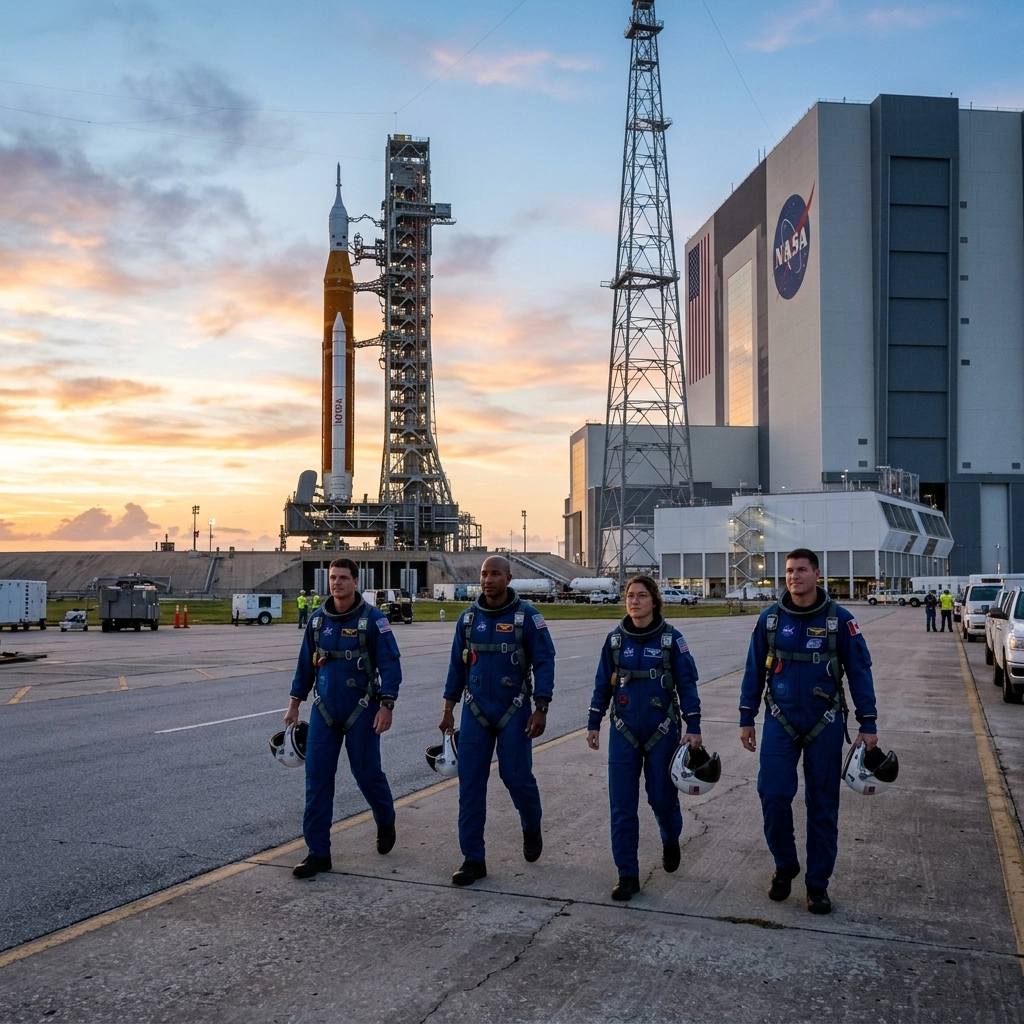
It is actually happening. After decades of looking at the Moon and wondering when we would finally head back, the moment is almost upon us. Tomorrow, 1 April 2026, four human beings will climb into a capsule, sit on top of the most powerful rocket ever built, and blast off towards our closest celestial neighbour. It is the kind of stuff that usually fills the pages of science fiction novels, but for Reid Wiseman, Victor Glover, Christina Koch, and Jeremy Hansen, it is about to become a very intense reality.
As we sit here on 31 March, the crew is tucked away in quarantine. It is a strange, quiet period of reflection before the literal roar of the Space Launch System (SLS) engines takes over. Here at NowPWR, we love bringing you these untold stories: the bits of history that feel personal even when they are happening thousands of miles above our heads. While the world watches the countdown clocks, the crew is busy doing final checks, eating carefully monitored meals, and probably thinking about the fact that they are about to see the far side of the Moon with their own two eyes.
This mission, Artemis II, isn't just a quick jaunt. It is a ten-day loop that will take them further than any human has ever travelled. They aren’t landing just yet: that is for Artemis III: but they are the trailblazers making sure the path is safe. If you are looking for independent news UK style, you know we like to get into the nitty-gritty of why this matters for all of us back here on Earth.
The Faces Behind the Visors and Life in Isolation
The four people currently sitting in a highly sanitised room in Florida aren't just "astronauts"; they are a team that has spent years preparing for this specific ten-day window. Reid Wiseman is the commander, a veteran who knows his way around a spacecraft. Then you have Victor Glover, the pilot, and mission specialists Christina Koch and Jeremy Hansen. Jeremy is actually making history as the first Canadian to leave Earth’s orbit, which is a massive win for international cooperation in space.
Quarantine might sound a bit boring, but for these four, it is a vital part of the mission. They have to stay healthy. The last thing you want when you are 200,000 miles away from the nearest chemist is a pesky head cold or a bout of the flu. They have been spending this time in a "bubble," talking to their families through glass or over video calls, and mentally rehearsing every single switch and dial inside the Orion capsule.
They have spoken about the camaraderie that develops in these final hours. It’s a strange mix of high-stakes professionalism and the kind of bond you only get when you’re about to be shot into a vacuum. They aren't just colleagues anymore; they are the only people on the planet: and soon, off it: who truly understand the weight of this mission. It is one of those untold stories of spaceflight: the quiet, human moments that happen before the fire and smoke of the launchpad take centre stage.
The Ten-Day Trek to the Far Side of the Moon
So, what does the mission actually look like once they leave the ground? It isn't a straight line. After the SLS rocket does its job of getting them out of Earth’s atmosphere, the Orion spacecraft will enter a high Earth orbit. This gives the crew a chance to check that all the life-support systems are working perfectly before they commit to the big "trans-lunar injection": the burn that sends them towards the Moon.
The journey to the lunar vicinity takes about three days. During this time, they will be testing out a lot of new tech. One of the coolest bits is the new optical communications system. Instead of the old-school radio waves, they will be using lasers to send data back to Earth at speeds of up to 260 megabits per second. That means we might get high-definition video of the Moon much faster than we ever have before.
Once they reach the Moon, they aren't going into a circular orbit. Instead, they will use a "free-return trajectory." This means they will fly around the far side of the Moon, using its gravity to sling-shot them back towards Earth. At their furthest point, they will be nearly 7,500 kilometres beyond the Moon. They will see views of the lunar surface that have never been seen up close by human eyes, including the rugged terrain of the far side that is always hidden from us here on Earth. It’s a massive test of the Orion’s navigation and guidance systems, ensuring that future missions can land safely near the lunar South Pole.
What This Means for Our Future Among the Stars
You might be wondering why we are doing this now. Why go back after fifty years? The answer lies in the science and the preparation for something even bigger. Artemis II is the ultimate "test drive." The crew will be part of some pretty incredible experiments, like the AVATAR project. This involves "organ-on-a-chip" devices to see how deep-space radiation affects human cells. It is the first time this kind of tech has gone beyond the International Space Station, and the data they bring back will be crucial for keeping future astronauts healthy on the way to Mars.
As an independent news UK source, we think it’s important to look at the broader picture. This isn't just about planting flags; it’s about establishing a long-term presence. By the time Artemis III rolls around in 2028, we hope to have humans living and working on the lunar surface. Artemis II is the bridge to that future. The astronauts will be making geological observations from their windows, scouting out locations and helping scientists understand the moon's history in ways that satellites just can't match.
There is also something deeply inspiring about this mission. In a world that often feels divided, seeing a multi-national crew head into the unknown reminds us of what we can achieve when we work together. These untold stories of human endeavour are what keep us looking up. When the SLS lifts off tomorrow, it won't just be carrying four people; it will be carrying the hopes and curiosities of everyone back home.
The countdown is well and truly on. The weather looks good, the rocket is ready, and the crew is as prepared as humanly possible. Whether you’re a space geek or just someone who enjoys a good story of adventure, tomorrow is a day to remember. We will be right here, keeping an eye on the mission as it unfolds, bringing you the updates that matter. It is a big leap for the crew, but a massive step for all of us as we finally head back to the Moon. Stay tuned, because the next ten days are going to be absolutely spectacular.