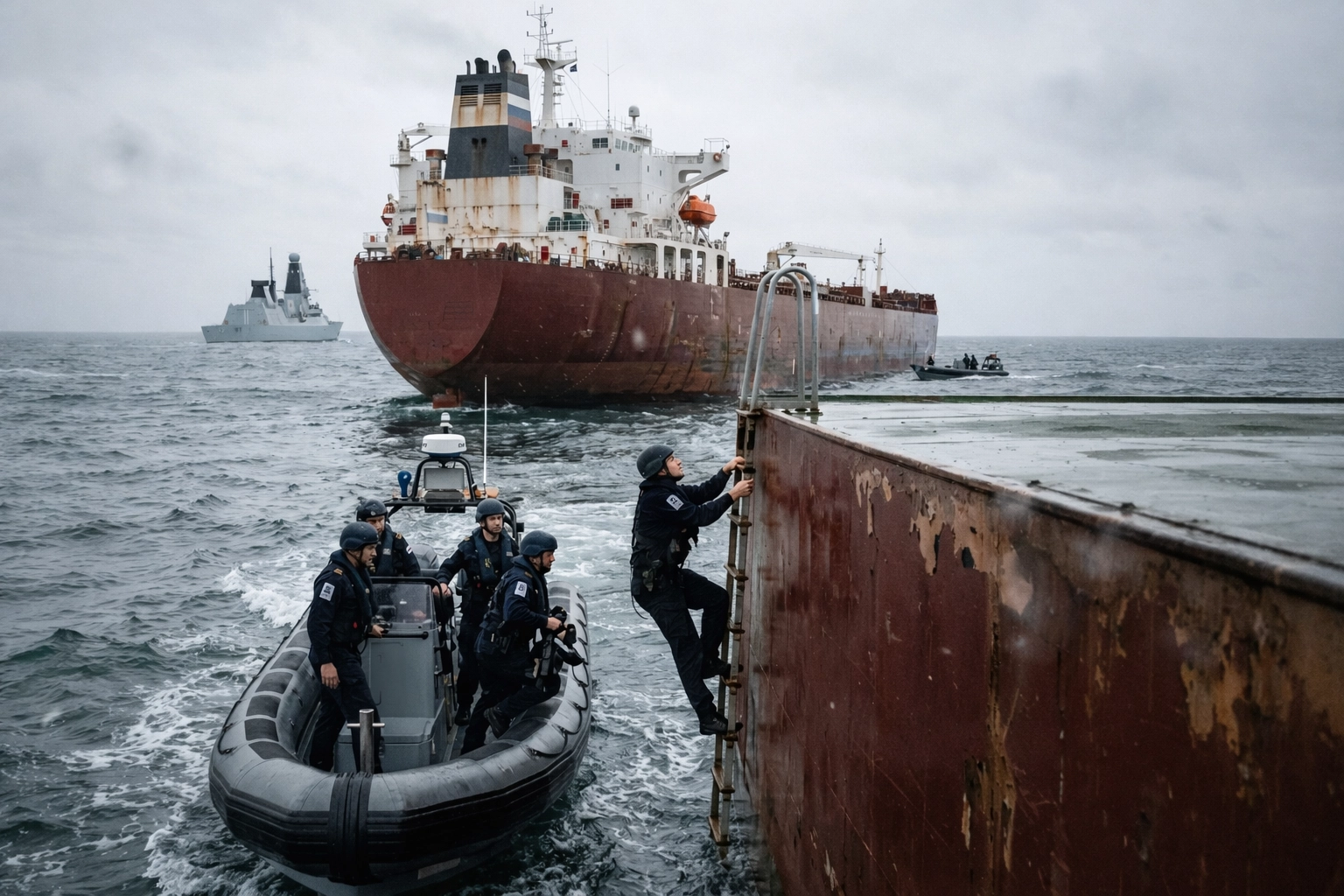
British Prime Minister Keir Starmer has formally authorised the Royal Navy and UK border forces to board and seize Russian tankers operating within British territorial waters. This landmark decision marks a significant escalation in the UK's strategy to disrupt the funding of the ongoing conflict in Ukraine. Government lawyers concluded legal reviews earlier this month, providing the necessary framework for the military to interdict vessels suspected of evading international sanctions.
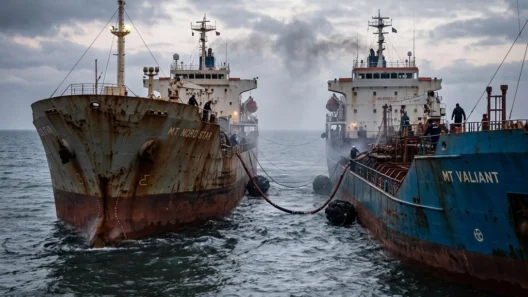
The move targets a clandestine network of more than 1,000 ageing vessels, commonly referred to as the "shadow fleet." These ships are used by Moscow to transport oil and other sanctioned goods, often flying flags of convenience to bypass Western restrictions. By intercepting these tankers, the UK aims to close a loophole that has allowed billions of pounds in oil revenue to flow back to the Kremlin.
Under the new directives, British forces are empowered to detain sanctioned vessels passing through the English Channel and other UK-controlled zones. This shift in policy follows years of tracking and monitoring by allied navies, moving from passive surveillance to active interdiction. The Prime Minister confirmed that the UK will work alongside northern European allies to ensure the "shadow fleet" is unable to operate with impunity in the North Sea and surrounding regions.
The Legal Framework for Maritime Interdiction
The authorisation granted to the Royal Navy rests on a series of legal conclusions reached by government experts in early 2026. These findings suggest that the threat posed by the shadow fleet: both in terms of sanctions evasion and maritime safety: justifies a more aggressive stance under international maritime law. Specifically, the UK is invoking its rights to ensure "innocent passage" does not cover vessels engaged in activities that directly fund illegal warfare or pose significant environmental risks.
Central to this enforcement action is a list of 544 ships that have been specifically identified and sanctioned by the UK government and its allies. These vessels are known to be part of a sophisticated logistics chain designed to circumvent the $60-per-barrel price cap imposed by the G7. By operating outside the standard maritime insurance and regulatory frameworks, these tankers have managed to deliver Russian crude to global markets while remaining largely invisible to traditional financial oversight.
The Royal Navy's new powers allow for "boarding under controlled conditions." This means that if a sanctioned vessel enters UK waters, British personnel can demand to board for inspection. If the vessel is found to be in breach of sanctions or lacks appropriate safety certification, it can be diverted to a UK port or detained at sea. This process is expected to be carried out with the support of the RAF and advanced maritime surveillance assets to ensure the safety of boarding parties.
Previous operations involving the shadow fleet were limited to tracking and intelligence sharing. For instance, the Royal Navy recently assisted the French Navy in locating a sanctioned Russian oil tanker in the Mediterranean. However, that vessel was only boarded once it reached international waters or specifically defined jurisdictions. The new British policy removes these limitations, allowing for immediate action within the UK’s own maritime boundaries.
Environmental and Security Risks of Ageing Vessels
Beyond the geopolitical implications, the UK government has cited grave environmental concerns as a primary motivator for the interdiction policy. The shadow fleet is largely composed of ageing tankers, many of which are over 20 years old and nearing the end of their operational lives. These vessels often operate without standard P&I (Protection and Indemnity) insurance, meaning that in the event of an oil spill, there would be no clear entity responsible for the billions of pounds in clean-up costs.
These "dark" tankers frequently engage in dangerous manoeuvres to avoid detection, such as "dark" ship-to-ship transfers where oil is moved between vessels with their Automatic Identification Systems (AIS) turned off. Such activities often take place in choppy waters or busy shipping lanes, significantly increasing the risk of collisions and catastrophic environmental damage. The English Channel, being one of the world's busiest maritime routes, is particularly vulnerable to these high-risk operations.
By boarding and inspecting these ships, British authorities can assess their structural integrity and safety standards. Many of the 544 sanctioned vessels are believed to be poorly maintained, with many lacking the necessary certifications to enter Western ports. The UK’s decision to intervene is framed as a necessary step to protect the British coastline and marine ecosystems from a potential ecological disaster caused by an unlisted and uninsured vessel.
The security risk extends to the personnel involved. The shadow fleet often employs crews from various jurisdictions who may not be fully aware of the legal status of their cargo. By establishing a physical presence on these ships, the UK intends to send a clear message to the owners and operators of these vessels: the UK will no longer tolerate the use of its waters as a safe transit corridor for illicit trade. The move is expected to significantly increase the insurance premiums and operational costs for those continuing to facilitate Russian oil exports.
Geopolitical Impact on Russian Conflict Financing
The strategic objective of the Royal Navy's new mandate is the systematic degradation of Russia’s ability to finance its military operations. Oil exports remains the primary source of revenue for the Russian state, and the shadow fleet is the vital artery that keeps this revenue flowing. Analysts suggest that even a partial disruption of these shipping routes could lead to a significant shortfall in the Kremlin's budget, forcing difficult choices between military spending and domestic stability.
This British initiative is part of a broader, coordinated effort involving the Joint Expeditionary Force (JEF), a UK-led coalition of ten northern European nations. By synchronising boarding and interdiction efforts, the JEF aims to create a "no-go zone" for the shadow fleet across the North Sea, the Baltic Sea, and the North Atlantic. This collective approach prevents sanctioned vessels from simply rerouting through the waters of a less vigilant neighbour.
The response from Moscow is expected to be one of diplomatic protest and potential maritime posturing. However, the UK government has remained firm, stating that the international community has a responsibility to uphold the integrity of the sanctions regime. The authorisation for British forces to board these tankers is seen as a necessary evolution of the economic warfare that has defined the West's response to the invasion of Ukraine since 2022.
As the Royal Navy begins active patrols and potential interdictions, the maritime landscape in Northern Europe is set for a period of heightened tension. The success of this policy will be measured by the number of vessels deterred from entering UK waters and the subsequent impact on Russian oil revenue. For now, the "shadow fleet" faces its most significant challenge to date, as the UK moves from the role of a watchful observer to an active enforcer on the high seas.
The situation remains fluid, with British forces expected to conduct the first of these new boarding operations in the coming days. International observers will be watching closely to see how the "shadow fleet" owners react and whether other G7 nations will follow the UK's lead in granting similar powers to their own naval forces. The battle for control over the world's illicit oil routes has entered a decisive new phase.