





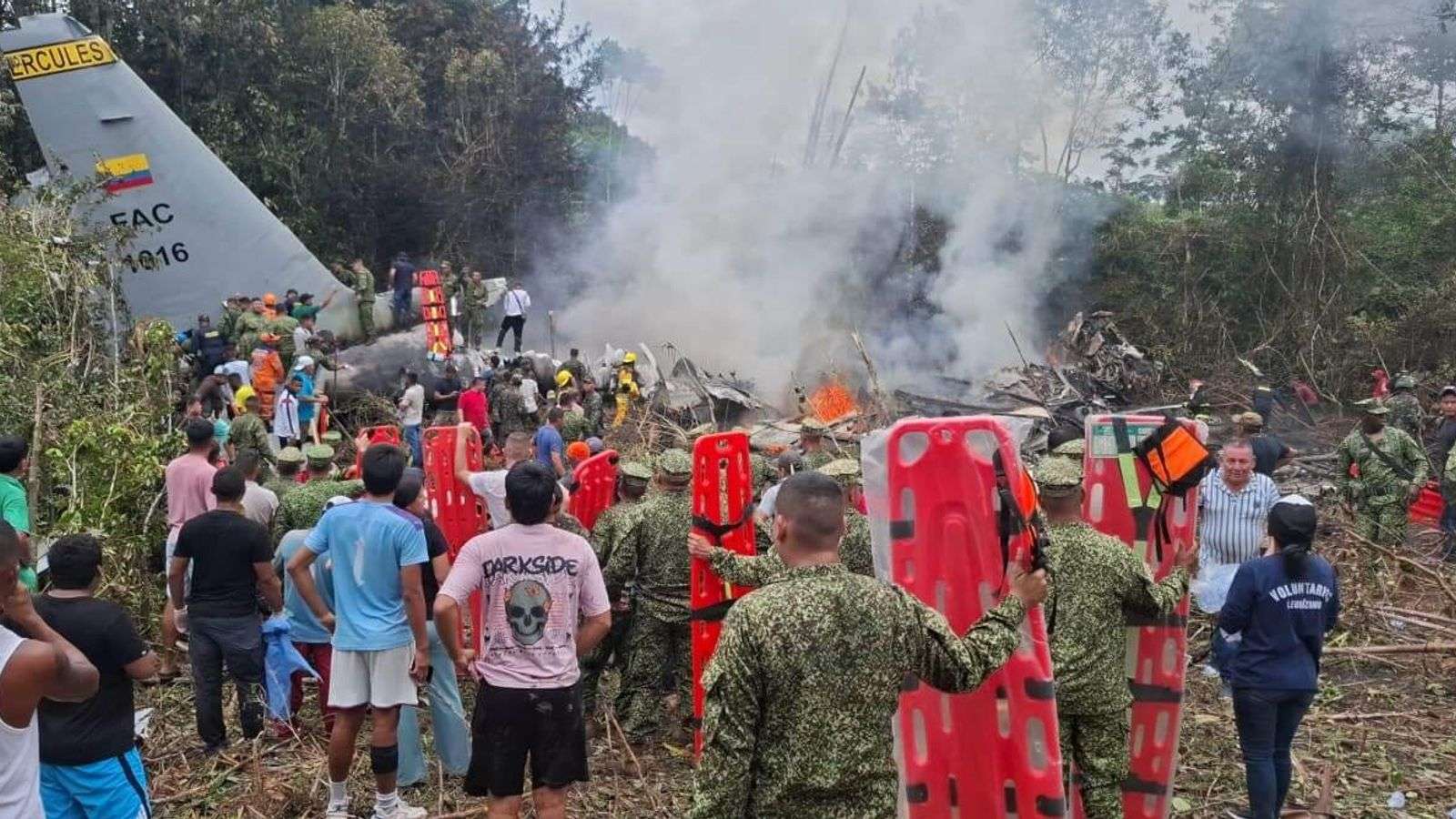
A Lockheed Martin C-130 Hercules transport aircraft belonging to the Colombian Aerospace Force has crashed in the country’s southern Amazon region. The vessel was carrying approximately 110 soldiers at the time of the incident, with early reports from local authorities suggesting that as many as 80 personnel are feared dead. The disaster occurred during a critical troop transport mission near the border with Peru, sending shockwaves through the nation’s military command and the international aviation community.
The aircraft went down shortly after taking off from Puerto Leguízamo in the Putumayo department. This remote region, characterised by dense rainforest and complex river systems, has become the site of a massive emergency response operation. Defence Minister Pedro Sánchez confirmed the tragedy in a sombre address, noting that the aircraft suffered a "tragic accident" during its initial ascent. The cause of the crash remains unknown, and an investigation has been launched to determine whether mechanical failure, pilot error, or environmental factors played a role in the downing of the multi-engine turboprop.
The C-130 Hercules is widely considered the workhorse of military transport worldwide, known for its ability to operate from unprepared runways. However, the loss of such a significant number of troops in a single aviation event represents one of the deadliest days for the Colombian military in recent history. As search and rescue teams descend on the site, the focus remains on locating survivors amongst the wreckage strewn across the Amazonian canopy.
The Fatal Ascent from Puerto Leguízamo
The flight was scheduled as a routine relocation of troops within the Putumayo region, an area where the Colombian military maintains a heavy presence due to ongoing security operations and border monitoring. The C-130 Hercules, a platform designed for heavy lifting and durability, was fully loaded with 110 soldiers and their equipment. Witnesses near Puerto Leguízamo reported seeing the aircraft struggle to gain altitude shortly after leaving the runway, though these accounts are yet to be formally verified by flight data.
The crash site is located approximately three kilometres (two miles) from the urban centre of Puerto Leguízamo. The proximity to the town allowed for a relatively rapid initial response from local emergency services, but the nature of the terrain: thick jungle and marshland: has hampered the ability of heavy machinery to reach the impact zone. Initial aerial surveys of the wreckage show a catastrophic impact, with the fuselage of the Hercules largely destroyed and charred by a post-crash fire.
Military officials have established a restricted perimeter around the site to preserve evidence. The Putumayo region is notorious for its unpredictable weather patterns, including sudden tropical storms and heavy mist, which frequently reduce visibility to near zero. While it is too early to pin the disaster on meteorology, investigators will be scrutinising the weather reports from the moment of takeoff. The loss of eighty lives would make this the most significant aviation disaster in Colombia since the 2016 Chapecoense plane crash, which claimed 71 lives in the mountains near Medellín.
Search and Rescue in the Amazonian Terrain
The Colombian Aerospace Force has deployed a fleet of search and rescue helicopters to the Amazon to coordinate the recovery effort. The Defence Ministry has mobilised specialised jungle rescue units, trained to operate in the punishing conditions of the southern departments. Despite the rapid deployment, the sheer scale of the crash and the density of the vegetation mean that reaching every part of the debris field is a painstaking process.
Defence Minister Pedro Sánchez stated that the government’s priority is the "honourable recovery" of the fallen and the immediate medical evacuation of any survivors found within the wreckage. Local hospitals in Putumayo have been placed on high alert, though the grim reality of the initial death toll suggests that few soldiers may have survived the high-velocity impact. The families of the 110 soldiers on board have begun to gather at military bases across the country, awaiting official confirmation of the manifest and the status of their loved ones.
Logistically, the operation is a nightmare. The Amazonian soil is soft and frequently flooded, making it difficult for investigators to secure the heavy engines and structural components of the C-130 for transport back to Bogota for analysis. The Colombian government has reached out to international partners for potential technical assistance in recovering the flight data recorders, commonly known as "black boxes," which are essential for understanding the final moments of the flight. The international community, including neighbouring Peru and Brazil, has offered support in the form of satellite imagery and logistical assets.
The C-130 Hercules and Military Aviation Safety
The Lockheed Martin C-130 Hercules has been a staple of the Colombian military’s logistics wing for decades. It is a four-engine turboprop aircraft that is prized for its versatility, used for everything from troop transport and medical evacuation to firefighting and maritime patrol. While the airframe is renowned for its ruggedness, the aging nature of some units within global fleets has raised questions about maintenance cycles and structural fatigue.
The Colombian military operates a mix of older and newer C-130 variants. This specific aircraft was part of a fleet that has seen heavy use in the country’s internal conflicts, often flying in high-stress environments and landing on short, unpaved strips in the jungle. Maintenance records for the downed aircraft will be a primary focus for the investigative board. In recent years, there have been several high-profile C-130 accidents globally, including a Chilean Air Force crash in 2019 that killed 38 people, which prompted renewed scrutiny of the platform’s safety protocols in South American service.
Beyond the mechanical aspects, the disaster highlights the inherent risks faced by military personnel in transport operations. Moving large numbers of troops via a single airframe is a standard practice for efficiency, but it carries the risk of mass casualties in the event of an accident. The Colombian government must now grapple with the impact this loss will have on its operational capabilities in the south of the country. Putumayo is a strategic corridor, and the sudden loss of a transport asset and a large contingent of soldiers leaves a temporary vacuum in the regional security apparatus.
As the sun sets over the Amazon, the fires at the crash site have largely been extinguished, but the work of the recovery teams is only just beginning. The nation remains in a state of mourning as it waits for the final casualty figures. This event is expected to trigger a comprehensive review of military aviation safety standards across South America, as nations look to prevent a repeat of such a devastating loss of life in the skies. The investigation is expected to take months, if not years, to reach a final conclusion, leaving the families of the 110 soldiers in a painful state of limbo as they seek answers for why their sons and daughters never reached their destination.