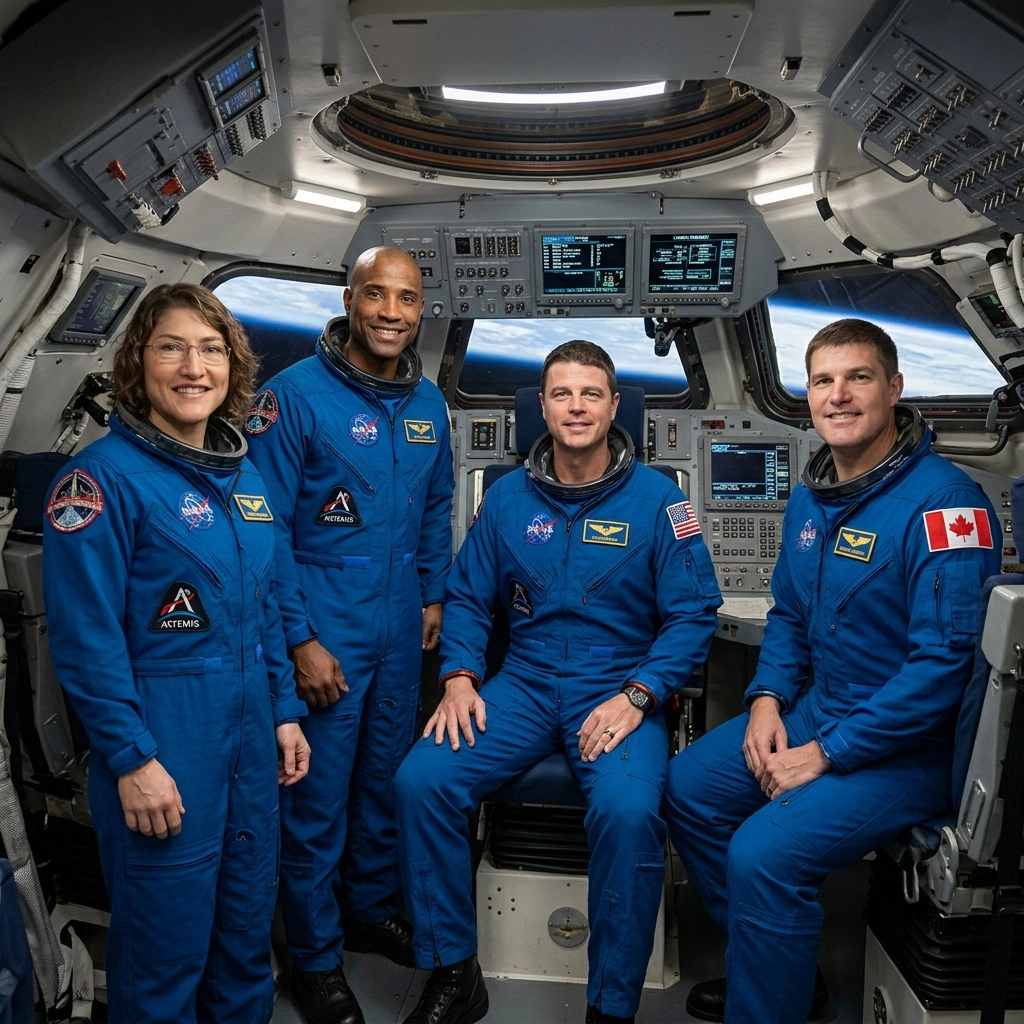
The return to the Moon is no longer a distant dream or a script from a science fiction film. It is a tangible reality being shaped by the Artemis programme. While the uncrewed Artemis I mission proved that the Space Launch System (SLS) and the Orion spacecraft could handle the rigours of deep space, Artemis II represents a massive leap forward. This time, there will be four human beings sitting inside that capsule, feeling the roar of the engines and watching the Earth shrink to a pale blue dot.
At NowPWR, we believe that the best human interest stories often come from the intersection of peak human performance and groundbreaking science. As space exploration enters this new era, independent news outlets play a vital role in bringing the personal side of these missions to the public. Behind the high-tech heat shields and the complex orbital mechanics are four individuals with unique backgrounds, families, and a shared sense of duty. Understanding who they are is just as important as understanding the rocket that will carry them.
The Leaders Guiding the Mission
The responsibility of commanding a mission that will travel further than any human has gone in over half a century falls to Reid Wiseman. A former Naval Aviator, Wiseman was selected as an astronaut in 2009. His career has been defined by a steady hand and a deep understanding of the technical demands of spaceflight. Having previously spent 165 days aboard the International Space Station (ISS) during Expedition 40/41, he is no stranger to the weightless environment.
During his time on the ISS, Wiseman became known for his ability to communicate the wonder of space through photography and social media, making the experience accessible to those of us back on the ground. This commitment to transparency and education aligns perfectly with the goals of contemporary initiatives that seek to inspire the next generation of scientists and engineers. After returning from his first mission, he served as the Chief of the Astronaut Office, a role that gave him an unparalleled view of the entire NASA corps and the preparation required for the Artemis era.
Sitting beside him in the pilot’s seat is Victor Glover. Selected in NASA’s 21st astronaut class in 2013, Glover’s journey to the Moon is a historic one, as he will be the first Black man to fly beyond low Earth orbit. Glover is a seasoned pilot with a background in flight testing, which is a critical skill set for a mission that is essentially a high-stakes test flight of the Orion spacecraft’s life support and manual control systems.
In 2020, Glover served as the pilot for the SpaceX Crew-1 mission, the first operational flight of the Crew Dragon. His 167 days in space provided him with the operational experience necessary to handle the complexities of the Artemis II mission profile. Glover’s presence on the crew highlights the progress made in diversifying the ranks of those who represent humanity in the stars. A closer look at how these teams are assembled reveals a conscious effort to ensure the crew reflects the world they leave behind.
Trailblazers and New Frontiers
Joining Wiseman and Glover are two mission specialists who bring extraordinary expertise to the table. Christina Hammock Koch is a name that has already been etched into the history books. An electrical engineer and physicist by training, Koch holds the record for the longest single spaceflight by a woman, a staggering 328 days. During that time, she participated in the first all-female spacewalk, a moment that resonated far beyond the aerospace industry.
Koch’s background is rooted in some of the most challenging environments on Earth. Before becoming an astronaut, she worked at remote research stations in the Arctic and Antarctic, honing the resilience and problem-solving skills that are essential when you are thousands of miles away from help. On Artemis II, she will be the first woman to travel to the lunar vicinity. Her role as a mission specialist involves monitoring the spacecraft’s complex systems and ensuring that the scientific objectives of the ten-day flight are met. Her story is a testament to the power of perseverance, often highlighted by independent news outlets that focus on individual achievement within massive global projects.
The fourth member of the crew is Jeremy Hansen, representing the Canadian Space Agency (CSA). Hansen’s inclusion is a landmark moment for international cooperation in space. He will be the first non-American to travel to the Moon, a feat made possible by the strong partnership between NASA and the CSA. Although Hansen is the only member of the Artemis II crew who has not yet flown in space, his preparation has been exhaustive.
A colonel in the Royal Canadian Air Force, Hansen has spent years in leadership roles within NASA’s astronaut training programme. He has managed the schedules of his peers, overseen simulation environments, and worked extensively on the ground to support ISS operations. His selection is not just a win for Canada but a signal to the international community that the return to the Moon is a global endeavour. The collaborative nature of this mission often touches on themes of global unity, much like the collective action seen in environmental campaigns or international climate agreements. Hansen’s role is to ensure that the Canadian contribution to the Artemis programme: including future robotics like the Canadarm3: is well-integrated into the mission’s success.
The Journey and the Orion Spacecraft
The mission itself is a meticulously planned ten-day journey that begins at Launch Complex 39B at the Kennedy Space Center. The four astronauts will be perched atop the SLS rocket, the most powerful launch vehicle ever built. Once they reach orbit, the crew will spend the first two days performing a series of checkouts to ensure the Orion spacecraft is fully functional and capable of supporting human life in the deep space environment.
The most critical part of the mission begins when they leave Earth's orbit and head toward the Moon. Unlike the Apollo missions, which entered lunar orbit, Artemis II will follow a "free return" trajectory. This means the spacecraft will use the Earth and Moon’s gravity to naturally swing back home after passing around the far side of the Moon. At its furthest point, the crew will be approximately 4,600 miles beyond the lunar surface, providing them with a view of the Moon and the Earth that very few have ever witnessed.
This mission is a vital step toward the eventual goal of establishing a long-term human presence on the lunar surface and, eventually, Mars. The data gathered during these ten days will inform how NASA and its partners approach Artemis III, which aims to land the first woman and the next man on the lunar South Pole. For those who follow climate issues and the preservation of our own planet, the "overview effect": the cognitive shift reported by astronauts when seeing Earth from space: often reinforces the need for better stewardship of our home world.
As the crew returns to Earth, they will face the ultimate test: re-entering the atmosphere at speeds of 25,000 miles per hour. The heat shield must withstand temperatures that are half as hot as the surface of the sun before the parachutes deploy for a splashdown in the Pacific Ocean. While the technology is impressive, the human element remains the most compelling part of the story. These four individuals are carrying the hopes and curiosities of billions of people.
In a world filled with complex challenges, the Artemis II mission serves as a reminder of what can be achieved through cooperation, scientific rigour, and a touch of human bravery. Whether you are following the technical updates or the personal journeys of Wiseman, Glover, Koch, and Hansen, this mission is a defining moment for the 21st century. Through human interest stories and the dedicated reporting of independent news outlets, we can all feel a little closer to the stars.
The Artemis II mission marks a significant milestone in human spaceflight, testing the systems and skills necessary for long-term lunar exploration. By profiling the crew and outlining the mission’s objectives, we gain a clearer understanding of the risks and rewards inherent in venturing beyond our home planet. As the 2026 launch date approaches, the focus remains on the four individuals who will lead the way into this new frontier of discovery.