





A catastrophic collision on the tarmac at New York’s LaGuardia Airport has claimed the lives of two commercial pilots, sending shockwaves through the aviation industry and prompting an urgent federal investigation.
The incident occurred during the busy evening peak when a regional jet, taxiing toward its designated gate after a routine landing, struck a heavy-duty maintenance truck at high speed.
Eyewitnesses described a scene of immediate chaos as emergency lights flooded the airfield and ground operations came to a sudden, grinding halt.
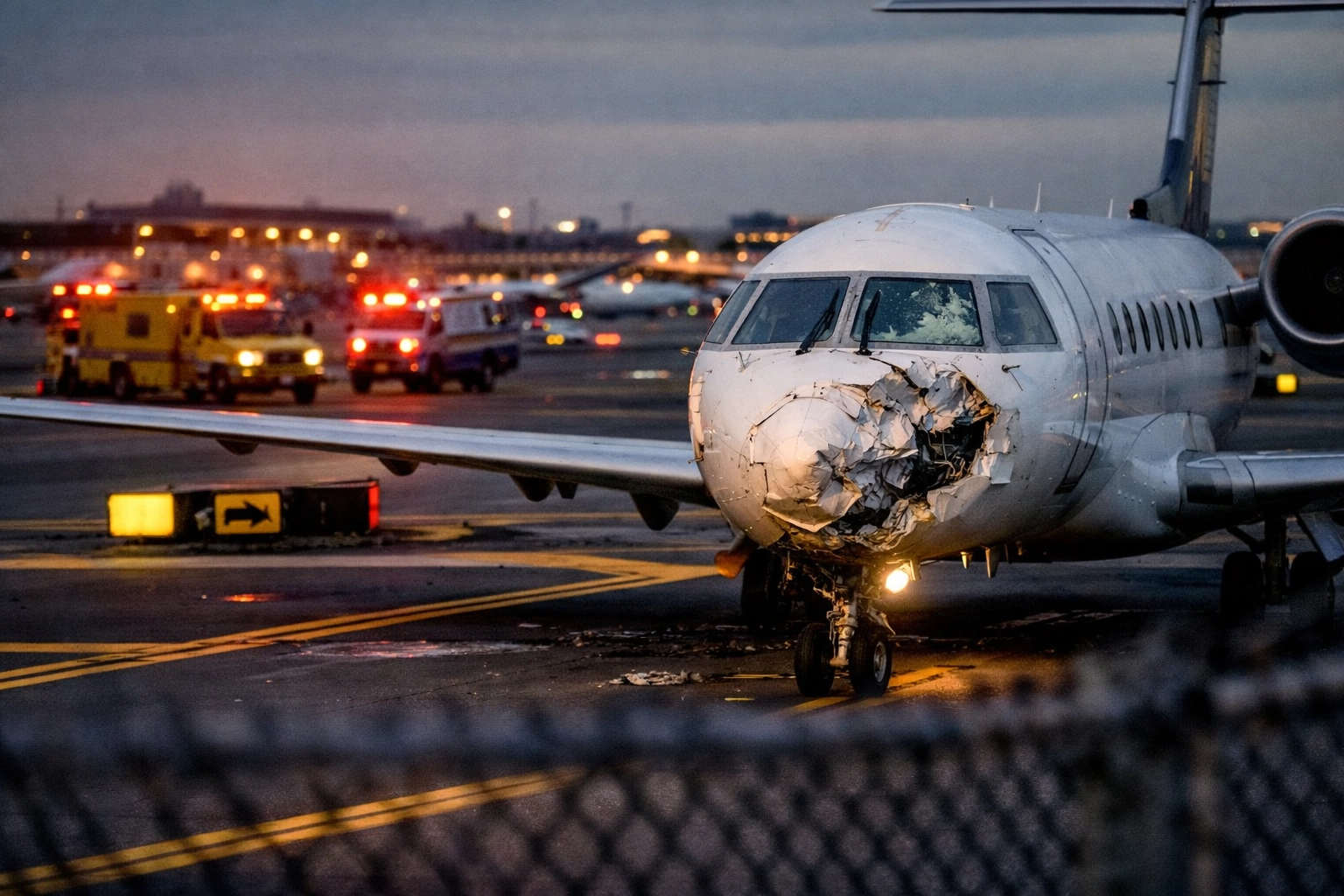
The impact was centred on the cockpit of the aeroplane, resulting in fatal injuries to the captain and the first officer, while the driver of the maintenance vehicle remains in a critical condition at a local hospital.
This rare and deadly ground incursion has raised immediate questions regarding the coordination of ground traffic at one of America's most congested transport hubs.
Emergency Response and Initial Findings
First responders from the Port Authority Police Department and the New York City Fire Department arrived at the scene within ninety seconds of the initial distress call.
The aircraft, a twin-engine regional jet, sustained significant structural damage to its nose section, with the aluminium fuselage torn open by the force of the heavy vehicle.
Rescue crews worked through the night to stabilise the wreckage and ensure there was no risk of a secondary fire from leaking aviation fuel.
Initial reports from the Federal Aviation Administration indicate that the maintenance truck was authorised to be on the airfield but may have inadvertently crossed into a restricted taxiway zone.
The National Transportation Safety Board has dispatched a "go-team" from Washington D.C. to lead the investigation into the mechanical and human factors that contributed to the tragedy.
Investigators are currently reviewing black box data, including the Cockpit Voice Recorder, to determine the final communications between the pilots and the control tower.
Ground radar data is also being analysed to establish the exact movements of both the aeroplane and the truck in the minutes leading up to the impact.
The airport remained closed for several hours following the crash, leading to hundreds of cancellations and thousands of passengers being stranded across the United States.
A temporary morgue was established near the hangar area as authorities worked to formally identify the deceased and notify their next of kin.
Labour unions representing airline staff have expressed deep concern over the safety protocols currently in place for ground support equipment.
They have called for an immediate review of visibility standards and lighting requirements for all non-aviation vehicles operating within the movement area.
The weather at the time of the collision was reported as clear, though some pilots have noted that the setting sun can create challenging glare at certain angles on the LaGuardia runways.
This specific environmental factor will be a key component of the NTSB’s final report, which is expected to take several months to complete.
In the interim, the debris has been cleared and moved to a secure facility for further forensic examination by aeronautical engineers.
Operational Failures and Safety Protocols
LaGuardia Airport has long been criticised by pilots and safety experts for its cramped layout and the complex intersection of its taxiways and runways.
The geographic constraints of the site, bordered by water on three sides, mean that ground movements are managed with razor-thin margins for error.
This latest fatality highlights the inherent risks associated with mixing heavy commercial aircraft with smaller, faster-moving ground service vehicles.
Safety protocols dictate that all ground vehicles must be equipped with transponders and high-intensity strobe lights to remain visible to both pilots and air traffic controllers.
Investigators are looking into whether the maintenance truck’s signalling equipment was fully operational at the time of the accident.
There are also questions regarding the training and certification of ground crew members who are tasked with navigating the airfield’s high-stakes environment.
Aviation safety expert Sir Alastair Graham noted that ground incursions have become a primary focus for international aviation bodies in recent years.
"While mid-air collisions are now exceptionally rare due to advanced technology, the 'last mile' of a flight: the taxi to the gate: remains a zone of high human variability," he stated.
The FAA has been under pressure to accelerate the rollout of the Airport Surface Detection Equipment, Model X, which is designed to prevent such accidents.
However, the implementation of these advanced radar systems has been delayed at several major airports due to budget constraints and technical challenges.
The investigation will also probe the workload and fatigue levels of the air traffic controllers on duty during the evening shift.
Managing the constant flow of departures and arrivals at LaGuardia requires intense concentration, and even a brief lapse in communication can have fatal consequences.
The NTSB will examine the radio transcripts to see if there was any ambiguity in the instructions given to the pilots or the driver of the maintenance truck.
In many previous ground accidents, non-standard phraseology or "read-back" errors have been identified as a root cause of the confusion.
Furthermore, the design of the maintenance truck itself will be scrutinised to see if its height and weight contributed to the severity of the cockpit breach.
Modern safety standards for airport vehicles are supposed to include "break-away" components, but heavy-duty snow-clearing or repair trucks often lack these features.
The aviation industry is now bracing for a series of new mandates that could fundamentally change how ground operations are conducted during peak hours.
The Human Cost and Aviation Impact
Beyond the technical failures and the logistical disruption, the deaths of two experienced aviators have left a profound void in the aviation community.
The captain was a veteran with over fifteen thousand hours of flight time, known for his mentorship of junior pilots and his impeccable safety record.
His first officer was a rising star in the industry, having recently completed advanced training for long-haul operations.
Colleagues described the pair as a highly professional crew who were well-regarded for their calm demeanour and skilful handling of the aircraft.
Memorial services are being planned in their respective home cities, with many pilots expected to attend in full uniform to honour their fallen comrades.
The tragedy serves as a sobering reminder of the dangers that persist in an industry that often prides itself on being the safest mode of transport in the world.
For the families of the victims, the focus is now on seeking answers and ensuring that such a lapse in safety never occurs again.
The legal implications of the crash are also beginning to surface, with several firms specialising in aviation law already monitoring the NTSB’s progress.
Damages resulting from the loss of life and the destruction of the airframe are expected to run into the tens of millions of dollars.
However, the more lasting impact will be the potential loss of public confidence in the ground safety measures of major metropolitan airports.
Travelers at LaGuardia the following morning were met with a somber atmosphere and heightened security presence as the airport returned to limited operations.
Industry analysts suggest that this event could lead to a permanent change in how maintenance is scheduled, perhaps restricting heavy vehicle movement to late-night hours.
Such a shift would have a significant knock-on effect on the efficiency of airport maintenance and the overall cost of operations.
The global aviation community is watching the New York investigation closely, as the lessons learned here will likely be applied to airports in London, Paris, and Tokyo.
Ground safety is a universal challenge, and the data gathered from the wreckage at LaGuardia will inform the next generation of safety software.
As the sun rose over the East River the day after the crash, the silhouette of the damaged jet served as a grim monument to the risks of the runway.
For now, the investigation continues, with the primary goal of turning this tragedy into a catalyst for systemic change across the globe.
The aviation sector remains committed to the principle of "zero accidents," a goal that seems momentarily distant in the wake of this fatal collision.
The final report will ultimately be the document that determines the legacy of this dark day in New York’s aviation history.