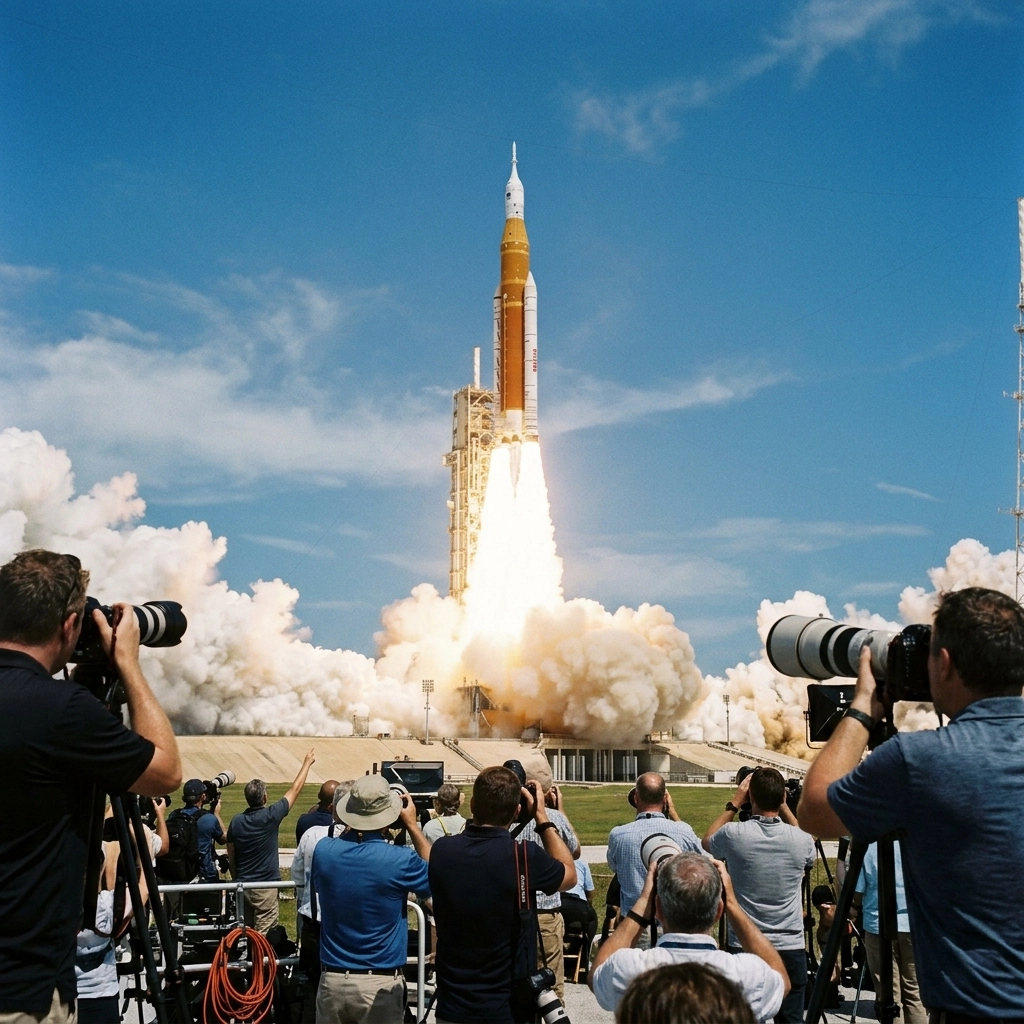
The rumble that shook the Florida coastline on the 1st of April 2026 was more than just the ignition of a massive rocket; it was the sound of a new era in human history finally finding its voice. After decades of looking at the Moon through telescopes and grainy archival footage from the 1960s, humanity is officially back in the lunar neighbourhood. The Artemis II mission, NASA’s first crewed voyage to the Moon in over fifty years, has successfully cleared Earth’s orbit and is currently hurtling through the void towards our celestial neighbour.
The atmosphere at the Kennedy Space Centre was electric, a mixture of high-stakes tension and the kind of pure, unadulterated excitement that only space exploration can generate. For those watching from the beaches of Cape Canaveral or via live streams across the globe, the sight of the Space Launch System (SLS) rocket piercing the twilight sky was a reminder of what can be achieved when global talent converges on a single, monumental goal. This isn't just a technical exercise; it is a deeply human endeavour, filled with personal sacrifices and the quiet determination of thousands of individuals working behind the scenes.
The human interest stories behind the crew
At the heart of this mission are four individuals who have become the face of modern exploration. Commander Reid Wiseman, Pilot Victor Glover, and Mission Specialists Christina Koch and Jeremy Hansen are not just elite pilots and scientists; they are the protagonists of modern human interest stories that resonate far beyond the confines of a cockpit. Each brings a unique perspective to the Orion spacecraft, which has been aptly named Integrity.
Christina Koch, who already holds the record for the longest single spaceflight by a woman, represents a bridge between the grit of early exploration and the sophisticated science of the modern age. Her presence on the mission is a testament to endurance and the breaking of glass ceilings that have existed since the dawn of the space race. Meanwhile, Victor Glover’s role as the pilot marks a historic milestone as the first person of colour to embark on a lunar mission. His journey from naval aviator to lunar pioneer is the kind of narrative that inspires the next generation of engineers and dreamers in classrooms across the world.
Then there is Jeremy Hansen, the Mission Specialist from the Canadian Space Agency. His inclusion highlights the international flavour of the Artemis programme. It isn't just a NASA victory; it’s a global one. For Hansen, the mission represents years of waiting and training, often in the shadows of larger programmes, waiting for the moment when Canada would take its place in deep space. The camaraderie between these four is evident in every transmission. They aren't just colleagues; they are a tight-knit unit tasked with the incredible responsibility of ensuring that the Orion spacecraft performs exactly as it was designed to do under the most extreme conditions imaginable.
Solving the technical puzzles of the launch
While the launch itself looked flawless to the casual observer, the hours leading up to the "go" command were fraught with the kind of high-stakes drama that rarely makes the evening news. This mission is a collection of untold stories involving engineers who have spent the better part of a decade preparing for every possible contingency. On the day of the launch, a brief but significant technical challenge arose with the Flight Termination System (FTS). In a world dominated by cutting-edge digital technology, the solution actually came from a surprising source: legacy equipment from the Space Shuttle era.
The ability of the ground crew to pivot and utilise tried-and-tested hardware to solve a modern problem is a fascinating look at the "MacGyver-like" ingenuity that still exists within NASA’s walls. It proves that while we are looking toward the future, the lessons and tools of the past still hold immense value. Once the FTS issue was resolved, the countdown proceeded with a precision that was almost poetic. At 6:35 p.m. EDT, the SLS roared to life, generating 8.8 million pounds of thrust and lighting up the evening sky with a brilliance that could be seen for hundreds of miles.
The mission hit its next major milestone on Flight Day 2. The crew successfully executed the translunar injection (TLI) burn, a critical manoeuvre that involved firing the Orion’s main engine for 5 minutes and 50 seconds. This burn provided the necessary velocity to break free from Earth's gravitational pull and set the spacecraft on a trajectory toward the Moon. Reaching this stage is a massive relief for the teams at Mission Control in Houston. It signifies that the most volatile part of the journey is behind them, and the spacecraft is now performing as a true deep-space vessel. The Orion is no longer just a craft in orbit; it is a traveller in the vast expanse between worlds.
The untold stories of global collaboration
As the Orion spacecraft continues its ten-day journey, it is worth reflecting on the sheer scale of the effort required to get to this point. The Artemis programme is often framed as a successor to Apollo, but the reality is far more complex. Where Apollo was a product of the Cold War and intense national competition, Artemis is built on a foundation of international cooperation. From the European Service Module that powers the Orion to the robotic contributions from Japan and the lunar gateway components being developed in various corners of the globe, this is a truly terrestrial effort to leave the nest.
There are untold stories in the factories in northern England, the research labs in Germany, and the assembly plants in Ontario. Thousands of people who will never see their names in a headline have spent years perfecting the seals on the hatch, the code in the navigation computers, and the nutritional balance of the crew’s meals. These human interest stories are the engine of the mission. When we see the stunning images of the Earth receding in the Orion’s windows, we are seeing the result of millions of hours of collective labour and a shared belief in the value of exploration.
The significance of Artemis II cannot be overstated. It is the final "flight test" before NASA attempts to land humans back on the lunar surface with Artemis III. Everything the crew does over the next week: testing the life support systems, evaluating the communication delays, and monitoring the radiation levels: will provide the data necessary to ensure that future landings are safe and sustainable. The mission also serves as a critical stepping stone for the eventual journey to Mars. By learning how to live and work in the lunar environment, we are developing the skills required to navigate the much longer and more hazardous path to the Red Planet.
The journey home will be just as harrowing as the launch. The Orion spacecraft will have to survive a high-speed re-entry into Earth’s atmosphere, hitting speeds of nearly 25,000 miles per hour and enduring temperatures twice as hot as molten lava. But for now, the world can take a moment to celebrate. The successful launch of Artemis II is a reminder that even in a world often focused on its divisions, we are still capable of coming together to achieve something truly magnificent. The Moon is no longer a distant, unreachable orb; it is a destination once again.
The mission is proceeding as planned, with the crew reporting that the Orion spacecraft is handling beautifully in the deep space environment. As they approach the lunar far side, they will become the first humans to see that rugged, cratered landscape with their own eyes since 1972. It is a moment of profound historical symmetry, marking the end of a long hiatus and the beginning of a permanent human presence in deep space. The success of Artemis II confirms that the SLS and Orion are ready for the challenges ahead, and that the dream of walking on other worlds is very much alive.