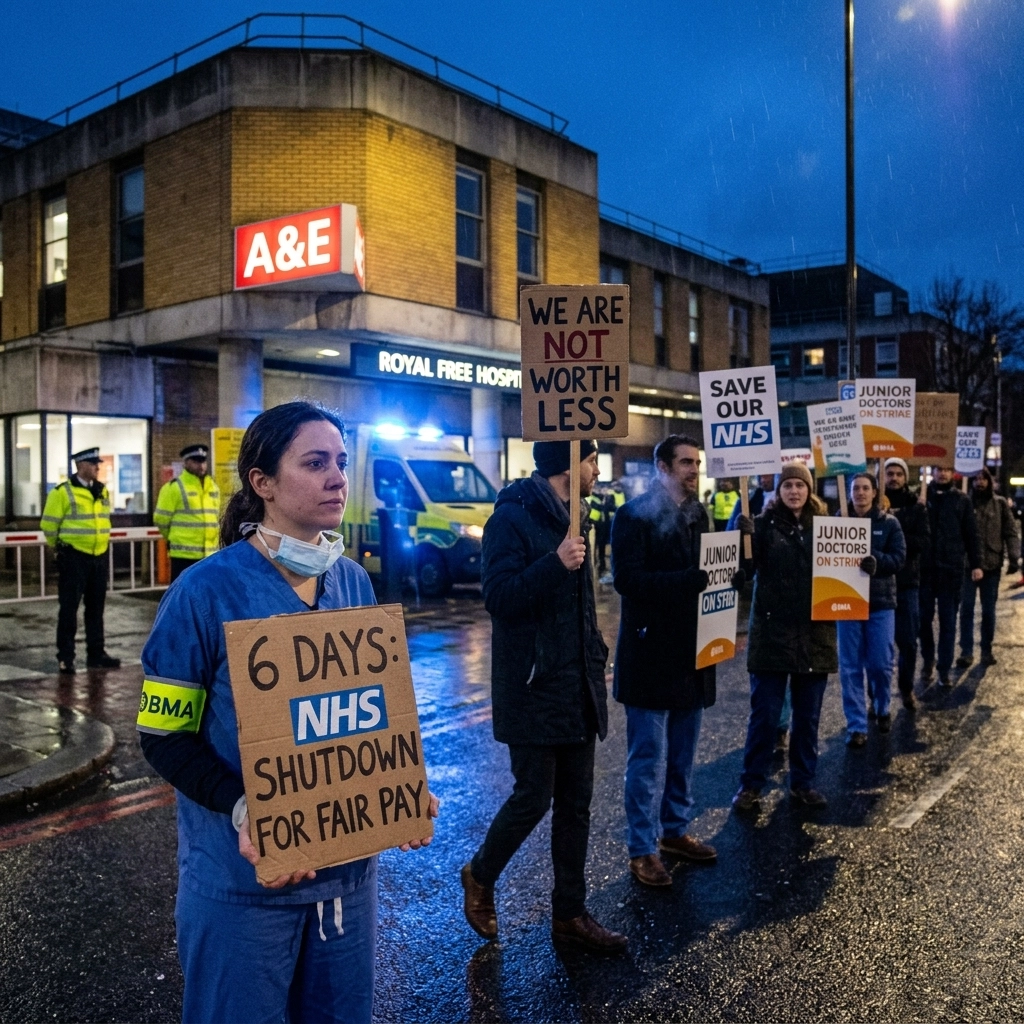
The National Health Service is bracing for one of its most significant challenges yet as a fresh wave of industrial action has been officially confirmed. Following a breakdown in high-stakes negotiations between the government and medical representatives, resident doctors across England are set to walk out for six consecutive days this April. The announcement marks a significant escalation in the ongoing dispute over pay, working conditions, and the long-term sustainability of the medical profession within the UK. For patients and staff alike, the coming weeks promise a period of intense pressure and logistical complexity as the healthcare system attempts to maintain emergency cover while normal services grind to a halt.
The strike action is scheduled to begin at 7am on Tuesday, 7 April, and will continue until 7am on Monday, 13 April. This six-day window represents a substantial block of time that will inevitably lead to the cancellation of thousands of elective procedures and outpatient appointments. While the British Medical Association (BMA) has maintained that the action is a necessary step to protect the future of the NHS workforce, the government has expressed deep disappointment, citing the potential risks to patient safety and the disruption of recovery efforts following the pandemic backlogs.
As the news ripples through the country, many are looking for clarity on why these talks failed and what the specific sticking points were. This latest development is not just a matter of internal NHS policy but a major story in uk political news, reflecting broader tensions between public sector workers and the Treasury. With the dates now set in stone, the focus shifts to how hospitals will cope and whether any last-minute interventions could possibly avert the shutdown.
The Breakdown of Negotiations and Training Disputes
The path to this six-day strike was paved with several weeks of intensive discussions that many hoped would lead to a breakthrough. However, the BMA’s resident doctors committee ultimately determined that the government’s latest offer was insufficient to meet the needs of its members. At the heart of the most recent disagreement was an offer from the Department of Health and Social Care (DHSC) to provide 1,000 additional training places for doctors. While this might sound like a positive step forward, the BMA argued that the proposal "falls short" of the required standard and failed to address the more systemic issues of pay erosion and workplace retention.
In a move that further soured the relationship between the two parties, the government chose to withdraw the offer of those 1,000 training posts almost immediately after the strike dates were announced. The Department of Health stated that the training expansion is no longer "financially or operationally" possible because the BMA decided to proceed with industrial action. This "take it or leave it" approach has been a recurring theme in independent news uk reports, highlighting a growing rift where both sides feel the other is acting in bad faith. The government maintains that they cannot negotiate while strikes are being called, while the union argues that they cannot stop striking until a credible offer is on the table.
Beyond the specific number of training places, the broader context of the dispute remains centred on "pay restoration." Resident doctors have seen their real-terms earnings decline significantly over the last fifteen years, leading to a crisis in morale and an increasing number of qualified medics seeking opportunities abroad or in the private sector. The BMA’s stance is that without a significant correction in pay, the NHS will continue to lose its most valuable asset: its people. The government, on the other hand, points to the need for fiscal responsibility and the inflationary pressures that large-scale public sector pay rises might trigger. This stalemate has resulted in a cycle of walkouts that have now culminated in this planned six-day shutdown.
What the Walkout Means for Patients and Services
The practical implications of a six-day strike are staggering for a health service that is already operating at maximum capacity. Health trusts across the country, particularly in regions like Sussex and Surrey, are already moving into emergency mode to prepare. Contingency plans involve redeploying senior consultants and other healthcare professionals to cover essential services like A&E, intensive care, and maternity wards. While life-preserving care will be maintained, the "shutdown" aspect refers to the almost total cessation of non-urgent activity.
Patients who have been waiting months, or even years, for hip replacements, cataract surgeries, or routine diagnostic tests are likely to see their appointments pushed back once again. This creates a massive administrative burden for the NHS, as staff must work to re-book thousands of slots while simultaneously managing the immediate pressure of the strike period. Independent news uk sources suggest that the cumulative effect of these strikes is making it increasingly difficult for the NHS to hit its targets for reducing waiting lists, which remains a key pillar of current government policy.
In Sussex and Surrey, health leaders have been vocal about the "significant disruption" expected. The timing of the strike, running through a full work week and into the following Monday, means there is very little breathing room for services to recover between the start and the end of the action. People are being urged to use NHS services wisely during this period: visiting pharmacies for minor ailments and using 111 online where possible: to ensure that A&E departments are kept clear for those in genuine life-threatening conditions. The psychological toll on the remaining staff, who must pick up the slack and manage patient frustrations, is also a growing concern for hospital management.
A Broader Look at UK Political News and the Future
From the perspective of uk political news, the 6-day strike is a significant headache for the current administration. Healthcare remains one of the top priorities for the British public, and a prolonged period of industrial action reflects poorly on the government’s ability to manage essential services. There is a delicate balancing act at play: appearing firm on the budget while also appearing compassionate toward the plight of frontline workers. As the strike dates approach, political pressure is mounting on the Health Secretary to return to the table with a revised offer that goes beyond training places and addresses the core issue of remuneration.
The BMA has indicated that it remains open to an improved offer and that the strikes could still be averted if the government shows a genuine willingness to negotiate on pay. However, the recent withdrawal of the training post offer suggests that the Department of Health is currently opting for a more confrontational stance. This tug-of-war is likely to dominate headlines for the next fortnight, as both sides attempt to win the "battle for public opinion." Surveys on public support for the doctors have shown a complex picture, with many people sympathetic to the doctors' demands but increasingly frustrated by the impact on their own healthcare access.
Looking further ahead, the outcome of this April strike will likely set the tone for industrial relations in the NHS for the remainder of the year. If the six-day walkout proceeds without a resolution, it could embolden other sectors or lead to even longer periods of action. For the NHS to move forward, a long-term settlement that addresses recruitment, retention, and fair pay is essential. Until that happens, the cycle of confirmed strikes and emergency contingency planning looks set to continue, leaving the future of the UK’s healthcare system in a state of precarious uncertainty.
The situation remains fluid, and should any further negotiations occur before the April 7th deadline, the schedule could change. However, as it stands, the NHS is preparing for a week of minimal service, and patients are being advised to keep a close eye on communications from their local health trusts. The focus now is on safety, mitigation, and the hope that a middle ground can eventually be found to end this long-running dispute.