





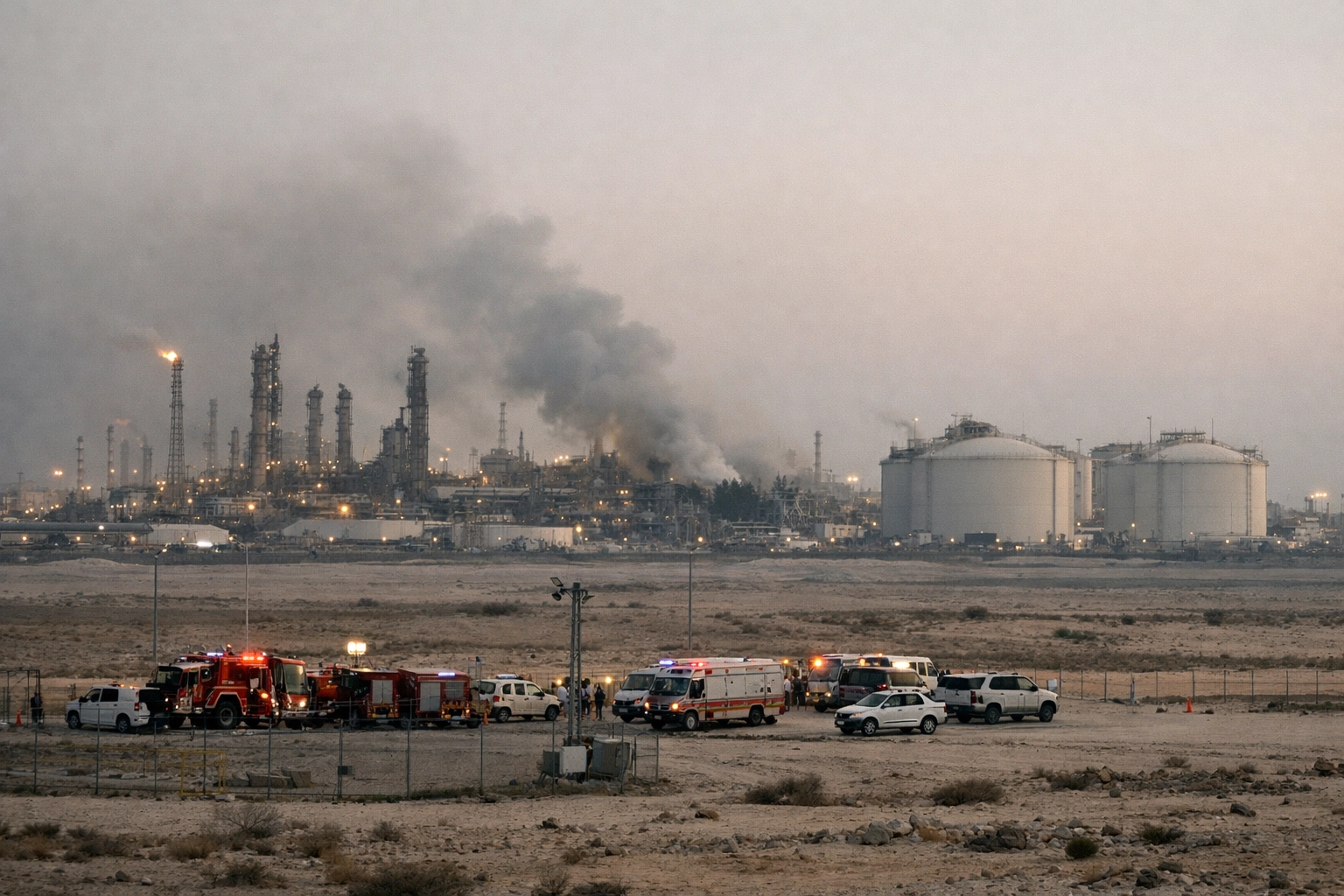
Global energy markets have entered a period of profound instability following a series of Iranian missile strikes on Qatar’s Ras Laffan industrial complex. The attack, which occurred in the early hours of Thursday, 19 March 2026, has successfully disrupted approximately 17 per cent of Qatar’s total liquefied natural gas (LNG) export capacity. For a world already grappling with fragile post-pandemic recoveries and regional instabilities, the sudden removal of a primary energy pillar has triggered immediate panic in the trading pits of London and New York.
The Ras Laffan complex, situated approximately 80 kilometres north of Doha, is the world’s largest LNG export facility. It serves as the beating heart of Qatar’s economy and a critical artery for global energy security. Initial damage assessments suggest that the precision strikes targeted two of the site’s 14 liquefaction "trains": the massive units used to cool natural gas into liquid form for shipping. One gas-to-liquids facility was also reportedly compromised. Analysts suggest the resulting fallout will sideline roughly 12.8 million tonnes of annual output for a period of three to five years.
For the British consumer, the implications are immediate and severe. As Qatar supplies nearly 20 per cent of the world’s LNG, any reduction in its output creates a vacuum that other producers are currently unable to fill. The UK, which has transitioned heavily towards gas-fired power and domestic heating over the last two decades, finds itself particularly exposed to the resulting price volatility on the international spot market.
The supply chain fracture and force majeure
The operational halt at Ras Laffan has forced QatarEnergy to declare force majeure on its entire LNG output. This legal declaration, which allows a company to suspend its contractual obligations due to extraordinary circumstances beyond its control, has sent shockwaves through the capitals of major energy importers. Long-term contracts with nations including Italy, Belgium, South Korea, and China are now effectively in limbo.
The disruption is not limited to natural gas. The Ras Laffan complex is a multi-commodity hub, and the damage has crippled the production of several critical by-products. Condensate production is estimated to be down by 24 per cent, while liquefied petroleum gas (LPG) has seen a 13 per cent reduction. Perhaps most concerning for the high-tech and medical sectors is the 14 per cent drop in helium production. Qatar is one of the few global sources of helium, a gas essential for the cooling of MRI machines and the manufacturing of semi-conductors.
The technical challenges of rebuilding the damaged infrastructure are immense. Modern LNG trains are bespoke pieces of engineering that require specialised components, many of which have lead times extending into years. Experts estimate that the rebuilding costs alone will reach approximately $26 billion (£20.6 billion). Furthermore, the lost annual revenue for Qatar is projected at $20 billion, creating a massive fiscal hole in one of the world's wealthiest energy exporters.
As the smoke clears in the Gulf, the physical reality of the damage is becoming apparent. Satellite imagery confirms that the structural integrity of the storage tanks has been tested, and the surrounding pipelines have sustained significant shrapnel damage. This is not a "quick fix" scenario. The global energy market must now price in a three-to-five-year deficit in supply, a factor that will keep prices elevated well into the latter half of the decade.
Inflationary pressures on the British household
In the United Kingdom, the strike on Ras Laffan has immediate domestic consequences that go beyond the headlines of geopolitical tension. The British economy is highly sensitive to fluctuations in the price of natural gas, which dictates not only the cost of heating homes but also the price of electricity. Following the news of the strikes, Brent crude and natural gas futures spiked by over 15 per cent in a single day of trading, a move that will inevitably filter down to petrol pumps and utility bills.
The Bank of England has already expressed concern regarding the inflationary impact of the energy shock. Inflation, which had shown signs of stabilising, is now expected to face renewed upward pressure. This "cost of living" crisis 2.0 is likely to complicate the central bank’s interest rate strategy. If energy costs drive inflation higher, the Bank may be forced to keep interest rates elevated for longer, increasing the burden on mortgage holders and businesses seeking credit.
UK households are expected to see the impact in three distinct stages. First, the price at the pump: petrol and diesel prices typically respond within days to shifts in global oil benchmarks. Second, the energy price cap: while the cap offers some protection from immediate volatility, the long-term nature of the Ras Laffan disruption means that future adjustments by Ofgem are almost certain to be upwards. Third, food inflation: the cost of transporting goods and the price of energy-intensive farming fertilisers are both tied to gas prices, meaning the weekly shop is set to become more expensive.
The government has reportedly convened a COBRA meeting to discuss energy security and the potential for rationing in extreme scenarios, though ministers have been quick to reassure the public that gas stocks remain sufficient for the immediate future. However, the reliance on the global spot market means the UK will be competing with Asian economies, such as India, which sources 40 per cent of its LNG from Qatar. This competition will drive prices to record highs as nations bid for the remaining available cargoes.
A multi-year roadmap for global energy recovery
The geopolitical ramifications of the strike are as significant as the economic ones. The targeting of Ras Laffan represents a major escalation in Middle Eastern hostilities, drawing a direct line between regional conflict and global economic stability. As the international community weighs its response, the focus in the energy sector has shifted towards resilience and the acceleration of alternative supply routes.
However, diversifying away from Qatari gas is not a task that can be accomplished overnight. While the United States and Australia are significant producers, their capacity is largely tied up in existing long-term contracts. The expansion of LNG infrastructure in North America is underway, but many of these projects are not scheduled to come online until 2027 or 2028. This leaves a "supply gap" that will likely define the global economy for the next several years.
The crisis has also reignited the debate over the pace of the green energy transition. Proponents of renewable energy argue that the Ras Laffan strike is a definitive argument for ending reliance on fossil fuels imported from volatile regions. They suggest that increased investment in domestic wind, solar, and nuclear power is the only way to achieve true energy sovereignty. Conversely, industry advocates point out that gas remains an essential "transition fuel" and that the current crisis necessitates more, not less, investment in gas infrastructure to ensure redundancy.
For the average citizen, the coming months will require a degree of financial agility. With energy costs projected to remain at a premium, the push for energy efficiency in the home: through insulation, heat pumps, and smart technology: is no longer just an environmental concern but a financial necessity. The "Oil Shock" of 2026 serves as a stark reminder of how interconnected the modern world is; a missile strike thousands of miles away can directly dictate the disposable income of a family in Manchester or Birmingham.
As QatarEnergy begins the arduous process of clearing debris and assessing the microscopic damage to its liquefaction units, the world waits. The immediate volatility may subside as the news is "priced in," but the structural deficit remains. The Ras Laffan strike has fundamentally altered the trajectory of the global economy, ensuring that energy security will remain the primary concern of governments and households alike for the foreseeable future. The recovery will be measured not in weeks or months, but in years.