The waters around the United Kingdom have long been central to international trade, but they are now also a pressure point in a much wider sanctions battle. As of April 2026, the British government has moved to let the Royal Navy and UK Special Forces board and potentially detain sanctioned Russian “shadow fleet” vessels in British territorial waters. It is a firmer step from monitoring to direct enforcement, and it shows how seriously ministers are treating the issue.
The English Channel remains one of the busiest shipping routes in the world, and that matters here. Oil tankers travelling between the Baltic and wider markets pass through a narrow, highly sensitive corridor where any security breach, legal dispute or environmental accident could have serious consequences. By authorising military intervention, the UK is trying to make it far harder for sanctioned cargoes to move through these waters without challenge.
The focus is on the so-called shadow fleet: ageing tankers often used to dodge price caps, ownership checks and other restrictions. Many of these ships operate with limited transparency, patchy insurance arrangements and poor maintenance records. That makes this story one of the key untold stories in maritime enforcement right now, because it is not only about geopolitics but also about the practical risks posed to British waters.
The Mechanics of the Shadow Fleet and the War Machine
The shadow fleet has become a major workaround for sanctions. These vessels often rely on ship-to-ship transfers, frequent flag changes and periods with tracking systems switched off, all of which make movements harder to follow. In global news coverage, the phrase now points to a loose but effective network designed to keep oil moving while avoiding the normal financial and regulatory systems that govern international shipping.
That creates a genuine risk for the UK. Older tankers moving through narrow routes without standard protection and indemnity cover raise the stakes for everyone nearby. If there were a collision, grounding or spill in the Channel, the clean-up burden could quickly fall on Britain and neighbouring states. That concern helps explain why the government has chosen a more active posture instead of simply watching from the sidelines.
The legal issue is also important. Sanctioned ships may be barred from British ports, but passage through the Channel has often sat in a grey area because of international rules around innocent passage. By preparing to board vessels suspected of sanctions breaches, the UK is signalling that British waters will not be treated as an easy route for workarounds. It is a serious move, but one aimed at raising the cost and difficulty of keeping the shadow fleet in business.
Tactical Training and the Risks of Boarding Operations
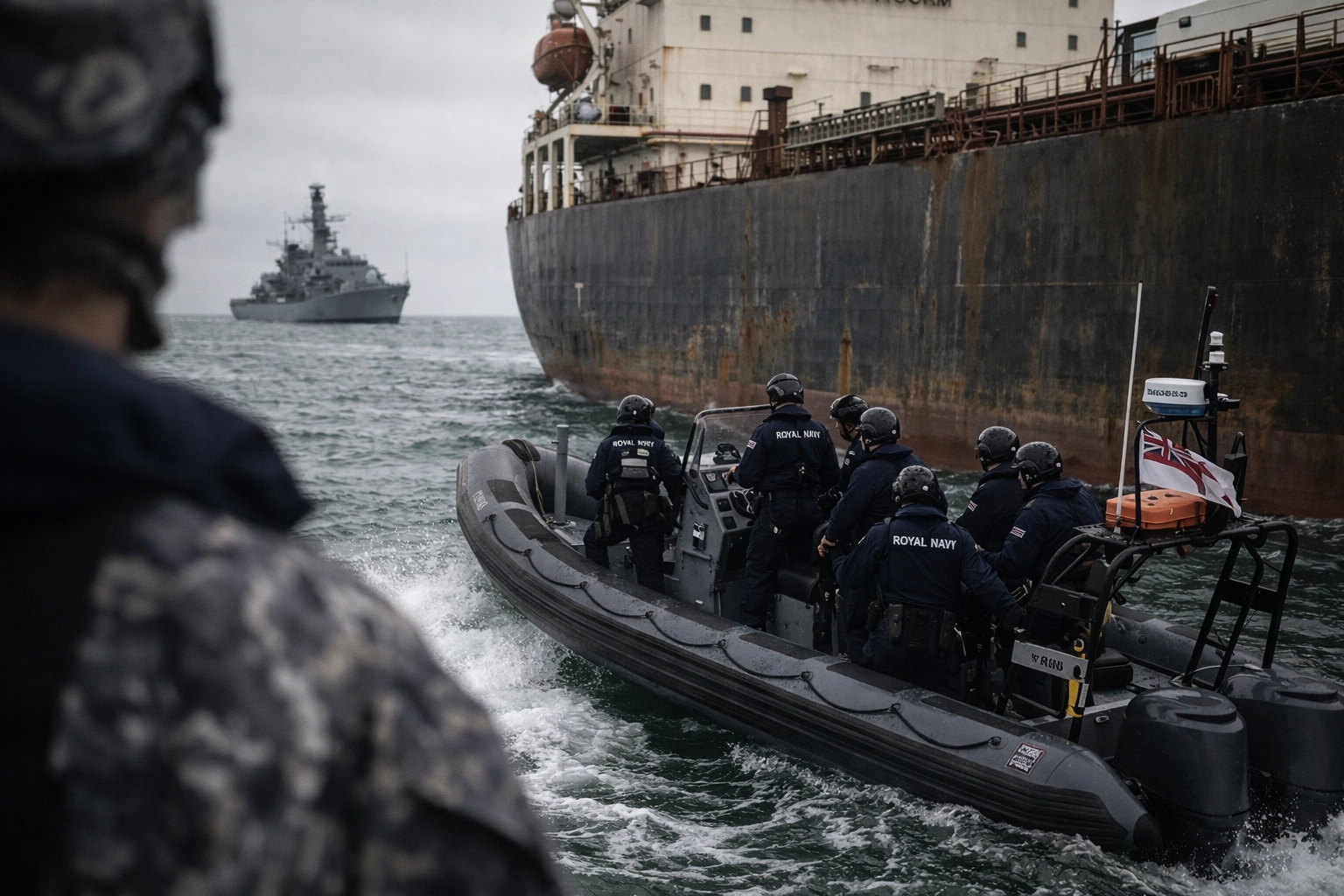
Boarding an oil tanker at sea is not straightforward. Royal Navy and Royal Marines teams have reportedly trained for Visit, Board, Search and Seizure operations that can involve helicopters, rigid inflatable boats and fast-moving decisions on deck. These missions require precision and calm judgement, especially when crews are uncooperative or when the legal threshold for action has to be clearly met in real time.
There are risks beyond the boarding itself. Crews may resist, communication systems can fail, and every operation has to be assessed for diplomatic as well as operational consequences. That is why each case is expected to go through intelligence review, legal checks and ministerial approval before any action is taken. The aim is to stay measured rather than dramatic, even if the headlines sound sharp.
This selective approach is likely to define the policy. The Royal Navy is not expected to stop every sanctioned vessel that enters British waters. Instead, enforcement will focus on ships judged to present the clearest sanctions links or the biggest safety and environmental concerns. For readers following independent news uk, that matters because the real story is not spectacle but the steady tightening of pressure on routes that had previously remained difficult to police.
A Selective Strategy in the Channel’s Game of Cat and Mouse
The strategy in the Channel is likely to remain a game of cat and mouse. Intelligence-led enforcement gives the UK flexibility, while the visible possibility of a boarding can act as a deterrent on its own. Even if only a limited number of vessels are physically stopped, the wider effect can still be significant if insurers, operators and crews begin to see these journeys as too risky.
That financial pressure may end up being just as important as the military side. Once boarding becomes a realistic possibility, insurance premiums can rise, crews can become harder to recruit and operators may find that the economics of evasion no longer stack up. In that sense, the policy is about disrupting systems, not just intercepting individual ships.
For the UK, the move reflects a broader attempt to use maritime geography as leverage. Britain sits beside one of the world’s most important shipping corridors, and that gives it a practical role in sanctions enforcement that few other countries can match. The policy also shows how security, trade and environmental protection increasingly overlap in the same space. The message is clear enough: British waters are being treated as a place for enforcement, not a quiet passage for sanctioned shipping.