








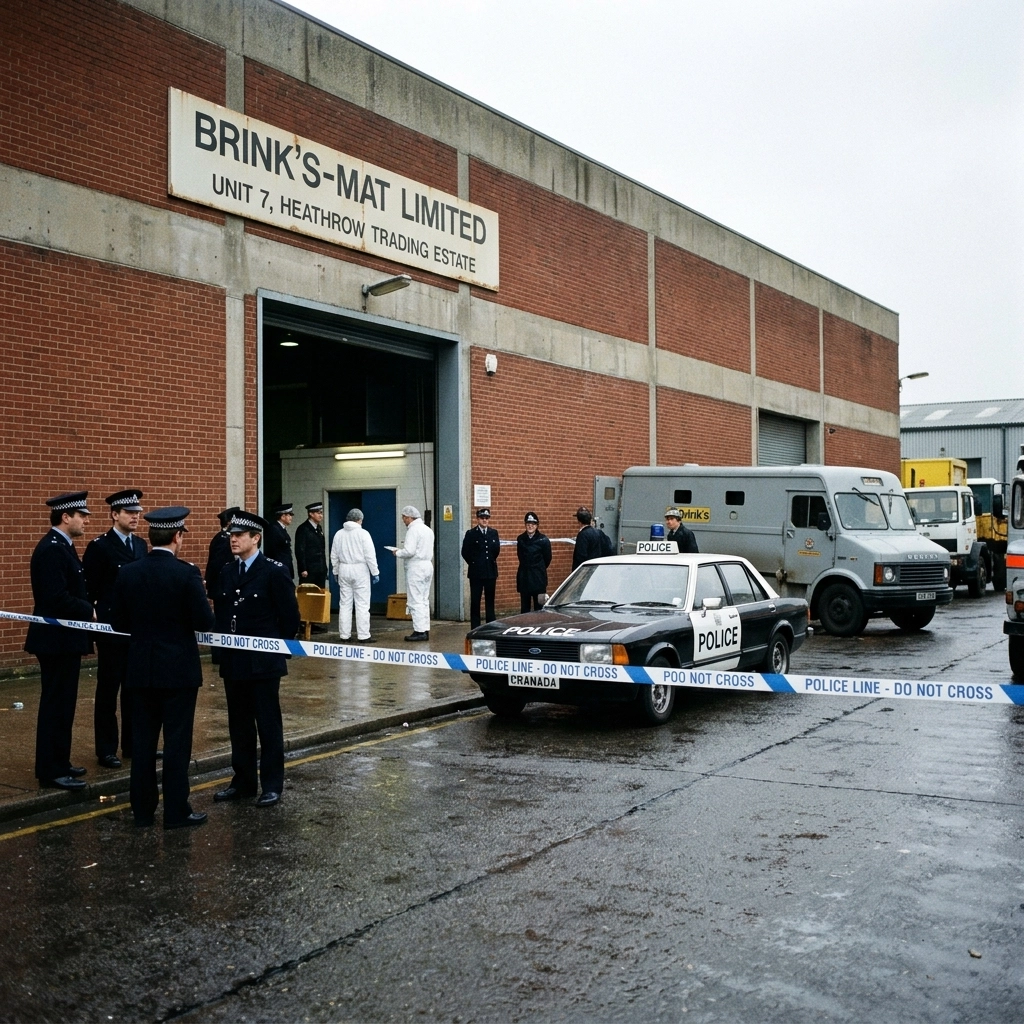
It was a cold, unassuming Saturday morning on November 26, 1983, when six men in balaclavas changed the course of British criminal history. At the Heathrow International Trading Estate, just outside the perimeter of one of the world's busiest airports, a security warehouse owned by Brink's-Mat became the stage for what would be dubbed the "crime of the century." The intruders weren't expecting to make history; they were looking for a quick win. Rumour had it there was about £1 million in Spanish pesetas waiting in the vault. Instead, they stumbled upon three tonnes of pure gold bullion.
The scale of the haul was staggering. We aren't talking about a few bags of coins; we are talking about 6,800 bars of 24-carat gold, along with diamonds and cash, totalling a value of £26 million at the time. In today’s money, that is comfortably over £100 million. The robbers were so overwhelmed by the sheer weight and value of the stolen gold that they actually had to spend extra time figuring out how to move it. This wasn't just a heist; it was a logistical nightmare that would spark a decades-long search and leave a trail of blood, mystery, and untold stories across the globe.
To this day, the Brink's-Mat heist remains a fascination for those following independent news uk and true crime enthusiasts alike. It wasn't just the robbery itself that captivated the public, but the impossible question that followed: how do you hide three tonnes of gold? As the police began their desperate hunt, they quickly realised they weren't just dealing with common thieves, but a sophisticated network of launderers and villains who were about to change the face of the UK's black market forever.
The Night That Changed British Crime Forever
The entry into Unit 7 of the Heathrow International Trading Estate was surprisingly simple, thanks to an "inside man." Anthony Black, a security guard at the facility, was the brother-in-law of one of the architects of the robbery, Brian Robinson. Black let the gang in just after 6:30 am. Once inside, the gang showed a level of ruthlessness that set the tone for the investigation. They poured petrol over the security guards and threatened them with a lit match if they didn't provide the combinations to the vault.
The sheer volume of the stolen gold presented an immediate problem for the gang, led by Robinson and Micky McAvoy. Gold is incredibly heavy, and three tonnes is not something you can just throw into the back of a standard getaway car. They had to use a transit van that was barely up to the task, the suspension groaning under the weight of the bullion. By the time the alarm was finally raised, the gang and their golden cargo had vanished into the morning mist of suburban London.
The police investigation, known as Operation Badger, was one of the most intense in British history. Detectives were under immense pressure to recover the bullion before it could be moved out of the country. However, the thieves had a head start, and the gold was already being moved through a series of "safe houses." The betrayal by Anthony Black was eventually uncovered, leading the police to Robinson and McAvoy. Within months, both were behind bars, sentenced to 25 years each. But the victory for the police was hollow. While they had the men who pulled the trigger and held the petrol, they didn't have the gold. The three tonnes of bullion had effectively evaporated.
Laundering Gold and the Melting Pot Strategy
With the primary robbers in prison, the focus shifted to the "disposal" team. This is where the story moves from a simple robbery into a complex web of financial crime and alchemy. Enter Kenneth Noye, a man whose name would become synonymous with the Brink's-Mat legacy. Noye was a master of the "melting pot." He realised that if you want to sell stolen gold, you have to make it unrecognisable.
Noye, along with a network of associates including a gold dealer named John Palmer, set up a sophisticated smelting operation in a garden shed in Kent. They didn't just melt the bars; they mixed them with copper coins to change the purity and the "fingerprint" of the gold. By the time they were finished, the 24-carat bullion belonging to Johnson Matthey Bankers Ltd was disguised as lower-grade scrap gold. This "new" gold was then funnelled back into the legitimate market through various assay offices and gold dealers.
The audacity of the scheme was remarkable. Because the gold was being sold back into the legitimate market, there is a very high probability that if you bought gold jewellery in the UK during the late 80s or 90s, you are wearing a piece of the Brink's-Mat haul. The laundering process was so successful that it is estimated the gang managed to process nearly half of the three tonnes through these channels. The money generated from these sales didn't just sit in bank accounts; it flooded into the London property market. Much of the development in the London Docklands during the 1980s property boom is rumoured to have been funded, indirectly or directly, by the proceeds of the heist.
The investigation into Noye led to one of the most controversial moments in the saga. During a police surveillance operation at his home, Noye discovered an undercover officer, DC John Fordham, in his grounds. In the ensuing struggle, Noye stabbed and killed the officer. Remarkably, Noye was acquitted of murder on the grounds of self-defence, though he was later convicted for his role in handling the stolen gold. The "Goldfinger" moniker he earned was a testament to his ability to turn stolen metal into untraceable wealth, but it also highlighted the lethal stakes involved in the hunt.
The Legacy of the Three-Tonne Mystery
As we look back on the Brink's-Mat heist decades later, the mystery of the missing gold remains one of the most compelling untold stories in British history. While Robinson, McAvoy, and Noye all served time, the vast majority of the gold has never been found. It is widely believed that about two tonnes of the bullion were never smelted or sold through Noye’s network. Instead, it was likely buried, moved abroad, or hidden in plain sight through complex offshore accounts that the technology of the 1980s simply couldn't track.
The "curse" of the Brink's-Mat gold is another layer of the legend. Over the years, dozens of people associated with the heist or the laundering of the proceeds have met violent ends. From the shooting of jeweller Solly Nahome in 1998 to various other gangland executions, the stolen gold seemed to bring nothing but misery to those who touched it. The search for the remaining bars continues to haunt investigators, but as time passes, the trail grows colder. The gold has likely been recycled so many times that its original form is gone forever, living on in wedding rings, dental fillings, and electronics across the globe.
The heist changed the way the UK handled high-value security and how the police approached organised crime. It led to the collapse of Johnson Matthey Bankers, who were unable to absorb the loss and the subsequent financial scandals. Today, the Brink's-Mat story serves as a reminder of a different era of crime: one of balaclavas, physical bullion, and the sheer audacity of six men who thought they could get away with stealing three tonnes of the world's most precious metal.
The hunt for the stolen gold may never truly end, as the legend of the Heathrow heist continues to be retold in books, documentaries, and news reports. It remains the benchmark against which all other robberies are measured, a heist of such proportions that it literally changed the weight of the British economy for a time. Whether the remaining gold is buried in a Kentish field or sitting in a Swiss vault, the story of Brink's-Mat is a permanent fixture in the annals of British history.
The Brink's-Mat robbery was more than just a theft; it was a cultural event that exposed the vulnerabilities of the financial system and the lengths to which individuals would go for unimaginable wealth. As we continue to uncover the details of this massive operation, the fascination with the missing three tonnes shows no signs of fading. It is a story of greed, betrayal, and a mystery that may never be fully solved.