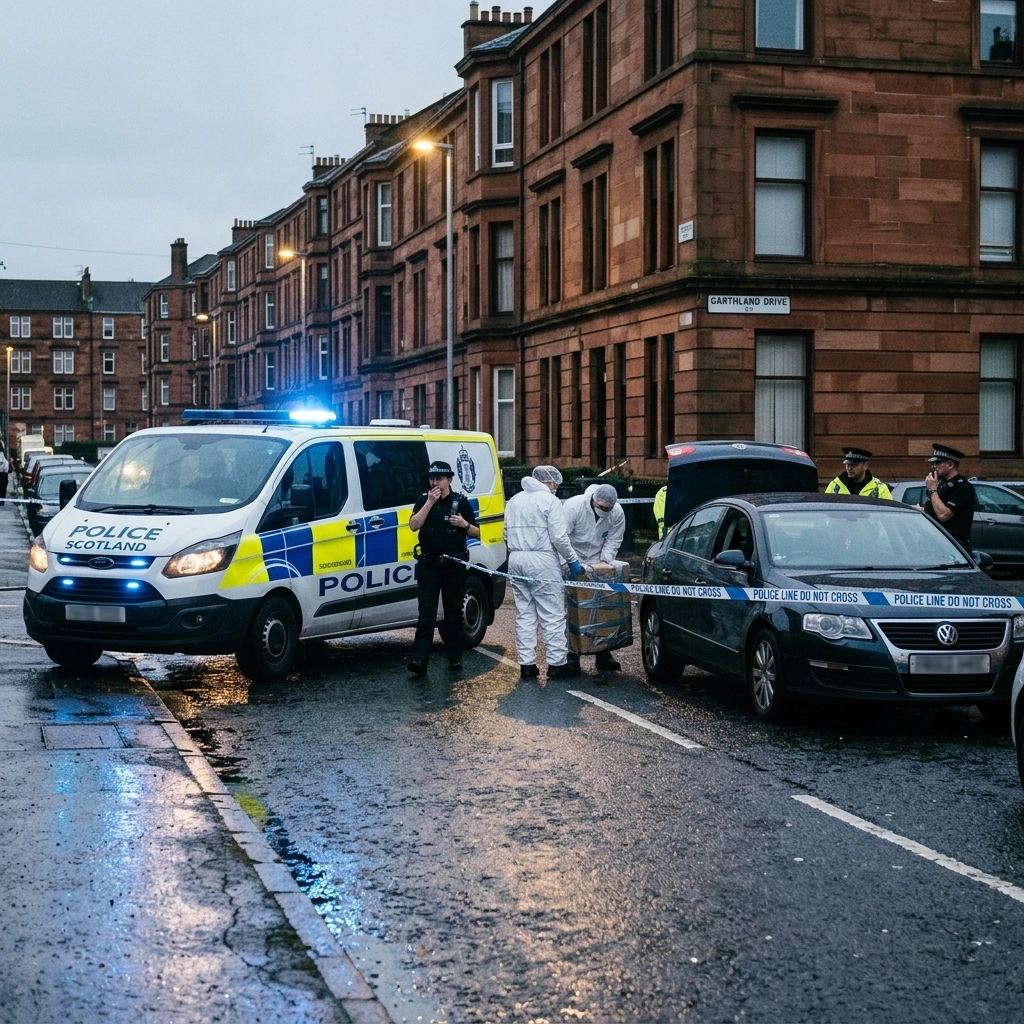
A police pursuit in Glasgow has led to one of the more striking recent drug cases to come before the Scottish courts. The story centres on a high-speed chase, the recovery of a large quantity of Class A drugs, and a personal trainer whose involvement ended with serious criminal consequences. Set not on a film set but on the streets of the city, the case highlights both the scale of organised drug activity and the legal fallout that can follow.
At NowPWR, we love bringing you the kind of independent news UK readers actually care about. These are the untold stories that happen right on our doorstep, often while the rest of us are just nipping out for a pint of milk or heading to the gym. Speaking of the gym, that’s where our protagonist, William Paterson, spent his days. By all accounts, he was a 37-year-old personal trainer helping people get fit. But as it turns out, his side hustle involved a lot more heavy lifting than just dumbbells. We’re looking at a story that involves nearly a million pounds worth of cocaine and a desperate attempt to ditch the evidence while the blue lights were flashing in the rearview mirror.
The High-Speed Drama in the Streets of Glasgow
The drama kicked off back in March 2023. It was a day that started like any other in North Glasgow, but for William Paterson, it was about to become the most expensive commute of his life. He was behind the wheel of a Mercedes, which is a nice enough car, but not exactly a subtle choice when you’re hauling nine kilos of high-purity cocaine. The police were already onto him, thanks to a massive investigation we’ll get into in a bit, and they were waiting for the right moment to pounce.
When the unmarked police cars tried to box him in, Paterson didn't exactly go quietly. Instead of pulling over and accepting his fate, he decided to turn Glasgow’s public roads into a race track. During the pursuit, things got incredibly dangerous. At one point, Paterson actually drove his Mercedes directly at an unmarked police car. Imagine being the officer in that vehicle: just doing your job, trying to keep the streets safe, and suddenly a luxury car is barreling towards you like a battering ram. It’s the kind of split-second terror that rarely makes the evening news but stays with the people involved forever.
While he was weaving through traffic and trying to evade capture, Paterson realised he had a massive problem sitting in his car. He had a black box containing nine kilos of cocaine, with a street value estimated at roughly £900,000. In a moment of pure desperation, he decided to lighten his load. As he sped past Hogganfield Loch, he chucked the box out of the window, hoping it would vanish into the grass or be overlooked by the chasing officers. He then kept going, eventually being stopped and searched. When the police finally got him out of the car, they found over six thousand pounds in cash, but the "cargo" was missing. Luckily, the police are pretty good at their jobs. They retraced the route of the chase and found the discarded black box sitting on a street right across from the loch. Just like that, the million-pound gamble had failed.
Operation Windstriker and the Hidden Life of a PT
You might be wondering how the police knew Paterson was carrying such a heavy load in the first place. It wasn't just a lucky break or a random stop-and-search. This was the result of a massive, coordinated effort known as Operation Windstriker. This was an intensive investigation targeting an organised crime group operating across the West of Scotland. It’s one of those untold stories of policing where months of surveillance, data analysis, and undercover work finally come to fruition in a single afternoon of action.
Operation Windstriker was designed to peel back the layers of the drug trade in the region. Often, when we think of drug dealers, we imagine the stereotypes we see on TV. We don’t necessarily think of the local personal trainer who seems to have a successful business and a decent life. But that’s the reality of modern organised crime in the UK; it often hides behind a veneer of respectability. Paterson wasn't just some small-time dealer on a street corner; he was a courier moving significant quantities of Class A substances that fuel misery and crime in our communities.
When you provide independent news UK audiences can trust, it’s important to look at the scale of these operations. Nine kilos of cocaine isn't just a "personal stash." It represents a massive chain of supply that reaches from international cartels down to local distributors. By taking Paterson off the road, the police didn't just stop one guy in a Mercedes; they disrupted a major artery of a criminal network. It’s a reminder that while the chase itself was cinematic, the underlying issues are very real and very serious. The fact that a PT was involved shows how deep these roots can grow, involving people you might see every day at the local leisure centre.
Settling the Tab and the Real Cost of Crime
Fast forward to August 2024, and the chickens finally came home to roost. Paterson appeared at the High Court in Edinburgh, where he pleaded guilty to being concerned in the supply of cocaine. The judge didn't take it lightly, handing down a sentence of five years and four months. For most people, that would be the end of the story: a long stretch behind bars to think about what they’d done. But the legal system in Scotland has another tool in its arsenal: the Proceeds of Crime Act.
This brings us to the most recent update in March 2026. Even though Paterson is already serving his time, the court hasn't finished with his finances. A new order has been issued requiring him to repay thousands of pounds. The court determined that his total benefit from criminal conduct was a staggering £205,000. While he was "only" ordered to pay back £46,370 initially (based on his available assets), it’s a clear signal that crime doesn't pay in the long run. The state is essentially saying, "We’re not just taking your freedom; we’re taking the profit you made from breaking the law."
The million-pound cocaine chase might sound like an exciting headline, but the aftermath is a slow, methodical process of dismantling a criminal's life. This is the part of the story that often goes unheard: the years of legal wrangling and the financial ruin that follows a moment of criminal "glory." Paterson's life as a PT is long gone, replaced by a prison cell and a mountain of debt to the Crown.
It's important for us to talk about these outcomes because they highlight the reality of the independent news UK landscape. We see the flash, the chase, and the arrest, but the real impact is felt in the courtrooms and the communities left behind. Glasgow is a city with a big heart, but it’s also a city that has struggled with the fallout of the drug trade for decades. Every time a major courier like Paterson is caught, it’s a small victory for the people who actually live there. It shows that the "untold stories" of our police forces are often stories of persistence and justice, even if it takes a few years to fully settle the bill.
For William Paterson, the case did not end with arrest and imprisonment. His five-year-and-four-month sentence was followed by financial recovery proceedings under the Proceeds of Crime Act, with the court assessing substantial criminal benefit and ordering repayment based on available assets. That outcome underlines the broader legal consequences in cases like this: custodial sentences may remove a person’s liberty, but confiscation orders are designed to strip away the financial gains of criminal conduct as well.