



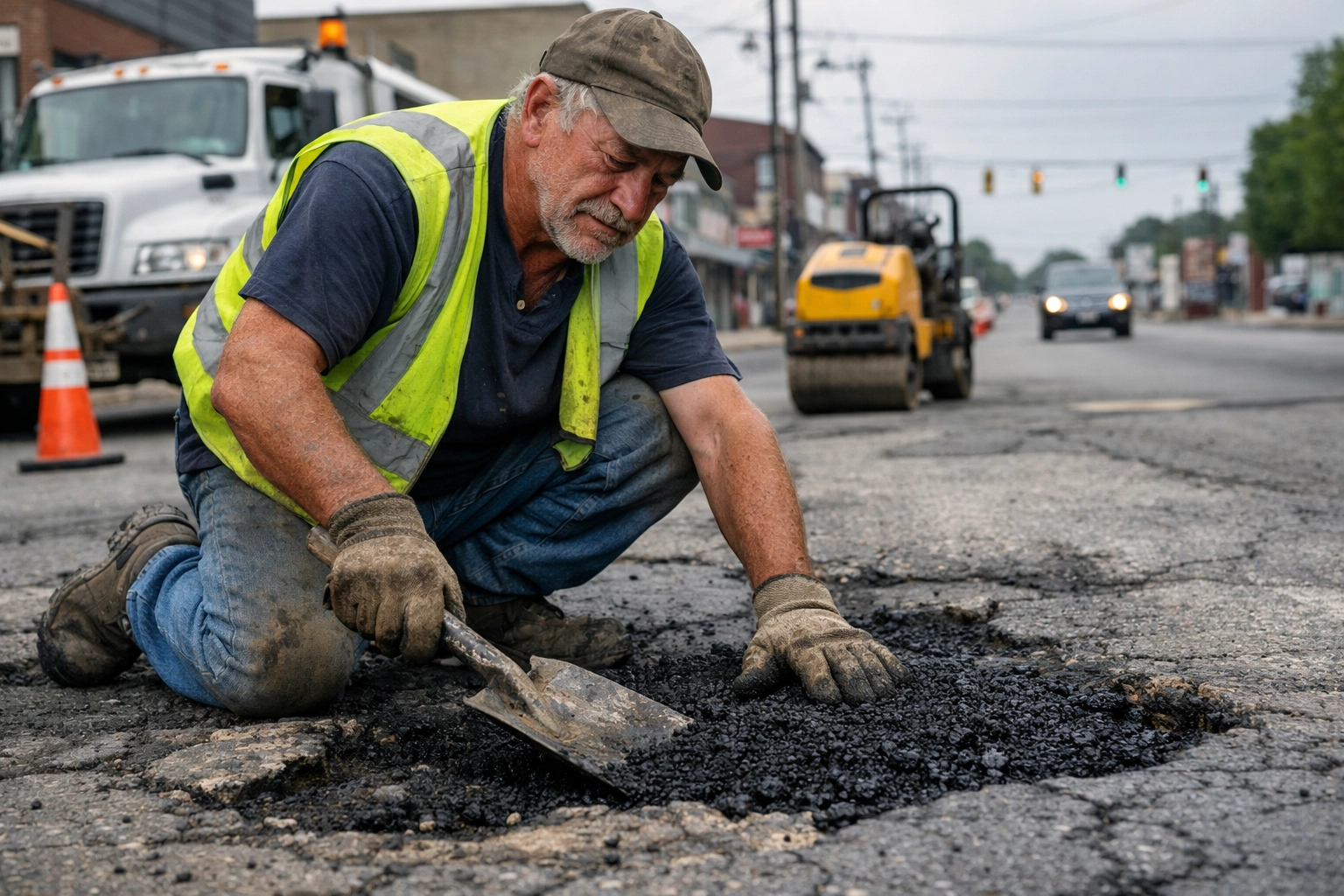
At 81 years of age, most people might be looking for a slower pace of life, perhaps tending to a garden or enjoying a quiet walk through the Derbyshire countryside. For Pete Thexton, however, the mission is much more hands-on: and significantly more rugged. For two decades, Pete has been the self-appointed guardian of his local neighbourhood, armed with little more than a wheelbarrow, a shovel, and an unwavering sense of civic duty. In a small corner of Derbyshire, a man has become a local legend for doing what the local authorities won’t: fixing the roads.
The story of Pete Thexton is one of perseverance against the literal and metaphorical cracks in modern infrastructure. While the rest of the country grumbles about the state of British roads, Pete has spent twenty years actively doing something about it. His battlefield is a stretch of unadopted road, a legal no-man’s land where the council has no responsibility and the residents are often left to fend for themselves. This isn’t just about a few loose stones; it is about keeping a community connected and safe.
Every morning, Pete can be seen navigating the uneven terrain, assessing the damage caused by the previous night’s rain or the heavy transit of delivery vans. To his neighbours, he is more than just a resident; he is “The Pothole Hero.” His work has saved countless tyres, prevented numerous trips and falls, and maintained a sense of pride in a place that could easily have been left to crumble.
The Decades-Long Mission on an Unadopted Road
The concept of an “unadopted road” is one that causes significant stress for homeowners across the United Kingdom. According to government data, there are approximately 40,000 such roads in England and Wales alone. These are highways which are not maintained by a highway authority at the public expense. For the people living on them, this means that the local council: in Pete’s case, Derbyshire County Council: is under no legal obligation to fill a single pothole or repair a crumbling verge.
Pete moved to his home twenty years ago and quickly realised the challenge ahead. The road was a patchwork of neglect, a series of craters that made every journey a gamble for suspension systems. Recognising that help was not coming from the local government, Pete decided to take matters into his own hands. He didn’t wait for a committee meeting or a community fund; he simply picked up a shovel.
The scale of the task is immense. An unadopted road doesn’t just suffer from standard wear and tear; it lacks the professional drainage and foundational layering of a main A-road. Every time it rains in the hilly terrain of Derbyshire, water pools in existing divots, expanding them into dangerous traps. Pete’s mission became a race against the elements. Over two decades, he has developed a keen eye for road maintenance, learning which materials bind best and how to level a surface using only manual tools and gravity.
It is a lonely job in many ways, but Pete sees it as a necessity. He often sources materials himself, finding scrapings or hardcore that can be repurposed to fill the ever-widening gaps. His commitment has turned what could be an impassable track into a viable thoroughfare. The persistence required to do this for twenty years, especially as one moves into their eighties, is nothing short of extraordinary. It reflects a generation that values “making do and mending” over waiting for a bureaucratic solution that may never arrive.
A Daily Labour of Love for the Community
For Pete, the work is as much about the people as it is about the pavement. Filling a pothole is a physical act, but the motivation is deeply social. He knows every neighbour, every delivery driver, and every postman who uses the road. He understands that for an elderly neighbour, a deep pothole is not just a nuisance for a car; it is a genuine hazard when walking to the bin or the post box.
His routine is methodical. He starts by identifying the most “urgent” repairs: those deep enough to cause mechanical damage or cause a cyclist to lose their balance. He then transports his materials in a weathered wheelbarrow, often making multiple trips from his supply pile to the site of the repair. The physical toll of this work would be significant for a man half his age, yet Pete treats it as his daily exercise, a way to stay fit and engaged with the world around him.
The community response has been overwhelmingly positive. While the council remains at a distance due to the legal status of the road, the residents are Pete’s biggest fans. He is often greeted with waves, thank-yous, and the occasional cup of tea brought out to the roadside. In a world where people often feel increasingly isolated from their neighbours, Pete’s work acts as a bridge. He is the common thread that keeps the neighbourhood functional and friendly.
However, the job is never truly finished. Road repair is a Sisyphean task. As soon as one section is levelled and packed down, a heavy storm or a cold snap can create three more problems elsewhere. This is where Pete’s legendary status truly comes from: not just the fact that he does the work, but that he never gives up. He has watched the seasons change for twenty years from the vantage point of a shovel handle, and his resolve has never buckled. He is a reminder that community spirit isn’t something that is talked about; it is something that is practiced through action.
The Wider Impact of Local Grit and Determination
Pete Thexton’s story resonates far beyond the borders of Derbyshire because it speaks to a national crisis in infrastructure and the power of the individual. Across the UK, the “pothole plague” has become a staple of local news and political debate. Millions of pounds are pledged every year to fix the nation’s crumbling network, yet the problem seems to outpace the funding. In this climate, people like Pete are becoming more than just local curiosities; they are symbols of a growing DIY movement in local maintenance.
While there are often warnings from authorities about the safety and liability of performing “guerilla” road repairs, the reality for many is that they have no choice. If Pete stopped his work, the road would likely become a graveyard for car axles. His 20-year battle highlights the precarious nature of our secondary and unadopted road networks. It also raises questions about the responsibilities of modern society: where do we draw the line between personal responsibility and state duty?
Beyond the politics and the logistics, Pete’s legacy is one of inspiration. He proves that age is no barrier to making a tangible difference in the world. At 81, he is a “Pothole Hero” not because he has some special power, but because he has the most rare of modern qualities: patience and a willingness to get his hands dirty. He isn’t seeking fame or fortune; he just wants the road to be flat.
As we look toward a future where budgets are tight and infrastructure is aging, the “Pete Thextons” of the world will become increasingly vital. They represent the grit and determination that keep small communities thriving. Pete continues his work today, a familiar figure in a high-vis vest, slowly but surely making Derbyshire a slightly smoother place to live. His 20-year battle against the potholes is a testament to the fact that while you might not be able to fix the whole world, you can certainly fix the bit right outside your front door.