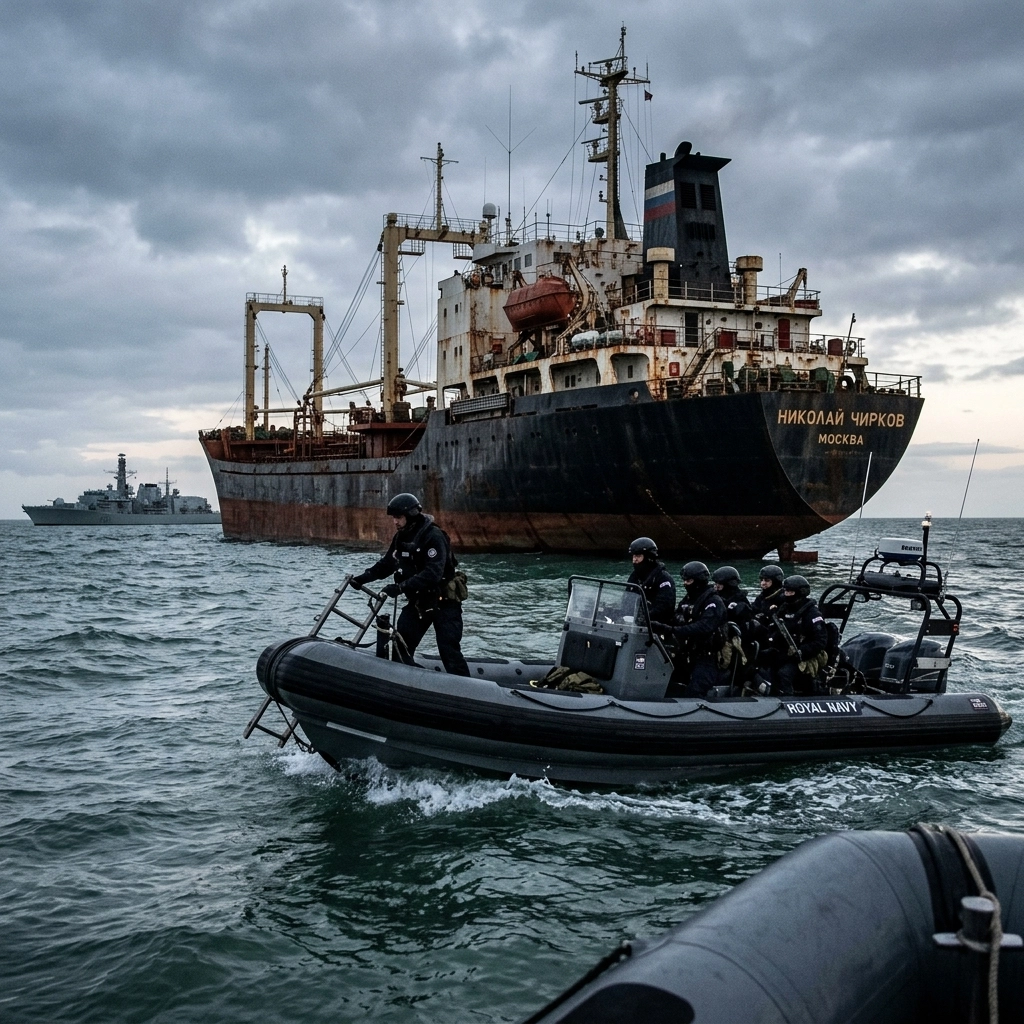
The English Channel has long been a theatre of history, but the drama unfolding in its choppy grey waters today feels like something straight out of a Cold War thriller. For months, a ghostly procession of rust-streaked tankers has been slipping through British waters, often operating under the radar of international maritime law. These vessels, collectively known as the Russian shadow fleet, have become the primary focus of a major shift in British foreign policy. In a move that signals a significant escalation in the West’s response to the ongoing conflict in Ukraine, the UK government has authorised elite military units to board and seize these vessels.
This isn't just about patrolling the borders; it’s a direct strike at the financial heart of the Kremlin’s war machine. For the average observer, the sight of a tanker on the horizon is a mundane part of coastal life. However, for those monitoring UK maritime security, these ships represent a multi-billion pound loophole. By using ageing vessels with opaque ownership and dubious insurance, Russia has managed to circumvent global sanctions, continuing to fund its military operations despite the heavy economic pressure applied by the international community.
The decision to deploy the Royal Marines and UK special forces to intercept these ships marks a departure from purely diplomatic or economic measures. It is a physical assertion of authority in British sovereign waters. When we talk about independent news uk, we often look for the untold stories that define our era, and there is perhaps no story more critical right now than how Britain is physically stepping in to plug the leaks in the global sanctions regime.
Cutting the Kremlin’s Financial Lifeline
The primary motivation behind this aggressive new stance is simple: money. Since the invasion of Ukraine, Western nations have sought to cripple the Russian economy by targeting its most lucrative export: oil. While many countries have officially stopped buying Russian crude, the Kremlin has proved remarkably adept at finding alternative routes to market. This is where the Russian shadow fleet comes into play. These ships often disable their AIS (Automatic Identification System) transponders, engage in ship-to-ship transfers in the middle of the ocean, and operate under "flags of convenience" from nations with lax oversight.
By authorising UK forces to board these vessels, Prime Minister Sir Keir Starmer is sending a clear message that the UK's territorial waters will no longer be a safe passage for sanctioned cargo. The legal framework established earlier this year provides the necessary authority for military personnel to step onto these decks. It is a calculated risk. Each boarding operation is a complex logistical challenge, requiring precision, speed, and a firm understanding of international maritime law.
The disruption of these trade routes is vital. Every barrel of oil that reaches its destination via a shadow tanker contributes to the funding of missiles, tanks, and infantry on the front lines. For the UK, this is an exercise in strategic persistence. It’s about making the cost of doing business so high for the Kremlin that the shadow fleet becomes an unsustainable liability rather than a profitable workaround.
Elite Units and the Legal High Seas
Boarding a massive oil tanker in the middle of a swell is not a job for the faint-hearted. The units tasked with these operations, including the Royal Marines and Special Boat Service (SBS), are among the most highly trained maritime counter-terrorism and boarding specialists in the world. They are equipped to handle unpredictable crews and potentially hostile environments. Often arriving via Merlin or Wildcat helicopters, or approaching rapidly in fast-raiding craft, these teams must secure the bridge and engine room within minutes to ensure the vessel remains under their control.
The tactical reality of these operations is fraught with danger. Many of the ships in the shadow fleet are in poor mechanical condition. There are genuine concerns about the structural integrity of these ageing tankers, some of which are decades old and have lacked proper maintenance. A collision or a mechanical failure during a boarding operation could lead to a significant environmental disaster in the English Channel, adding another layer of complexity to the mission.
However, the legal groundwork laid by the government provides a solid foundation for these actions. By designating specific vessels as being in breach of international sanctions, the UK can justify these interventions as a matter of national and international security. This isn't just about enforcing rules; it's about redefining what maritime enforcement looks like in an era of hybrid warfare. The focus on UK maritime security has never been more intense, as the government seeks to prove that its "Global Britain" stance includes the muscle to back up its mandates.
Geopolitical Risks and Maritime Safety
While the tactical goals are clear, the broader geopolitical implications are immense. Russia has already signalled its displeasure with the UK’s increased involvement in monitoring its maritime activities. There is a very real risk that Moscow could view the physical seizure of its (admittedly unofficial) assets as a direct provocation. This raises the spectre of escalation. Will Russia begin escorting these tankers with its own naval assets? Could we see a standoff between the Royal Navy and Russian frigates in the North Sea or the Channel?
Beyond the immediate threat of military friction, there is the environmental angle that cannot be ignored. These untold stories often miss the fact that many shadow fleet vessels are essentially "environmental ticking time bombs." Without standard P&I (Protection and Indemnity) insurance, a major oil spill from one of these ships would leave coastal nations: including the UK: footing a massive bill for the cleanup. By intercepting these ships, the UK is also acting as a guardian of the marine environment, preventing potential catastrophes before they happen.
The international community is watching closely. If the UK is successful in significantly hampering the shadow fleet’s operations, other nations may follow suit. This could lead to a tightening of the net around Russian exports globally. However, it also places the UK at the forefront of a high-stakes game of maritime chicken. The bravery of the personnel involved and the strategic resolve of the government will be tested in the coming months as these boarding operations become more frequent.
The struggle over the Russian shadow fleet is a modern conflict fought with old-school maritime tactics. It combines the complexities of global finance, the precision of elite military operations, and the high stakes of international diplomacy. As Britain asserts its right to police its waters and uphold international law, the English Channel remains a critical frontier in a much larger global struggle. The success of these missions will not just be measured by the number of ships boarded, but by the tangible impact on the Kremlin's ability to sustain its campaign.
This ongoing operation highlights the evolving nature of national security. It is no longer enough to guard against traditional threats; the modern state must also be prepared to tackle the "grey zone" activities that undermine global stability. Through a combination of legal innovation and military readiness, the UK is attempting to close one of the most significant gaps in the sanctions regime, ensuring that the shadow fleet no longer operates in the dark.