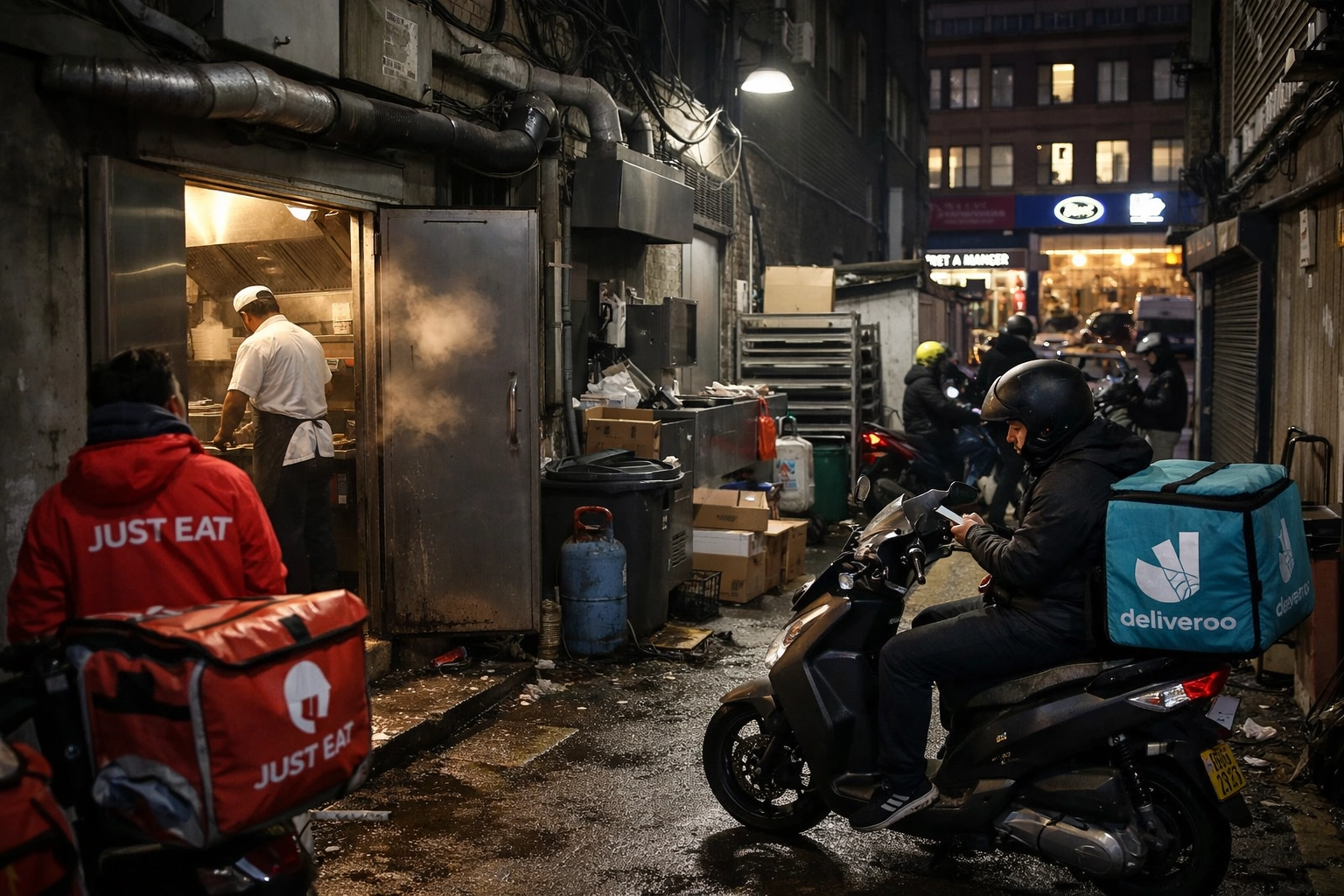
London’s culinary landscape is undergoing a silent transformation as traditional storefronts give way to windowless industrial units known as ghost kitchens.
The shift is redistributing the capital’s economic geography, moving food production from bustling high streets to grey industrial estates and railway arches.
While these "dark kitchens" offer efficiency for delivery platforms, they are creating a competitive vacuum that threatens the survival of independent cafes and the social fabric of local neighbourhoods.
Data from market analysts suggests that the delivery-only sector has grown by over 200% in the last five years, accelerated by shifting consumer habits and high property overheads.
In areas such as Bethnal Green, Battersea, and Bermondsey, clusters of shipping containers now house dozens of different restaurant brands, all operating without a single table or chair for customers.
This model allows global chains and venture-backed startups to flood the market with digital-only brands, often undercutting the prices of traditional establishments that must pay for "front-of-house" staff and prime retail rents.
Alternative news sites have begun to document the phenomenon as a "high street haunting," where the lights are on in the kitchens, but the storefronts remain dark.
For the average Londoner, the change is mostly invisible, manifesting only as a surge in moped delivery drivers navigating residential side streets.
However, for the owners of independent coffee shops and family-run bistros, the rise of the invisible kitchen represents a fundamental threat to their business model.
The Industrialisation of the London Takeaway
The logistics of food in London have moved from a service industry to a high-speed manufacturing process.
Leading delivery platforms have invested heavily in bespoke kitchen hubs, providing the infrastructure for restaurants to expand their reach without the risk of opening a physical branch.
These facilities are often located in "black holes" of the city: areas with high residential density but low commercial rent.
A single warehouse can contain thirty separate kitchen pods, each producing a different cuisine ranging from Thai street food to artisanal pizza.
The efficiency of this model is undeniable; by stripping away the dining room, businesses eliminate the costs of heating, lighting, and decorating a public space.
Labour costs are also significantly reduced, as there is no requirement for waiters, baristas, or cleaning staff to manage a seating area.
This industrialisation allows for a "global business analysis" approach to dining, where menus are adjusted in real-time based on data trends rather than seasonal availability or chef preference.
If data shows a spike in demand for poke bowls in a specific postcode, a ghost kitchen can launch a new brand to meet that demand within forty-eight hours.
Traditional cafes, tethered to their physical menus and local reputation, cannot compete with this level of digital agility.
The result is a market saturated with "virtual brands" that exist only on an app, often sharing the same chefs and ingredients behind a closed door.
Critics argue that this clinical approach to food production removes the soul from the city’s gastronomy, turning a cultural experience into a mere commodity transaction.
Residents living near these hubs have also raised concerns regarding noise pollution and the constant traffic of delivery vehicles at all hours of the night.
Despite these local grievances, the economic momentum behind ghost kitchens continues to grow as investors seek high-yield, low-asset opportunities in the hospitality sector.
Competitive Disparity and the High Street Void
The economic pressure on London’s high streets has reached a critical point as the disparity between physical and virtual operations widens.
Independent cafes are currently facing a "triple threat" of rising energy bills, increased business rates, and the predatory pricing of delivery-only competitors.
A traditional cafe on a typical London high street may pay upwards of £50,000 per year in rent and rates alone, while a kitchen pod in an industrial estate costs a fraction of that amount.
This financial gap allows ghost kitchens to absorb the high commission fees charged by delivery apps: often between 25% and 35%: which would otherwise bankrupt a small independent operator.
As more consumers opt for the convenience of home delivery, footfall on the high street continues to decline, leading to a "hollowing out" of local commerce.
When a local cafe closes, it is rarely replaced by another independent business; instead, the unit often remains vacant or is taken over by a multinational chain with the capital to weather the storm.
This process contributes to the "haunting" of the high street, where the loss of community meeting points leads to social isolation and a decline in local security.
The invisible kitchen model effectively "outsources" the cost of the dining room to the customer’s own home, removing the need for a shared public space.
Global business analysis indicates that this trend is not unique to London, with similar patterns appearing in New York, Paris, and Berlin.
However, London’s unique property market and high density make it a particularly fertile ground for the expansion of dark kitchens.
The shift also impacts the quality of employment in the sector, moving hospitality workers from public-facing roles into windowless, high-pressure production lines.
The social value provided by a local cafe: as a space for remote work, socialising, and community engagement: is not factored into the balance sheets of delivery platforms.
Without the physical presence of these businesses, the high street loses its identity, becoming a mere corridor for logistics rather than a destination for people.
The long-term impact of this "invisible" competition is a permanent alteration of the urban fabric, where the convenience of the few outweighs the community needs of the many.
Regulatory Lag and the Global Business Model
Legislation and urban planning have struggled to keep pace with the rapid proliferation of ghost kitchens across the capital.
Currently, many of these hubs operate under "light industrial" planning permissions, which were originally intended for workshops or small factories rather than high-volume food production.
This creates a regulatory loophole where businesses can operate 24-hour commercial kitchens in residential areas without the same level of scrutiny applied to a standard restaurant.
Local councils have expressed frustration at their lack of power to manage the environmental impact of these sites, particularly regarding waste management and odour control.
There is also a growing debate regarding the tax contributions of these virtual entities.
While a high street cafe contributes directly to the local economy through business rates that fund local services, ghost kitchens located in industrial zones often pay significantly less.
This creates an unlevel playing field where the businesses that contribute the most to the community are the ones most likely to be forced out of the market.
International investors continue to pour capital into the sector, viewing ghost kitchens as the "logistics backbone" of the future food economy.
They argue that the model is a necessary evolution in a city where space is at a premium and consumer preferences have permanently shifted towards the digital.
However, some alternative news sites suggest that the current boom may be a bubble, predicated on low interest rates and the exploitation of gig-economy labour.
As the government considers new "no body, no parole" style strictness for gig-worker rights and environmental standards, the profitability of the dark kitchen model may be challenged.
Furthermore, the "Suzanne’s Law" of urban planning: the idea that a city must protect its physical heritage to remain viable: is gaining traction among policymakers.
Proposed changes to the Levelling Up and Regeneration Act may give councils more power to restrict the conversion of industrial units into delivery hubs in areas where the high street is under threat.
For now, the battle for the soul of London’s kitchens remains largely hidden from view, played out behind the corrugated steel doors of industrial estates and on the screens of smartphones.
The future of the London high street depends on whether a balance can be struck between the demand for digital convenience and the necessity of physical community spaces.
As the invisible kitchens continue to expand, the haunting of the high street serves as a stark reminder of the costs of "frictionless" consumption in a modern metropolis.
The story of London’s food is no longer being written in its shop windows, but in the algorithms that dictate where, when, and how the city eats.