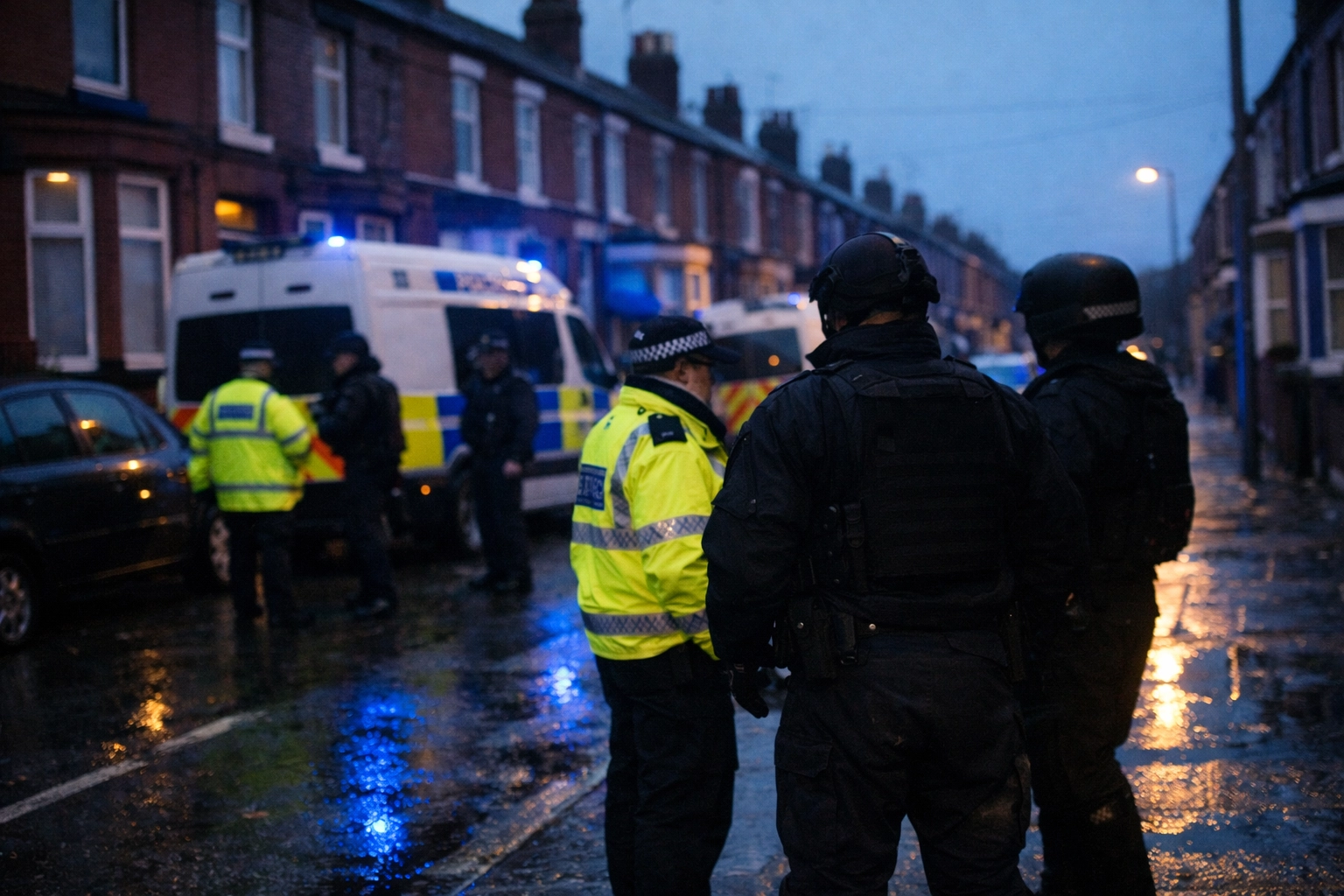
More than 400 Merseyside Police officers carried out early-morning raids across North Liverpool on Monday, 30 March 2026, as Operation Vanguard targeted suspected organised crime linked to Class A drugs and illegal firearms.
Most of the action focused on Anfield and Everton, where residents reported doors forced with hydraulic rams before dawn and streets filling with armed units and armoured vehicles.
Police said that by 08:00 they had made 17 arrests and found what they described as a “counting house” used to process illicit cash.
The operation followed an 18-month undercover investigation, built on surveillance and intelligence that rarely becomes public until the raids happen. For readers tracking independent news uk, it’s a reminder that big enforcement days are usually the end point of months of quiet groundwork.
It’s also the sort of story that sits right at the heart of investigative journalism uk: explaining who is running the operation, how the money moves, and why it matters to the people living alongside it.
Tactical Precision in the Heart of Anfield
Operation Vanguard moved fast. Officers were briefed at a secret location in the early hours, then sent out to around 20 addresses at the same time.
Police priority number one was to stop anyone getting hurt, after intelligence suggested the group may have had access to converted firearms and high-capacity pistols. In a terrace off Breck Road, officers reported finding weapons buried under a garden shed, underlining how far gangs will go to keep kit out of sight.
The raids sit within a wider “Clear, Hold, Build” approach: remove offenders, stop others moving in, and then try to support longer-term safety. But the untold stories from residents often focus on the bit in the middle — keeping the pressure on day after day — with reports of scrambler bikes, lookouts, and low-level intimidation becoming part of the background.
Forensics teams spent much of Monday searching properties, with drugs reportedly found in concealed spaces including false walls and kitchen appliances. The amount of cocaine and heroin seized has been estimated at a street value of millions of pounds.
The High Cost of Organised Crime Networks
Alongside drugs and weapons, police said the operation exposed the scale of money involved. In raids at higher-value addresses in Liverpool’s outer suburbs, officers seized luxury vehicles including Range Rovers, Porsches and a bespoke Lamborghini.
Investigators also recovered designer watches — some valued at more than £50,000 — plus bundles of cash totalling hundreds of thousands of pounds. These assets can be pursued under the Proceeds of Crime Act, and locally it matters because it punctures the idea that gang money is “easy” or untouchable.
Detectives said the group was also linked to County Lines activity, moving drugs into towns in North Wales and as far north as Scotland. By hitting the suspected hub in Anfield, police believe they have disrupted supply routes that feed smaller groups across the UK.
What This Means for Local Communities
For people living around the raid locations, days like Monday can feel like a reset — visible policing, road closures, and a sudden sense that something is finally being tackled.
But local impact is usually longer-term and more ordinary: whether intimidation drops, whether young people are pulled into supply roles less often, and whether residents feel confident enough to report what they see.
Merseyside Police’s “Clear, Hold, Build” model depends on what comes after the arrests, including neighbourhood reassurance, repeat patrols, and support services that reduce the chances of another group moving in. With further arrests possible as phones and encrypted devices are examined, residents in Anfield and Everton will be watching for sustained change rather than a one-off show of force.