For decades, the battle to keep contraband out of prisons was a game of cat and mouse played on the ground. It involved hollowed-out books, visitors with hidden packages, and the occasional desperate attempt to lob a tennis ball stuffed with drugs over a perimeter wall. But the game has changed. If you look up at the night sky over any major UK correctional facility today, the threat isn't coming from the ground: it’s buzzing through the air.
The rise of affordable, high-specification drones has created a new frontline in the struggle between organised crime and the prison service. This isn't just about a few hobbyists taking photos; it’s a sophisticated, high-tech arms race. Gangs are weaponising consumer technology, and the authorities are scrambling to keep up.
The Aerial Smuggling Revolution
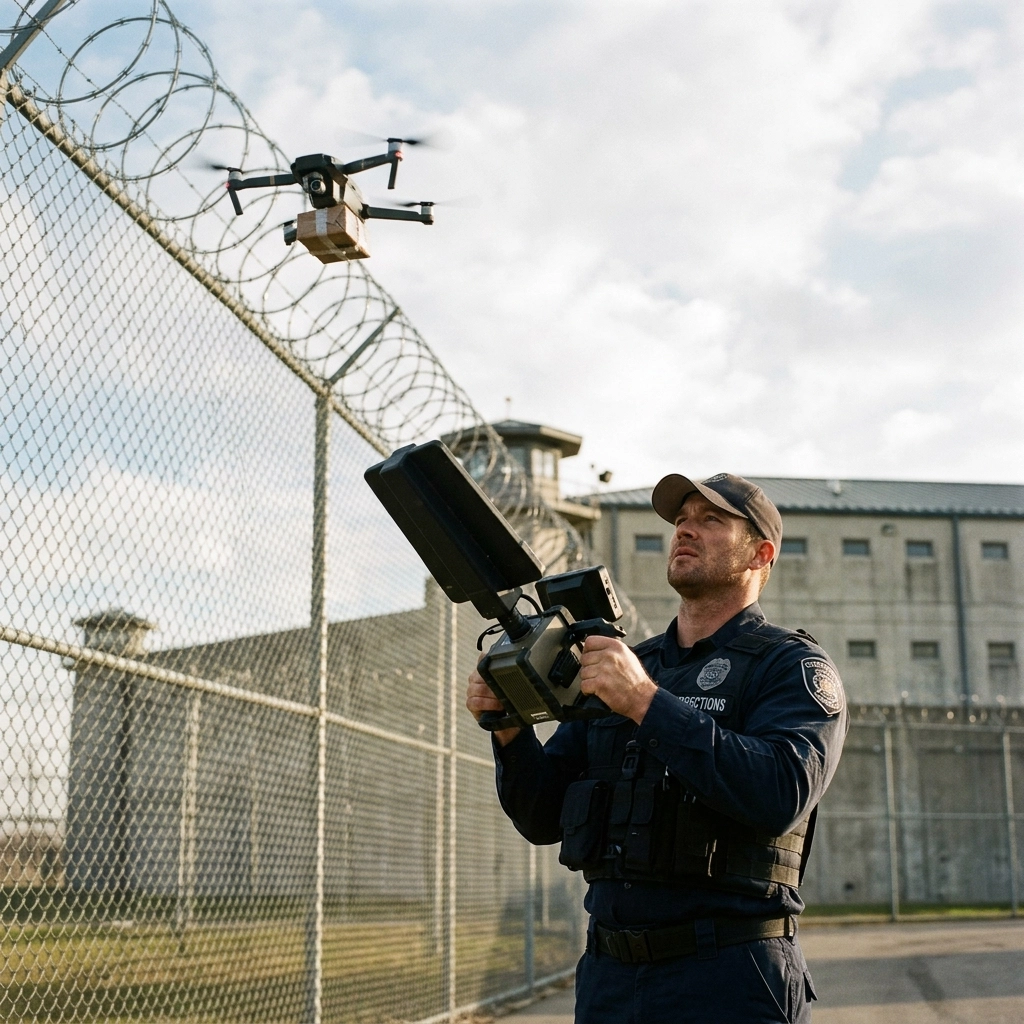
The shift to aerial delivery didn't happen overnight, but once it started, it scaled at a terrifying pace. In the past, smuggling was a high-risk endeavour for gangs. It required a human mule to bypass security, risking immediate arrest and a lengthy sentence. Drones have effectively removed that risk. A pilot can sit in a parked car two kilometres away, navigate a drone via a VR headset, and drop a payload directly to a specific cell window with pinpoint accuracy.
The economics of this operation are staggering. A mid-range drone might cost a criminal group around £1,000. That same drone can carry a payload of "spice," mobile phones, and tobacco with a prison black-market value of five or ten times the cost of the kit. Even if the drone is intercepted and seized, the loss is negligible compared to the potential profit. For gangs, it is simply the cost of doing business.
These "care packages" are more than just a nuisance. Mobile phones are the lifeblood of organised crime behind bars. They allow gang leaders to continue running their operations on the outside, intimidating witnesses, and coordinating further drug shipments while serving their time. The arrival of synthetic cannabinoids, commonly known as spice, has also led to a massive spike in violence and medical emergencies within the wings. When a drone drops a package, it’s not just delivering goods; it’s delivering chaos.
What makes this such a difficult problem to solve is the sheer accessibility of the technology. Modern drones are incredibly stable, easy to fly, and can be modified to carry significant weight. Some gangs have even been known to use "tethered" drops, where the drone lowers a line to a window, allowing inmates to pull the package inside without the drone ever needing to land or get too close to the sensitive perimeter sensors.
The Prison Perimeter Fights Back
Faced with this high-tech onslaught, the Ministry of Justice and prison governors have had to rethink their entire security strategy. The traditional "bits of wire and a high wall" approach is no longer enough when the threat can fly over it at 40 miles per hour. This has led to the implementation of "no-fly zones" around prisons, but as any security expert will tell you, a digital line in the sky is only as good as your ability to enforce it.
One of the primary weapons in the prison’s arsenal is Radio Frequency (RF) jamming. By flooding the area with signal noise, security teams can effectively "blind" the drone, cutting the link between the pilot and the craft. When this happens, most consumer drones are programmed to either land immediately or return to their starting point. However, this technology comes with its own set of technical headaches. Jamming signals don't stop at the prison fence; they can interfere with legitimate communication, emergency services, and even local Wi-Fi for residents living nearby.
Beyond jamming, prisons are turning to advanced detection systems. These use a combination of acoustic sensors that "listen" for the specific hum of drone rotors, and optical cameras that use AI to distinguish between a bird and a quadcopter. Once a drone is detected, "counter-drone" teams are alerted. In some cases, this leads to the deployment of physical interceptors: drones designed to catch other drones in nets: though this remains a relatively rare sight in the UK.
There is also a significant push on the legislative side. Police have also become much more adept at tracking the pilots. By using the drone's own flight data and signal tracking, officers can often identify the exact spot where a pilot is standing, leading to arrests and the dismantling of the ground-side smuggling rings. Police stings in muddy fields at 3 AM are becoming more common as the authorities refuse to cede the sky to the gangs.
A High-Stakes Game of Tech Leapfrog
As with any technological conflict, as soon as one side develops a shield, the other side develops a better sword. We are currently witnessing a game of high-stakes leapfrog. As prisons get better at jamming signals, gangs are looking toward more autonomous solutions. The next generation of smuggling drones may not rely on a constant radio link at all. Using GPS waypoints and computer vision, a drone could potentially navigate itself to a specific coordinate, drop its load, and return home without ever needing a signal that can be jammed.
There is also the issue of "swarm" tactics. While currently rare in the criminal world, the concept of sending multiple drones at once to overwhelm security systems is a genuine concern for the future. If ten drones approach a facility from different angles, even the most advanced security team will struggle to intercept them all. The one that gets through pays for the nine that were lost.
The battle has also moved into the software space. "Geofencing" is a feature built into many commercial drones that prevents them from flying into restricted areas like airports or prisons. However, the "modding" community and criminal tech experts have found ways to bypass these digital barriers using "cracked" firmware. This turns a standard consumer product into a "dark" drone that doesn't recognise any boundaries.
For the staff working inside these institutions, the drone wars are a constant source of stress. Every buzz in the night could mean more drugs on the wing, more powerful weapons in the hands of inmates, and a more dangerous environment for everyone. It’s not just a tech story; it’s a human story about the safety of those living and working within the system.
The UK government has committed millions of pounds to the "Drone Specialist Support Team," a dedicated unit designed to tackle this specific threat. Their work involves analysing seized drones to find fingerprints, DNA, and digital footprints that can lead back to the organised crime groups. It is a slow, methodical process, but it is starting to yield results. By treating the drone not just as a delivery vehicle but as a piece of forensic evidence, the authorities are fighting back on both the digital and physical fronts.
The reality is that as long as there is a demand for contraband in prisons, gangs will find ways to supply it. The sky just happens to be the current path of least resistance. As we move further into the 2020s, the "Drone Wars" will likely escalate, forcing a total reimagining of what "prison security" actually means in a world where the walls no longer have a ceiling.
The evolution of this conflict serves as a reminder of how quickly society must adapt to the double-edged sword of innovation. While drones have revolutionised photography, delivery, and search-and-rescue, they have also handed a powerful new tool to those looking to subvert the law.
As the technology continues to evolve, the response must be equally agile. Whether through better jamming, more robust legislation, or the development of dedicated interceptor units, the goal remains the same: ensuring that the "high-tech sky" does not become a lawless highway for organised crime. The battle for the perimeter is far from over; it has simply moved upwards.