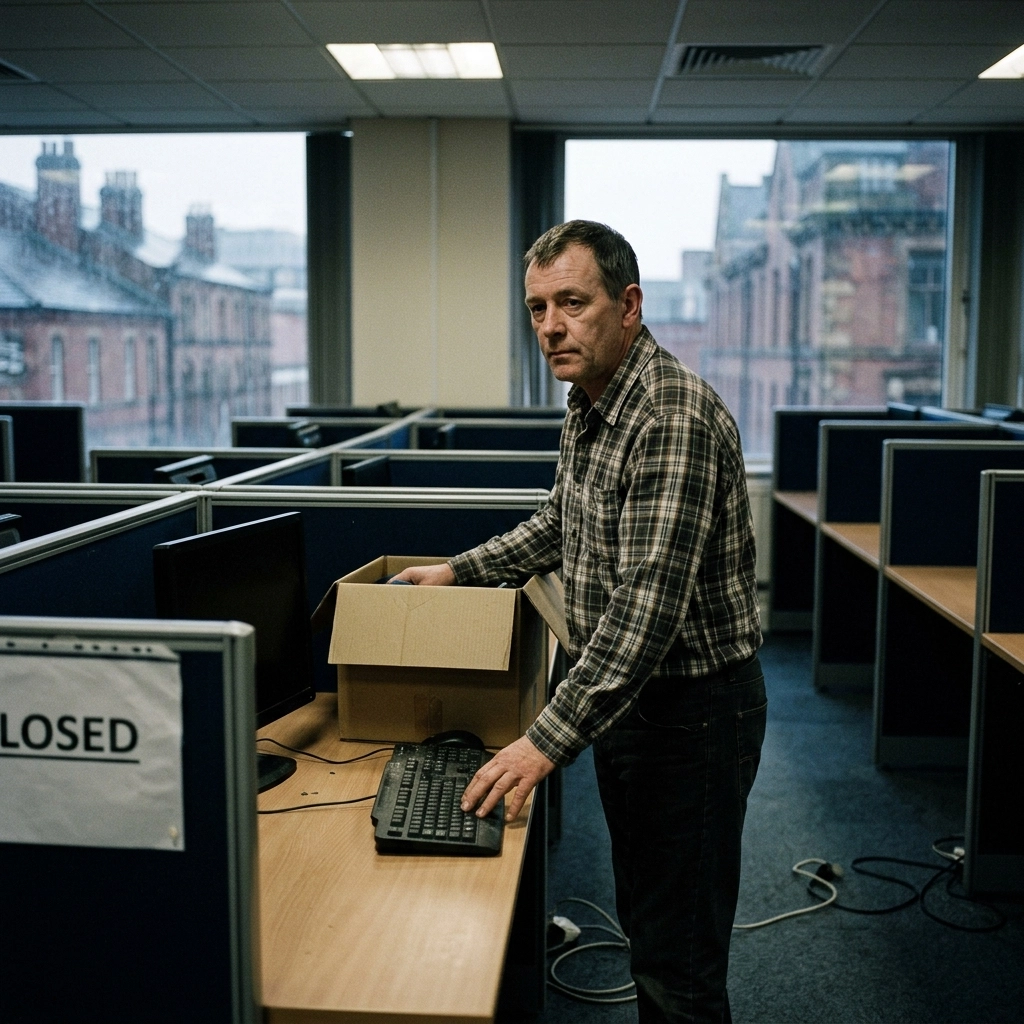
It is Tuesday, 14 April 2026, and the morning commute in London feels slightly lighter than it did two years ago. There hasn’t been a singular, explosive event or a massive stock market crash that cleared out the office blocks. Instead, there has been a quiet, persistent erosion. If you walk through the glass-fronted offices of the City or the creative hubs in Manchester, you might notice something different: the empty cubicles aren’t just a relic of the hybrid-working era. They are the seats of the first real casualties of the AI revolution.
For years, we were told that artificial intelligence would be a "co-pilot", a friendly digital assistant that would take the drudgery out of our days. But as we move deeper into 2026, the reality for thousands of UK workers is far more stark. This isn't science fiction anymore; it's about corporate bottom lines and real livelihoods. As an independent news uk source, we’ve been looking into the untold stories of those who found their login credentials revoked not because of a human manager's decision, but because an algorithm proved it could do their job for a fraction of the cost.
The invisible redundancy of the entry-level role
The most significant shift in the British workforce over the last eighteen months hasn't happened at the executive level. It’s happening at the bottom. Entry-level white-collar roles: the traditional "foot in the door" for graduates and young professionals: are evaporating. In 2024, a junior data analyst or a trainee paralegal would spend their days scouring documents, summarising reports, and organising data. In 2026, those tasks are handled almost instantly by Large Language Models that have been fine-tuned for specific industries.
Recent data suggests that nearly 68% of administrative and clerical tasks in the UK are now fully automated. This has created a "hollowed-out" effect in British firms. While senior directors and specialised consultants remain, the "middle" and "junior" layers are thinning. For many young people, the ladder has been pulled up. One in six UK employers admitted in a recent survey that they have actively reduced their recruitment of human staff in favour of AI-driven systems.
This isn't just about efficiency; it's about the fundamental way we train the next generation. If there are no junior roles to learn the ropes, where will the senior leaders of 2035 come from? We are seeing a generation of "ghost workers": individuals who are technically qualified but find themselves competing against code that doesn't need a lunch break or a pension contribution. The impact is particularly visible in sectors like insurance and bookkeeping, where the regional divide is becoming more pronounced. The automation of office work is hitting former industrial towns in the North and Midlands harder, as these areas often relied on back-office processing centres for employment.
A new generation turning to the tools
In a surprising twist that many economists didn't see coming, the fear of being replaced by a machine has led to a massive resurgence in skilled manual trades. In 2026, we are witnessing the "Great Pivot." Thousands of young Britons who might have once spent their twenties in a marketing agency or a customer service centre are instead enrolling in plumbing, electrical, and construction courses.
There is a logical survivalism at play here. While AI can write a press release or debug code, it still can’t fix a burst pipe in a Victorian terrace or rewire a commercial kitchen. The physical world has become a sanctuary for human employment. Apprenticeship applications for trades have surged by nearly 40% compared to three years ago, with many applicants citing "AI-proofing" as their primary motivation for switching careers.
This shift tells a series of untold stories about the changing British dream. The aspirational "desk job" is losing its lustre. We’ve spoken to former junior researchers who have traded their laptops for tool belts. They describe a sense of relief: a feeling that their work is now "real" and, more importantly, "un-hackable." However, this influx into the trades is creating its own set of challenges. While the construction sector is booming, the saturation of the market is beginning to drive down wages in some regions, proving that even when workers flee the digital threat, the economic pressures of a changing world follow them.
The tech sector itself isn't immune. Even roles once considered safe, like software testing and cloud engineering, are seeing significant exposure. Test analysts in the UK currently face an exposure score of 66/100, meaning two-thirds of their daily tasks are now performed more accurately by automated agents.
The ethics of the automated workplace
As the UK navigates this transition, the conversation is shifting from "how" AI works to "who" it serves. The quiet replacement of staff often happens through attrition, simply not replacing someone when they leave, or through subtle restructuring. This makes it harder for unions and advocacy groups to mount a traditional defence. There is no picket line against a software update.
The psychological toll on the remaining workforce is also becoming apparent. Those who survive the "AI cuts" often find their roles fundamentally changed. They become "AI minders," spending their hours checking the work of an algorithm rather than engaging in creative or strategic thinking. This "algorithmic management" can lead to a sense of alienation. When your KPIs are set by a machine and your output is monitored by a sub-routine, the workplace begins to feel less like a community and more like a factory floor.
Furthermore, the displacement of human workers raises serious questions about social mobility. If the entry-level roles that once allowed someone from a working-class background to break into the professional services are gone, we risk entrenching a new kind of class divide. One side of the divide will own the algorithms, and the other will be left to service the physical world or struggle in a gig economy governed by apps.
As we look toward the remainder of 2026, the UK government is under increasing pressure to implement a "Robot Tax" or a more robust Universal Basic Income to offset the loss of income tax from traditional employment. The stories of the first victims of AI replacement are a warning. They suggest that the transition to an AI-integrated economy won't be a smooth "upskilling" for everyone. For many, it is a disruptive, forced career change that requires a total re-evaluation of what it means to work in modern Britain.
The quiet in the office isn't just the sound of efficiency; it is the sound of a fundamental shift in the British social contract. As more roles are replaced by code, the value of human labour is being recalculated in real-time. Whether we can build a society that values people for more than their data-processing speed remains the defining question of our era.
The transition to an AI-driven economy is no longer a future prospect but a present reality. The UK workforce is currently at a crossroads, balancing the undeniable efficiencies of automation against the profound human cost of displacement. As junior roles vanish and the workforce pivots toward physical trades, the structural foundations of the British economy are being rewritten. Navigating this shift will require more than just technological adaptation; it will demand a renewed focus on the social and ethical frameworks that protect the dignity and livelihoods of all workers in an increasingly automated world.