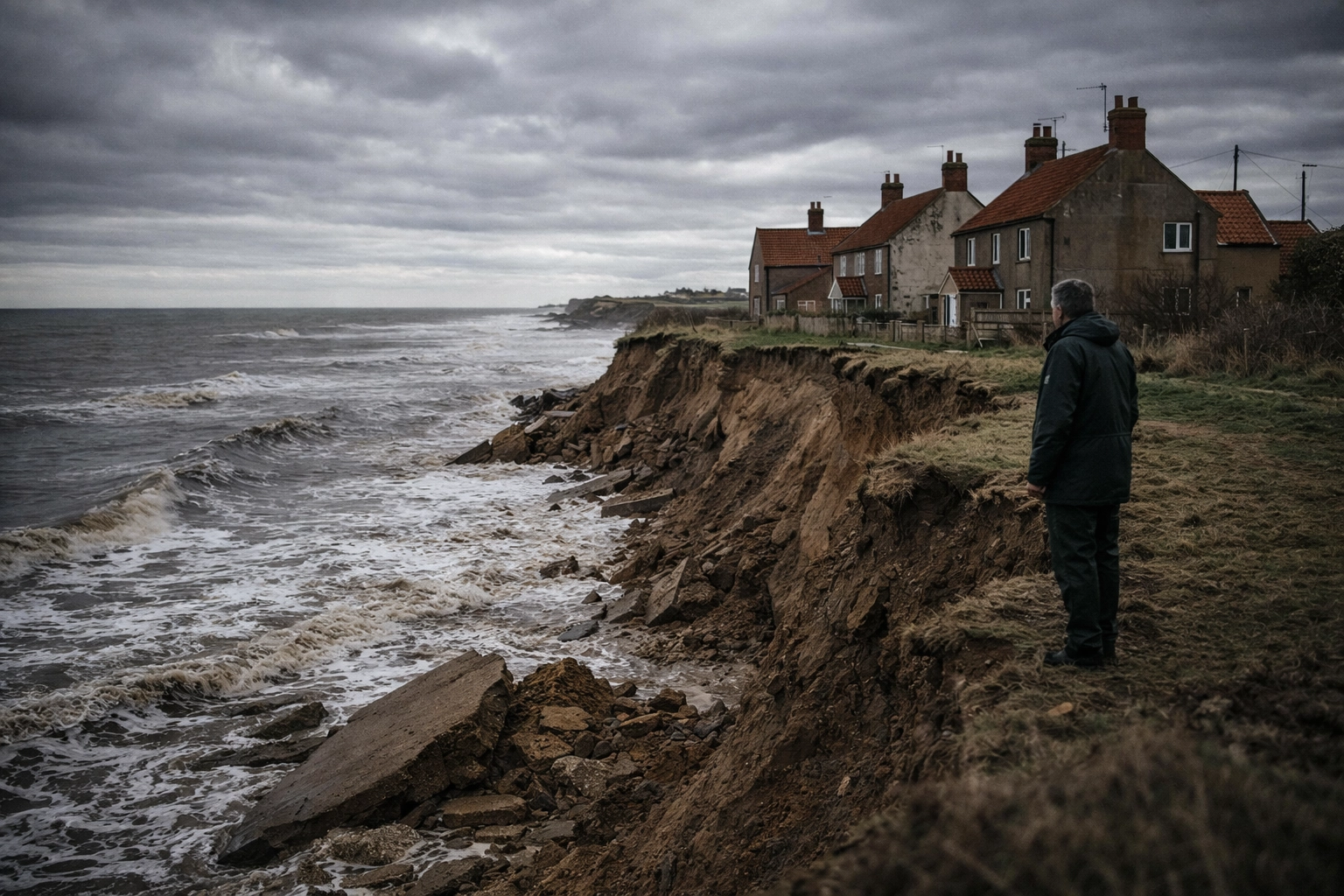
For an island nation like the UK, the sea is part of our DNA. It’s our border, our playground, and historically, our greatest defender. But for those living on the edges of Britain, the relationship with the ocean is much more complicated. It isn’t just a view; it’s a force that is slowly but surely reclaiming the land. Coastal erosion is one of those quiet crises that doesn't always make the front pages, but for dozens of communities, it is a slow-motion disaster that has been unfolding for centuries.
When we talk about the British coastline, we often think of the white cliffs of Dover or the rugged rocks of Cornwall. However, much of the eastern coast of England is made of far softer stuff. From the tip of Yorkshire down to the marshes of Suffolk, the land is often composed of soft clay, sand, and glacial till: material that was dumped there during the last Ice Age. To the North Sea, this isn't a barrier; it’s a buffet. Over the last few hundred years, entire villages have disappeared into the waves, leaving behind nothing but local legends and the occasional submerged ruin.
As we look at the state of our shores today, it is clear that this isn't just a historical curiosity. It is a living, breathing issue that is being accelerated by a changing climate and rising sea levels. At NowPWR, we believe in bringing you the untold stories of our landscape, providing independent news uk readers can trust to look beyond the immediate headlines. The story of our disappearing villages is one of resilience, loss, and the inevitable power of nature.
The Fast-Fading Holderness Coastline
If you want to see coastal erosion in its most aggressive form, you have to head to the Holderness coast in East Yorkshire. This stretch of land is officially the fastest-eroding coastline in Europe. On average, the cliffs here recede by about two metres every single year. That might not sound like much when you’re looking at a map, but over a decade, that’s twenty metres of someone’s garden, a local road, or a historic pub gone forever. Since the Roman times, it is estimated that more than thirty villages along this single stretch of coast have been lost to the sea.
One of the most heart-breaking examples in recent times is the village of Skipsea. Once a thriving community slightly inland, Skipsea now finds itself right on the frontline. The geology here is the main culprit; the cliffs are made of soft boulder clay. When the North Sea gets angry, especially during winter storms, it doesn't just wash away the beach: it bites huge chunks out of the cliff base. This causes the land above to collapse, taking whatever is sitting on top with it.
The people living in Skipsea and nearby settlements like Ulrome and Happisburgh are living with a level of uncertainty that most of us can’t imagine. It’s not just about the loss of property value: though that is devastating, as most of these homes are uninsurable and essentially worthless on the market: it’s about the loss of community. These are the untold stories of residents who have lived in their homes for generations, only to be told that within five to ten years, their living room will be part of the seabed. In a very real sense, the map of Yorkshire is being rewritten every time there is a high tide.
Norfolk and Suffolk Facing the Same Threat
The story doesn’t end in Yorkshire. Moving south into Norfolk and Suffolk, the "Lost Villages" become part of the local folklore. Perhaps the most famous of all is Dunwich in Suffolk. In the 11th century, Dunwich was one of the largest towns in England, a thriving international port that rivalled London in importance. Today, it is a tiny village with a population of fewer than 200 people. Most of the medieval city now lies ten metres below the waves. Local legend says that during particularly rough storms, you can still hear the bells of the submerged churches ringing from the depths of the sea.
While Dunwich is a story from the deep past, Happisburgh in Norfolk is a modern-day warning. Happisburgh is home to a beautiful Grade I listed lighthouse and a historic church, but it is also famous for the "Happisburgh footprint": the oldest human footprints found outside of Africa. These were revealed by the tide after a period of intense erosion and then washed away again just weeks later. It serves as a stark reminder of how much history is being claimed by the water.
The problem in these areas is a lack of "hard" sea defences. Building sea walls is incredibly expensive, and in many places, the government has moved away from a policy of "holding the line" to one of "managed realignment." This essentially means letting nature take its course because the cost of fighting the sea is simply too high. For the residents of these villages, this feels like a betrayal. As an independent news uk outlet, we see the tension between economic reality and the human right to protect one’s home. When a village is "de-commissioned," the social fabric that held it together for centuries often unravels long before the last house falls.
The Human Cost of a Changing Coast
It is easy to get lost in the statistics of metres per year or tonnes of earth moved, but the real story of coastal erosion is the human one. There are currently 21 villages and hamlets across England that have been identified as being at significant risk of being lost to the sea within the next few decades. This isn't a problem for the distant future; for many, the clock is already ticking.
The psychological toll on these communities is immense. Imagine the stress of watching a storm from your window, knowing that every wave is literally eroding your future. There is also the "blight" that erosion causes. Once a village is marked as being at risk, investment stops. Shops close, young people move away, and those who remain are often the elderly or those who simply cannot afford to leave. It creates a ghost-town effect years before the sea actually arrives.
Looking ahead, the situation is only going to get more challenging. With global sea levels rising and the frequency of "once-in-a-century" storms increasing, the rate of erosion is expected to accelerate. We are forced to ask difficult questions about which parts of our heritage we are willing to save and which we have to let go. Is a village of 500 people worth a £50 million sea wall? These are the uncomfortable debates that are currently happening in council offices and community halls across the country.
We often talk about climate change as something happening to polar bears or tropical islands, but the reality is that it is happening right here on our own doorstep. The loss of our coastal villages is a reminder that the land we stand on is more fragile than we like to think. By documenting these changes and sharing the experiences of those on the edge, we hope to keep these communities from being forgotten before they are even gone.
The UK's coastline will always be a place of beauty and inspiration, but we must also recognise it as a place of constant change. As the sea continues its slow march inland, the map of Britain will continue to shrink, and more names will be added to the list of villages lost to the waves. It is a process that has been going on since the end of the last ice age, and despite our best engineering, it is a battle that nature usually wins in the end. Understanding this history and the current risks is the first step in helping these communities navigate a very uncertain future. For readers looking for independent news uk coverage that centres untold stories, coastal erosion remains one of the clearest examples of a major issue unfolding in plain sight.