If the Sun has ever felt a bit like a bright blur in the sky, the Solar Orbiter has just changed that. What it has sent back is less “distant glowing disc” and more “front-row seat to controlled cosmic chaos”. These new close-ups offer a dazzling look at our nearest star, and yes, they are every bit as dramatic as they sound. For readers of independent news uk, this is a reminder that some of the most fascinating untold stories are not buried in briefing notes or boardrooms, but blazing away above us every single day.
What exactly did the Solar Orbiter capture?
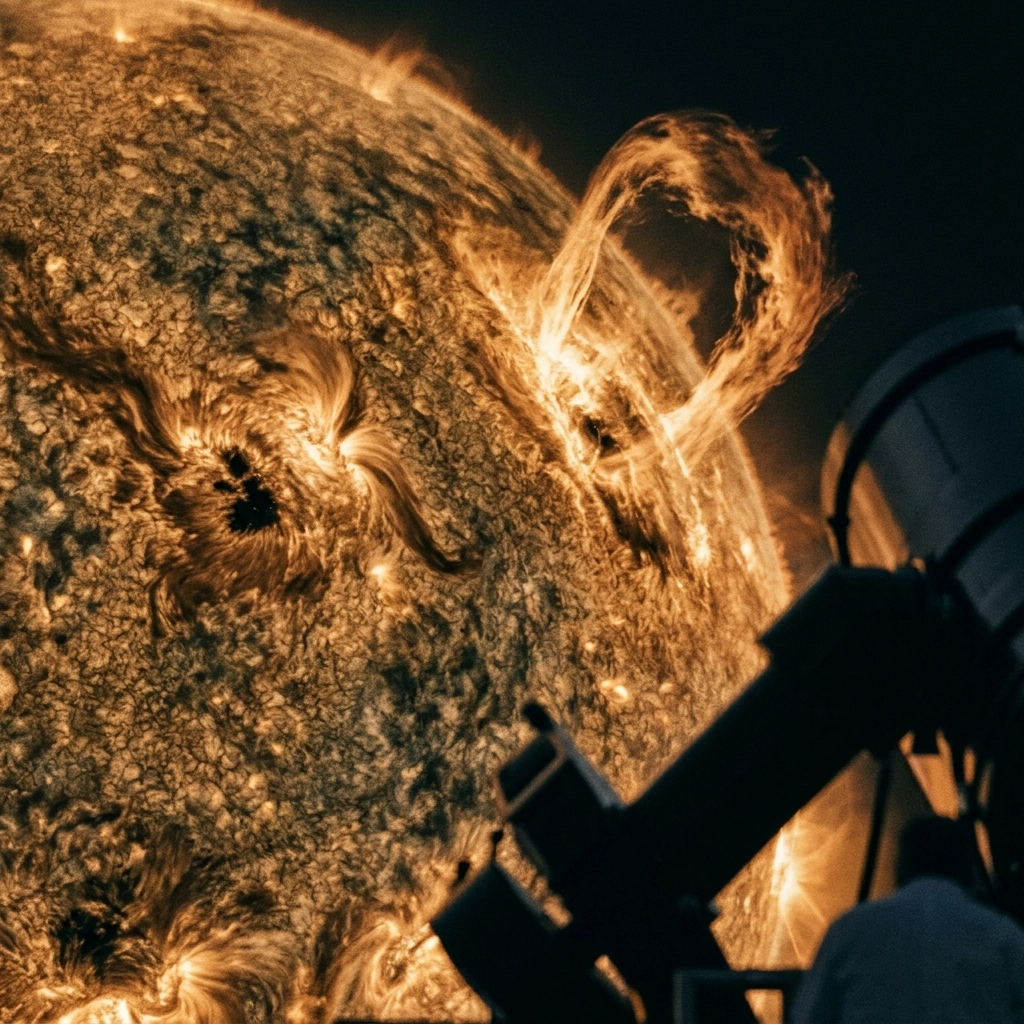
The headline-grabber is a vast solar mosaic built from around 200 ultraviolet images, stitched together to create one extraordinarily detailed view of the Sun. The spacecraft could not fit the entire star into a single shot at that distance, so it had to take overlapping frames and combine them into one enormous map. Think panorama mode, if panorama mode involved a spacecraft, intense radiation and the hottest object in our neighbourhood.
Those 200 UV images were captured by the Extreme Ultraviolet Imager, which sees wavelengths invisible to the human eye. That matters because ultraviolet light reveals the Sun’s upper atmosphere in rich detail, exposing features that would otherwise remain hidden behind the glare. The final result is not just sharp; it is staggeringly precise, turning the Sun from a familiar yellow circle into a textured, restless world of plasma and motion.
Why are the coronal loops such a big deal?
Because they look extraordinary and tell scientists something important at the same time. Coronal loops are giant arcs of superheated plasma, shaped and suspended by the Sun’s magnetic field. In the new Solar Orbiter imagery, they appear like glowing ribbons curling above the solar surface, elegant at first glance and faintly terrifying once you remember their scale.
They also sit at the centre of one of solar physics’ great puzzles. The Sun’s corona is vastly hotter than its surface, which sounds backwards because it is. Coronal loops may help explain how energy is transported and released in that outer atmosphere. In other words, these loops are not just visually spectacular; they are part of the untold stories scientists have been trying to decode for decades. Watching them twist, vibrate and occasionally snap gives researchers a clearer look at how solar flares and bursts of energy are triggered.
Why should people in the UK care about this?
Because the Sun is not just a pretty object in the sky. It drives space weather, and space weather has very real consequences on Earth. Powerful solar activity can interfere with satellites, communications, GPS systems and power infrastructure. The better scientists understand what the Solar Orbiter is seeing, especially in those 200 UV images and the coronal loops threaded through them, the better prepared we are for disruptive solar events.
There is also something refreshingly humbling about all this. We spend much of life absorbed by the noise of the day, then along comes a 4K-style solar close-up and reminds us that the biggest story in the sky has been unfolding all along. The Solar Orbiter has not made the Sun any less mysterious, but it has made that mystery feel gloriously close. It is a striking example of why independent news uk should still make room for wonder, and why some untold stories are written not in ink, but in fire.