The world of fundamental physics usually moves at the speed of a tectonic plate, but this week, the University of Liverpool just hit the accelerator. In a move that has sent shockwaves through the global scientific community and put a massive spotlight on independent news uk circles, a dedicated team of Scouse scientists has just bagged the 2026 Breakthrough Prize in Fundamental Physics.
We aren't talking about a small trophy and a handshake. We are talking about a cool $3 million (£2.4 million) prize, often dubbed the "Oscars of Science." The reason? They’ve been poking holes in the very fabric of reality using something called a muon. While the rest of the world was looking at standard headlines, these researchers were busy uncovering untold stories hidden within the subatomic realm.
The Particle That Refuses to Follow the Rules
To understand why a group of physicists in Liverpool is currently popping expensive champagne, you have to understand the muon. Think of it as the electron’s heavier, slightly more chaotic cousin. It’s unstable, it exists for only a fraction of a second, and right now, it is the biggest headache for theoretical physicists everywhere.
- What exactly is a muon? It is an elementary particle, similar to an electron but about 200 times more massive. Because it has a charge and spins, it acts like a tiny internal magnet.
- The "g-2" Mystery: In a perfect world: or at least the world described by the Standard Model of particle physics: we should be able to predict exactly how much this "magnet" wobbles when placed in a magnetic field.
- The Glitch in the Matrix: The problem is that the muon isn't wobbling the way it's supposed to. It’s wobbling more than the math says it should.
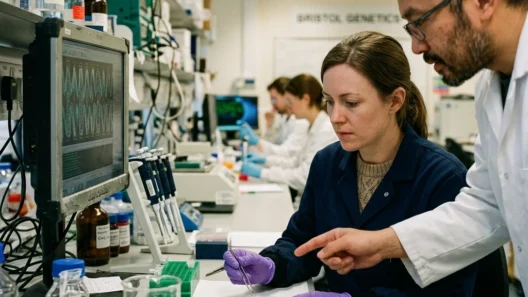
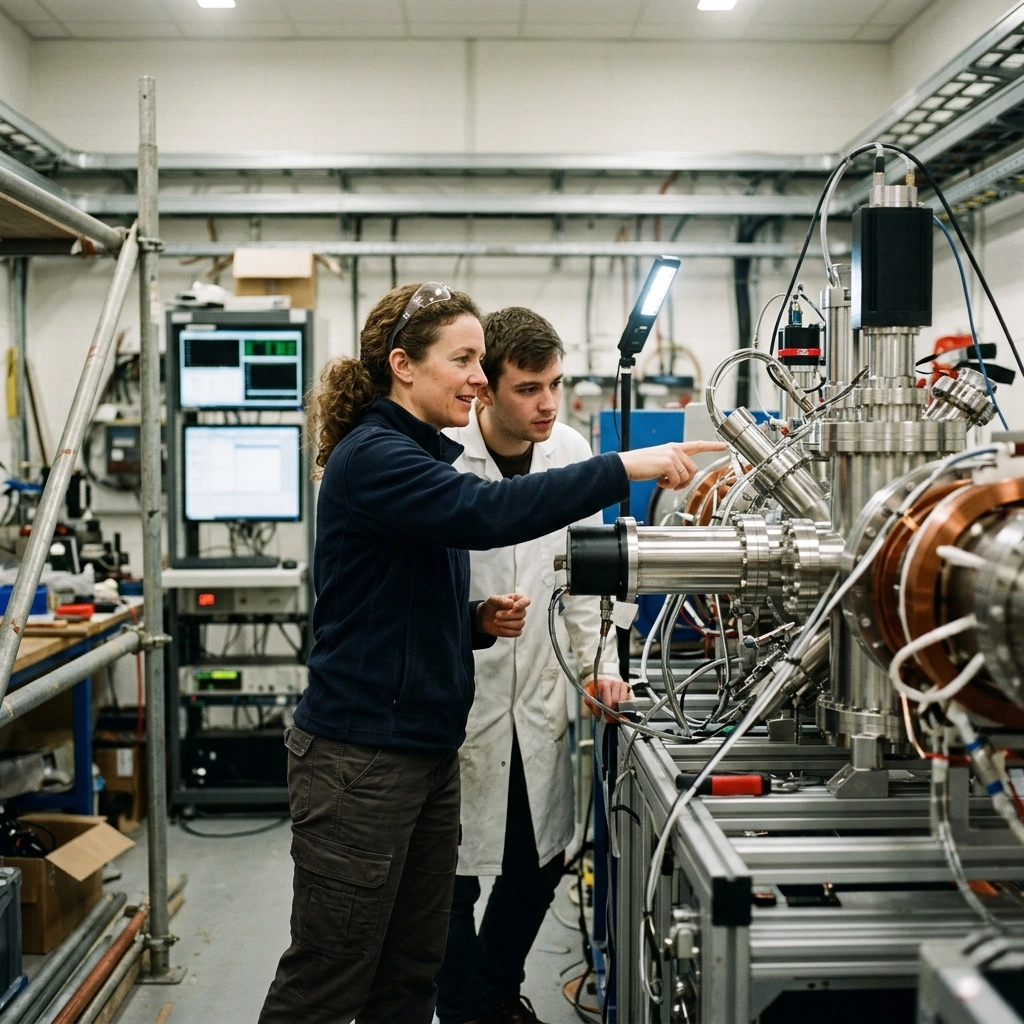
- The Liverpool Connection: The University of Liverpool team has been instrumental in the Muon g-2 experiment based at Fermilab. They designed and built the high-precision tracking detectors that monitor these particles as they zip around a 50-foot-wide superconducting magnetic ring.
- Precision is Everything: We are talking about measuring things to a precision of parts per billion. It’s the equivalent of measuring the length of a football pitch to within the width of a human hair.
- Why the Wobble Matters: If the wobble is "wrong," it means there is something else in the vacuum of space interacting with the muon that we haven't discovered yet. It could be a new force, a new particle, or even a hint at dark matter.
This isn’t just academic navel-gazing. This is about finding the "missing" pieces of the universe. The Standard Model has been the go-to instruction manual for physics for decades, but it can’t explain gravity or dark energy. The Liverpool team’s work on the muon is effectively pointing out that the instruction manual is missing a few chapters.
Liverpool’s Mastermind Physicists and the $3M Jackpot
Winning a Breakthrough Prize isn’t just about being smart; it’s about being right when everyone else is playing it safe. The University of Liverpool’s Department of Physics has long been a powerhouse, but this 2026 win cements its status as a global leader in high-energy physics. The $3 million prize is a massive glow-up for a department that has been grinding away at these untold stories for years.
- The Financial Injection: While $3 million is a life-changing amount of money for individuals, in the world of physics, it represents a massive endorsement of the "blue-skies" research being done in the UK.
- The Team Effort: Science at this level isn't a lone genius in a basement. It’s a massive collaboration. The Liverpool team worked alongside international colleagues, but their specific contribution to the tracking systems was what allowed the experiment to reach the required level of "statistical significance."
- High-Tech Infrastructure: Liverpool’s involvement relied heavily on their advanced manufacturing and semiconductor cleanrooms. This is where ai-technology and robotic precision meet raw theoretical physics.
- The Silicon Valley Connection: The Breakthrough Prize was founded by tech giants like Sergey Brin and Mark Zuckerberg. It’s designed to make scientists as famous as rockstars or athletes.
- Boosting the Local Economy: Beyond the prestige, awards like this attract the brightest minds in the world to Merseyside. It turns the city into a hub for innovation, proving that the UK’s scientific heart beats just as strongly in the North as it does in the "Golden Triangle" of London, Oxford, and Cambridge.
- The "Scouse" Science Brand: There’s a certain boldness in the way this team approached the problem. While other labs were hesitant to challenge the Standard Model, the Liverpool group leaned into the anomaly.
The prize money is intended to support further research, but it also serves as a beacon for the next generation of students. It proves that if you want to change how we understand the universe, you don't need to head to NASA; you can do it right here in the UK. This is the kind of narrative we champion at NowPWR, highlighting British excellence on a global stage.
Rewriting the Instruction Manual of the Universe
So, what happens next? You don’t just take the $3 million and retire to a beach. You use that momentum to tear down the walls of old physics. The Muon g-2 experiment is just the beginning of a new era of discovery that could redefine everything we know about reality.
- The End of the Standard Model? We are currently at a "five-sigma" level of certainty. In physics terms, that means there is only a one-in-3.5-million chance that this muon wobble is a fluke. We are looking at "New Physics."
- The Fifth Force: For a long time, we’ve lived with four fundamental forces: gravity, electromagnetism, and the strong and weak nuclear forces. The Liverpool results suggest there might be a fifth force we’ve never noticed before because it only talks to particles like the muon.
- Dark Matter Clues: One of the leading theories is that the "extra" wobble is caused by dark matter particles popping in and out of existence. If we can measure the wobble perfectly, we can start to figure out what dark matter actually is.
- Future Experiments: The team is already looking toward the next phase. With the prize money and the global attention, the University of Liverpool is well-positioned to lead the design for the next generation of particle colliders.
- Technology Spinoffs: High-precision tracking isn't just for particles. The tech developed in Liverpool labs often finds its way into medical imaging, cargo scanning, and even faster computing.
- A New Perspective for Independent News UK: This story is a reminder that the most important news isn't always what's happening in Parliament. Sometimes, the most world-shaking events are happening at a subatomic level in a lab in the North West.
The sheer scale of this achievement cannot be overstated. By successfully challenging the Standard Model, the Liverpool team has essentially told the world that we’ve been looking at the universe through a blurry lens, and they’ve just provided the corrective spectacles. It is a bold, witty, and incredibly Scouse way to handle the mysteries of the cosmos.
As we move further into 2026, the data from the muon experiments will continue to be analysed. The $3 million prize is a milestone, but the real reward is the knowledge that the "instruction manual" for the universe is finally getting the rewrite it desperately needs. This is the ultimate "glow-up": one that takes us from the known into the unknown, led by a team that wasn't afraid to ask why a tiny particle refused to sit still.
The University of Liverpool has proven that with enough precision, the right team, and a bit of a rebellious spirit, you can find the answers to the biggest questions in the smallest places. This win is a massive moment for UK science, confirming that when it comes to the fundamental laws of nature, Liverpool is currently calling the shots.
The Breakthrough Prize celebrates the "big ideas" that push humanity forward. In 2026, those big ideas are wearing a Liverpool lab coat. Whether it leads to the discovery of a fifth force or a better understanding of the Big Bang, one thing is certain: the world of physics will never look the same again.