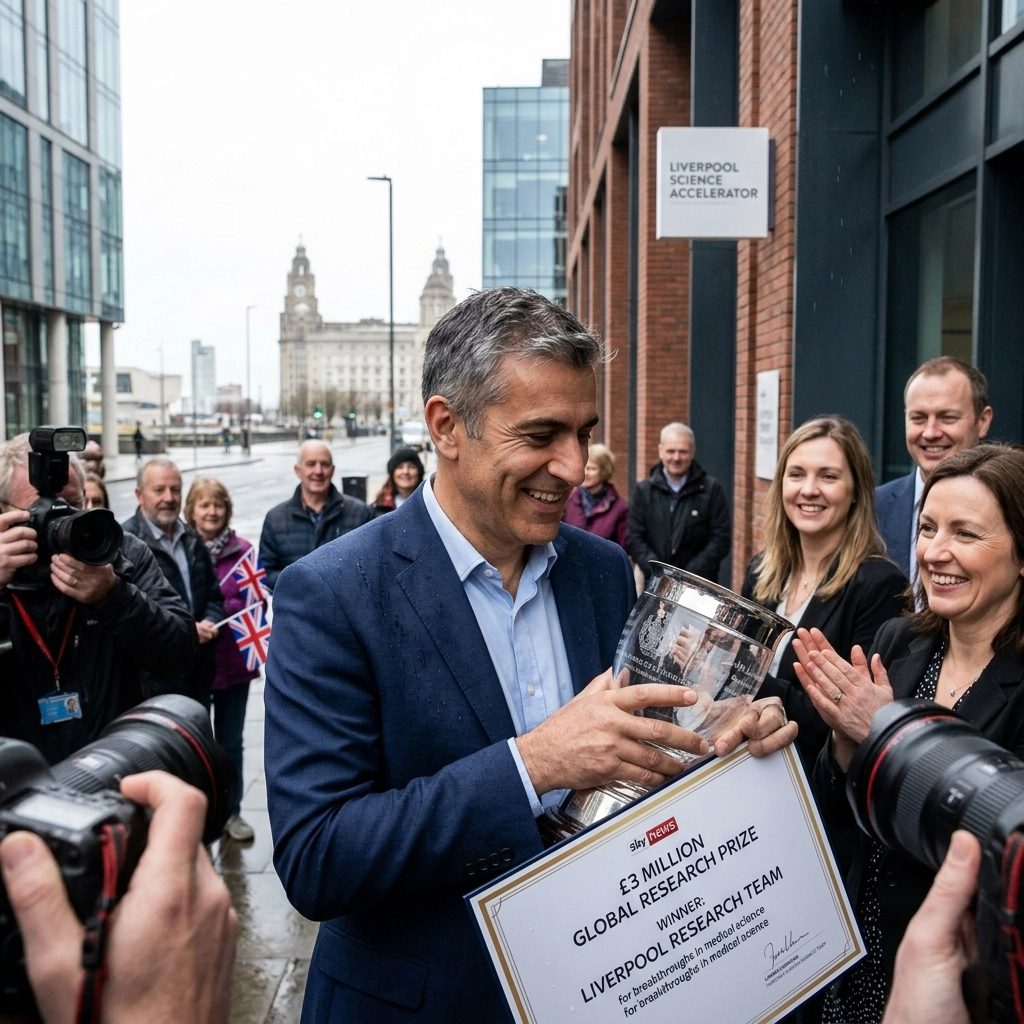
When you think of Liverpool, your mind probably goes straight to the Beatles, the historic docks, or the fierce rivalry at Anfield and Goodison Park. You might not immediately think of subatomic particles that exist for only two-millionths of a second. However, as of today, April 29, 2026, the city is officially a global powerhouse in the world of quantum physics. The Muon g-2 experiment has just been awarded the 2026 Breakthrough Prize in Fundamental Physics, bringing a cool $3 million (£2.4 million) to the international team, with a massive chunk of that recognition landing squarely in the North West of England.
This isn’t just a win for a few blokes in white coats; it is a monumental shift in our understanding of how the universe actually works. At the heart of this discovery are physicists from the University of Liverpool and the University of Manchester. For years, these researchers have been hunting for 'untold stories' hidden within the fabric of reality, and it turns out those stories are written in the wobble of a muon.
The Breakthrough Prize, often dubbed the ‘Oscars of Science,’ was founded by tech titans like Mark Zuckerberg and Yuri Milner to celebrate the kind of mind-bending work that usually flies under the radar of independent news UK outlets. By awarding this prize to the Muon g-2 team, the scientific community is acknowledging that we might be on the brink of discovering a fifth force of nature. And it all started with a giant magnetic ring and a lot of Scouse grit.
Why This Massive Win Matters for the North
For a long time, the narrative around UK science and innovation has been heavily weighted toward the 'Golden Triangle' of London, Oxford, and Cambridge. This $3 million prize flips that script entirely. The University of Liverpool’s physics department has been a key player in the Muon g-2 experiment since its inception, providing the high-precision tracking detectors that allowed the team to measure the muon's behaviour with unprecedented accuracy.
This win is a significant boost for the regional economy and the reputation of Northern universities. It proves that world-leading, ground-breaking research isn’t confined to the M25. When we talk about independent news UK stories, this is exactly the kind of achievement that deserves the spotlight. It highlights a level of expertise and dedication that often goes unnoticed in the national conversation. The Liverpool and Manchester teams didn't just participate; they led the way in one of the most complex experiments ever devised by humans.
Beyond the prestige, the prize money serves as a vital injection of resources. While $3 million split across an international collaboration might seem like a drop in the ocean compared to football transfer fees, in the world of academia, it is a life-changing sum. It funds further research, supports PhD students, and ensures that the North West remains a hub for global talent. It sends a clear message to young students in the region: you don’t have to move to the capital to change the world. You can do it right here on the banks of the Mersey.
The Mystery of the Wobbling Muon
So, what exactly is a muon, and why is everyone so excited about it wobbling? To understand this, you have to look at the Standard Model of particle physics. Think of the Standard Model as the ultimate rulebook for the universe. It explains how all the particles we know about interact with each other. For decades, this rulebook has been incredibly reliable. But physicists have always suspected that a few pages might be missing.
Enter the muon. The muon is essentially a 'fat' version of the electron. It has the same negative charge but is about 200 times heavier. Crucially, muons act like tiny internal compass needles. When placed in a magnetic field, they spin around: or wobble: at a very specific frequency. The Standard Model gives us a precise prediction of what that frequency should be. The Muon g-2 experiment, based at Fermilab, was designed to see if the real-world muon matches the rulebook.
The results, which have now been validated by this 2026 prize, show that the muon is wobbling slightly faster than the Standard Model predicts. It’s a tiny discrepancy: we’re talking about parts per billion: but in physics, a tiny discrepancy is a massive deal. It suggests that there are 'untold stories' in the subatomic world: perhaps new particles or forces that we haven't discovered yet: that are tugging on the muon and changing its behaviour. The Liverpool team’s job was to build the 'eyes' of the experiment, the detectors that could see this wobble with enough precision to prove the Standard Model is incomplete. Without their engineering brilliance, we’d still be guessing.
Breaking the Standard Model for Good
Winning the Breakthrough Prize isn't just a pat on the back for a job well done; it is a validation of a scientific revolution. By proving that the muon doesn't follow the established rules, the Liverpool and Manchester teams have effectively broken the Standard Model. This is the holy grail of modern physics. Breaking the model doesn't mean it’s wrong; it means it’s a subset of a much larger, more complex truth.
We are now looking at the very real possibility of a fifth force of nature. Currently, we only know of four: gravity, electromagnetism, and the strong and weak nuclear forces. If a fifth force exists, it could explain some of the biggest mysteries in the cosmos, such as what dark matter is made of or why there is more matter than antimatter in the universe. These are the kinds of questions that keep physicists up at night, and the answers are now closer than ever, thanks to the precision work done in the North of England.
The collaboration between Liverpool and Manchester has been seamless. While Liverpool provided the tracking systems, Manchester’s theorists and data analysts worked tirelessly to crunch the numbers and ensure that the results weren't just a statistical fluke. To reach a '5-sigma' level of certainty: the gold standard in physics: the team had to rule out every possible error. It is a testament to the rigour of British science that they achieved this. As we move forward, the data from this experiment will guide the next generation of particle colliders and space telescopes, shaping our understanding of reality for the next century.
The recognition of the Muon g-2 experiment with the 2026 Breakthrough Prize marks a definitive moment in scientific history. It highlights the vital role that UK institutions play in international collaborations and underscores the importance of supporting regional centres of excellence. The $3 million prize is a fitting reward for the years of meticulous work and intellectual bravery required to challenge the fundamental laws of physics. As the scientific community celebrates this achievement, the focus now shifts to identifying exactly what is causing the muon to wobble, a pursuit that promises to reveal even more about the hidden mechanisms of our universe. This success confirms that Liverpool and Manchester are not just participants in the global scientific dialogue but are leading it from the front.