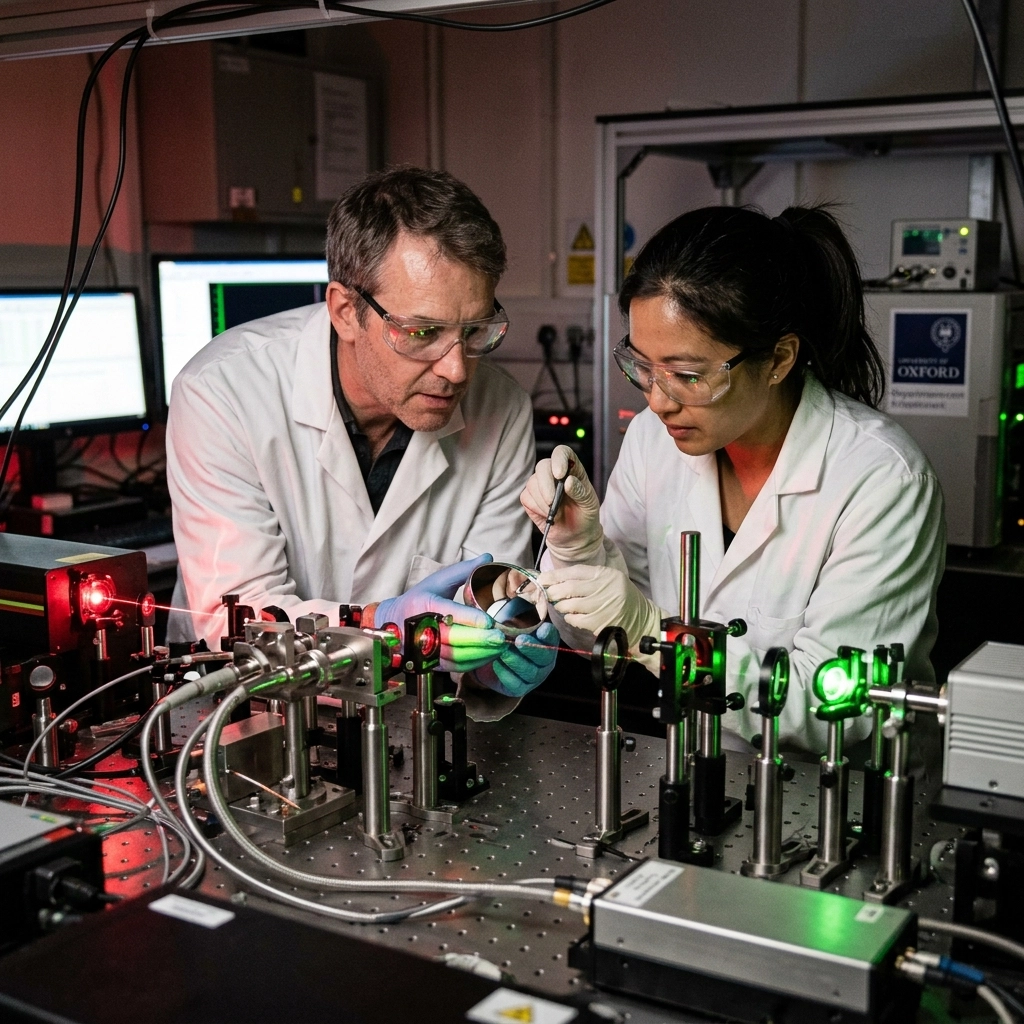
Scientists in the UK have just taken a massive leap into the future of physics, and frankly, it sounds like something straight out of a high-budget sci-fi flick. Researchers from the University of Oxford and the Science and Technology Facilities Council (STFC) have figured out how to turn plasma into a moving mirror that can intensify laser light to levels we’ve previously only dreamed of. This isn't just a minor tweak in the lab; it’s a fundamental shift in how we manipulate light at the most extreme scales. At NowPWR, we’re all about bringing you the untold stories that mainstream outlets might miss, providing that independent news uk perspective on the breakthroughs that actually matter.
This isn’t your bathroom mirror we’re talking about. We are diving into the world of relativistic harmonic generation. If that sounds like a mouthful, don’t worry: we’re going to break down why this "flying mirror" is the coolest thing to happen to British science this year.
The Magic of Einstein’s Flying Mirror
The core of this breakthrough lies in a concept that sounds remarkably simple but is incredibly difficult to execute: using plasma to reflect and compress light. Here is how the team at Oxford and STFC pulled it off:
- The Concept of the Flying Mirror: The researchers utilised what is often referred to as "Einstein's flying mirror." By firing an ultra-intense laser at a surface, they create a plasma: a soup of charged particles: that moves at speeds approaching the speed of light.
- Relativistic Speeds: When this plasma surface moves that fast, it starts behaving like a mirror. Because it’s moving toward the incoming laser beam at relativistic speeds, the physics of how light reflects off it changes entirely.
- The Doppler Shift on Steroids: You know how an ambulance siren sounds higher-pitched as it screams toward you? That’s the Doppler shift. When a laser reflects off this "flying mirror," the same thing happens to the light. Its frequency gets shifted upward, and its duration gets compressed.
- Harmonic Generation: This process creates "harmonics": integer multiples of the original laser frequency. Essentially, it takes the energy of the laser and packs it into much shorter, much more intense bursts of high-frequency light.
- Nature Publication: The results were so significant they were published in Nature, the gold standard for peer-reviewed scientific glory. This isn't just a theory anymore; it’s a demonstrated reality that has the physics community buzzing.
- Oxford and STFC Collaboration: This project is a prime example of the high-level collaborative work happening in the UK. The Science and Technology Facilities Council provided the heavy-duty infrastructure, while Oxford’s brightest minds provided the theoretical and experimental grunt work.
- Precision Engineering: To get this to work, the timing has to be perfect. We are talking about femtoseconds: one-quadrillionth of a second. If the pulse is off by even a fraction, the mirror doesn't form correctly, and the whole experiment goes dark.
- Intensity Gains: By compressing the light in time, the peak intensity of the laser increases exponentially. This allows researchers to probe the fundamental structure of vacuum and matter in ways that were previously impossible with traditional solid-state lasers.
Breaking the Intensity Ceiling
For nearly forty years, the world of high-power lasers has been dominated by a technique called Chirped Pulse Amplification (CPA). While CPA won its creators a Nobel Prize, it has its limits. The Oxford team is looking at what comes next.
- The Legacy of CPA: Invented in 1985 by Donna Strickland and Gérard Mourou, CPA allowed us to amplify laser pulses without destroying the laser itself. It’s the reason we have laser eye surgery and precision machining today.
- The Saturation Point: We’ve reached a point where building bigger CPA lasers is becoming prohibitively expensive and physically massive. To go further, we need a new trick. That’s where the plasma mirror comes in.
- Plasma vs. Glass: Traditional mirrors are made of glass or metal. At high enough intensities, the laser simply vaporises them. Plasma, however, is already "broken" matter. You can't destroy it with more intensity because it's already in its most energetic state.
- The Shrinking Lab: Instead of needing a building-sized laser to reach extreme intensities, plasma mirrors could allow us to achieve similar results in much smaller facilities. This democratises high-energy physics.
- Untold Stories of Innovation: While most people are looking at consumer tech, the real "untold stories" are happening in these high-energy labs. This research represents the UK's position as a global leader in laser physics.
- Independent News UK Context: In a landscape often dominated by political noise, these scientific milestones are the backbone of future economic and technological growth. Understanding this tech is key to seeing where the UK's "Content Creation" and R&D sectors are heading.
- Pushing the Relativistic Limit: The term "relativistic" means we are playing with physics where things move so fast that time and space start to warp. This mirror is a gateway to testing Einstein’s theories in a controlled laboratory setting.
- Coherent Harmonic Focus: The goal isn't just to make a bright light; it's to make a "coherent" light. This means all the light waves are in sync, allowing them to be focused down to a point smaller than a single atom.
What This Means for the Future of Science
So, why should the average person care about a flying plasma mirror in an Oxford lab? Because the implications for medicine, energy, and our understanding of the universe are staggering.
- Next-Gen Medical Imaging: High-frequency, high-intensity light pulses can be used to create X-rays and gamma rays that are far more precise than what we use in hospitals today. Imagine being able to image individual cells or biological processes in real-time.
- Clean Energy Research: Laser-driven fusion is the "holy grail" of clean energy. The more intense and controllable our lasers are, the closer we get to making fusion power a viable, limitless energy source for the planet.
- Particle Acceleration: Currently, we need miles of tunnels (like the Large Hadron Collider) to accelerate particles. Plasma-based accelerators, driven by these intense lasers, could do the same thing in a space the size of a tabletop.
- Vacuum Physics: At the extreme intensities promised by plasma mirrors, we can start to "boil the vacuum." According to quantum electrodynamics, even empty space isn't truly empty. Intense lasers can actually pull particles out of thin air (or rather, out of the quantum vacuum).
- UK Scientific Sovereignty: Projects like this highlight why the UK remains a powerhouse in the global scientific community. It’s about more than just "science"; it’s about maintaining a competitive edge in high-value industries.
- Educational Impact: For students and young researchers, this tech provides a roadmap for what’s possible. You can learn more about how we cover these topics by visiting our About page.
- Space Exploration: Compact, high-power lasers could eventually be used for laser-propulsion systems, pushing tiny probes to other star systems at a fraction of the speed of light.
- Materials Science: By hitting materials with these ultra-short pulses, we can observe how atoms move and bond in real-time, leading to the creation of entirely new materials with "impossible" properties.
The work being done by the Oxford and STFC teams is a testament to the power of thinking outside the box: or in this case, thinking outside the solid-state mirror. By turning the chaotic nature of plasma into a precision tool, they have opened a new chapter in the story of light.
This achievement is a reminder that the most exciting developments often happen at the intersection of high-level theory and gritty, hands-on experimentation. As we continue to follow these developments, it's clear that the future of UK science is looking brighter: and significantly more intense: than ever before. The plasma mirror isn't just a reflection of where we are; it’s a window into where we’re going.
The researchers have successfully demonstrated that the relativistic Doppler shift isn't just a curiosity for textbooks but a viable engineering path for the next generation of light sources. As this technology matures, the transition from lab-based experiments to industrial and medical applications will likely accelerate, cementing the UK's role in the next great technological revolution. This is the kind of progress that defines an era, proving once again that when it comes to innovation, the UK is operating at a truly relativistic level.