Forget what you think you know about teenagers in the West Midlands. While the stereotypical view might involve a lot of loitering and questionable fashion choices, a group of brilliant minds from Staffordshire has just flipped the script in the most spectacular, high-tech way possible. These aren't just kids with a hobby; they are the newly crowned UK Lego robotics champions, and they’ve proven that with enough plastic bricks and some seriously sharp coding skills, you can quite literally rule the world.
In an era where we are constantly bombarded with headlines about the decline of the UK’s technical prowess, this victory serves as a refreshing reminder of the talent simmering in our regional schools. It is one of those untold stories that rarely makes the front pages of the broadsheets, but at NowPWR, we believe this is exactly the kind of independent news uk readers need to see. This wasn’t a win handed to them on a silver platter; it was a gritty, high-stakes battle of wits, engineering, and nerves of steel.
The competition, part of the prestigious FIRST Lego League, isn’t just about building a cool-looking car and hoping it doesn’t crash into a wall. It is a gruelling multi-disciplinary tournament that tests everything from mechanical design to complex autonomous programming and innovative problem-solving. Our Staffordshire heroes didn't just participate; they dominated. Here is how they did it and why the rest of the country should be paying very close attention to what’s happening in Staffs.
1. Engineering a Masterpiece Under Pressure
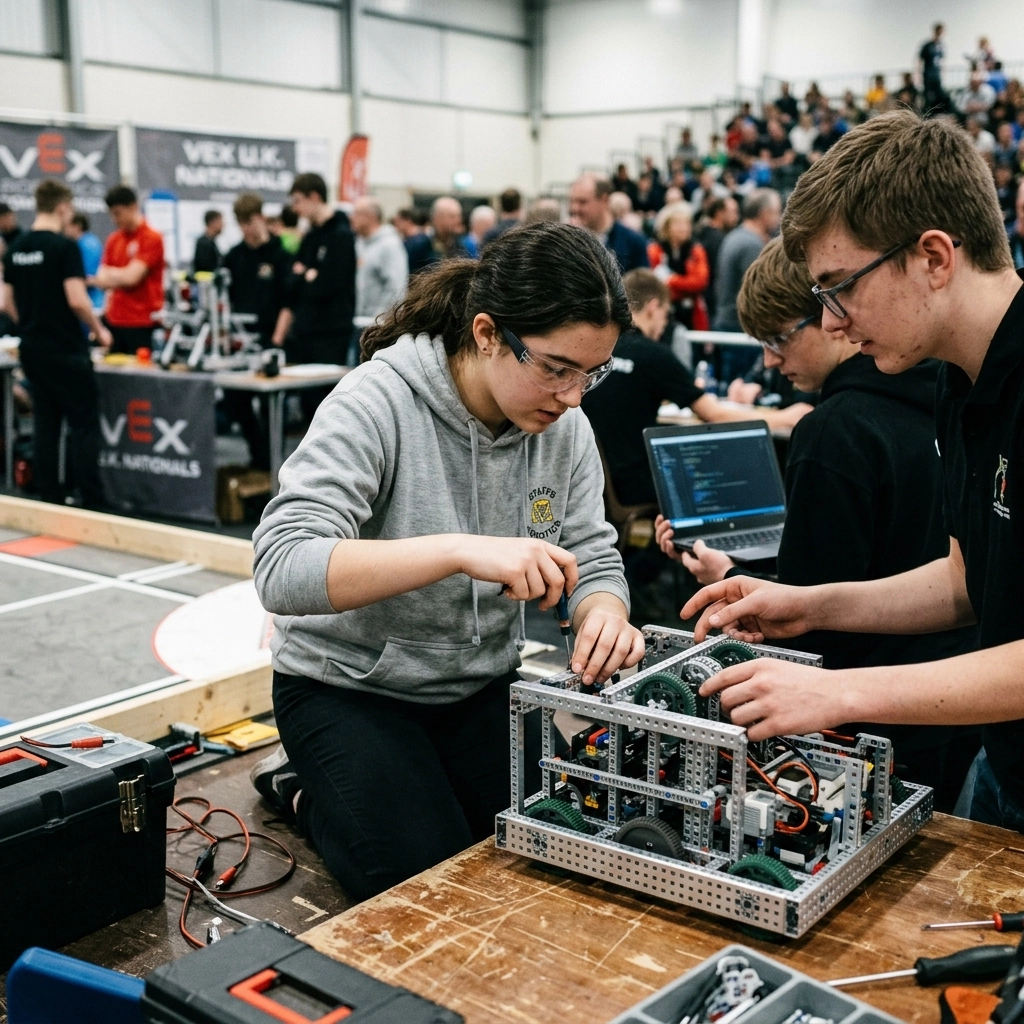
The heart of the competition lies in the Robot Game. Teams have to design, build, and programme an autonomous robot to complete a series of missions on a themed field. This year’s theme pushed the limits of what people thought was possible with consumer-grade hardware. The Staffordshire team, hailing from a modest local academy, didn't have the unlimited budgets of some of the private schools they were up against. Instead, they relied on sheer ingenuity and a refusal to accept "good enough."
Their robot was a marvel of minimalist engineering. While other teams were adding bells and whistles that looked great but functioned poorly, the Staffs crew focused on reliability. They utilised a modular attachment system that allowed their bot to switch tools in seconds: a critical advantage when every second on the clock feels like an hour. Their coding was equally impressive. Using advanced Python scripts rather than the standard block-based programming, they ensured their robot could navigate the field with centimetre-perfect precision.
What really set them apart, however, was their ability to pivot. During the semi-finals, a sensor failure threatened to derail their entire run. In a moment that would have seen most adults throwing their toys out of the pram, these teens stayed calm. They recalibrated their light sensors on the fly, adjusted the code to account for the overhead lighting in the arena, and delivered a flawless final performance. It was a masterclass in poise and technical skill, proving that the future of British engineering is in very capable hands. You can see more about how we cover these technical triumphs in our education section.
2. Solving Real-World Problems with Plastic
One of the most misunderstood aspects of Lego robotics is that it isn’t just about the robot. A massive chunk of the scoring comes from the Innovation Project. Teams are tasked with identifying a real-world problem and developing a creative solution. This is where the Staffordshire team truly showed their heart. They didn't look for a problem in some far-off land; they looked at their own community.
Their project focused on the accessibility of local green spaces for people with visual impairments. They developed a concept for an augmented reality audio-guide system that integrates with existing park infrastructure. They didn't just draw a picture on a poster, either. They consulted with local charities, interviewed tech experts, and built a working prototype using integrated sensors and a bespoke mobile app. Their presentation was so polished and their research so thorough that the judges were reportedly left speechless.
This level of empathy combined with technical application is exactly the kind of narrative we love to highlight. This isn’t just "kids playing with toys"; this is a group of young citizens using their skills to make the world a slightly better place. It’s a classic example of the untold stories that exist within our local communities: stories of brilliance that often get overshadowed by the national political noise. By focusing on these grassroots successes, we provide a brand of independent news uk that actually celebrates progress rather than just documenting decline.
3. Putting the Midlands on the Tech Map
For too long, the "tech hub" label has been hogged by London and the Silicon Roundabout. This victory for Staffordshire is a massive middle finger to the idea that you need to be in the capital to be at the cutting edge of innovation. The success of these teens has sent ripples through the local economy and the education sector, sparking a renewed interest in STEM (Science, Technology, Engineering, and Mathematics) across the county.
The impact of this win goes far beyond a trophy in a school display cabinet. It’s about aspiration. When younger students see people who look like them and come from the same streets winning national titles, it changes the internal monologue of what is possible. Staffordshire is now being looked at as a breeding ground for the next generation of roboticists and software engineers. Local businesses are already sniffing around, looking for ways to support the team as they prepare for the world championships in the United States.
This win also highlights the crucial role of dedicated educators who go above and beyond. The team’s mentors spent countless evenings and weekends in draughty classrooms, guiding the students without over-steering them. It’s a testament to the power of community-led education and the incredible results that can be achieved when young people are given the tools and the freedom to experiment. The Staffordshire teens haven't just won a competition; they’ve started a movement, proving that the Midlands is a force to be reckoned with in the global tech landscape.
The journey for these students is far from over. As they pack their bags for the international stage, they carry with them the hopes of a county and the respect of a nation. They have shown that "Staffs" isn't just about pottery and theme parks; it’s about world-class talent and the grit to succeed against the odds.
This victory underscores the importance of looking beyond the usual headlines to find the real drivers of change in our society. While the national news cycle focuses on grand gestures and political posturing, these teens were quietly building a better future, brick by brick. It is a reminder that excellence doesn't always wear a suit; sometimes, it wears a school jumper and carries a box of plastic gears. We will continue to follow their progress as they take on the best the world has to offer, confident that whatever happens next, they have already made their mark.
Staffordshire’s triumph in the Lego robotics world is a significant milestone for regional education and the UK's broader tech ambitions. By combining technical excellence with social consciousness and a resilient team spirit, these students have set a new benchmark for what young people can achieve. Their success is a clear signal that with the right support and an environment that encourages innovation, there are no limits to where these young engineers can go. The UK robotics scene has a bright future, and currently, that future is firmly rooted in the heart of Staffordshire.