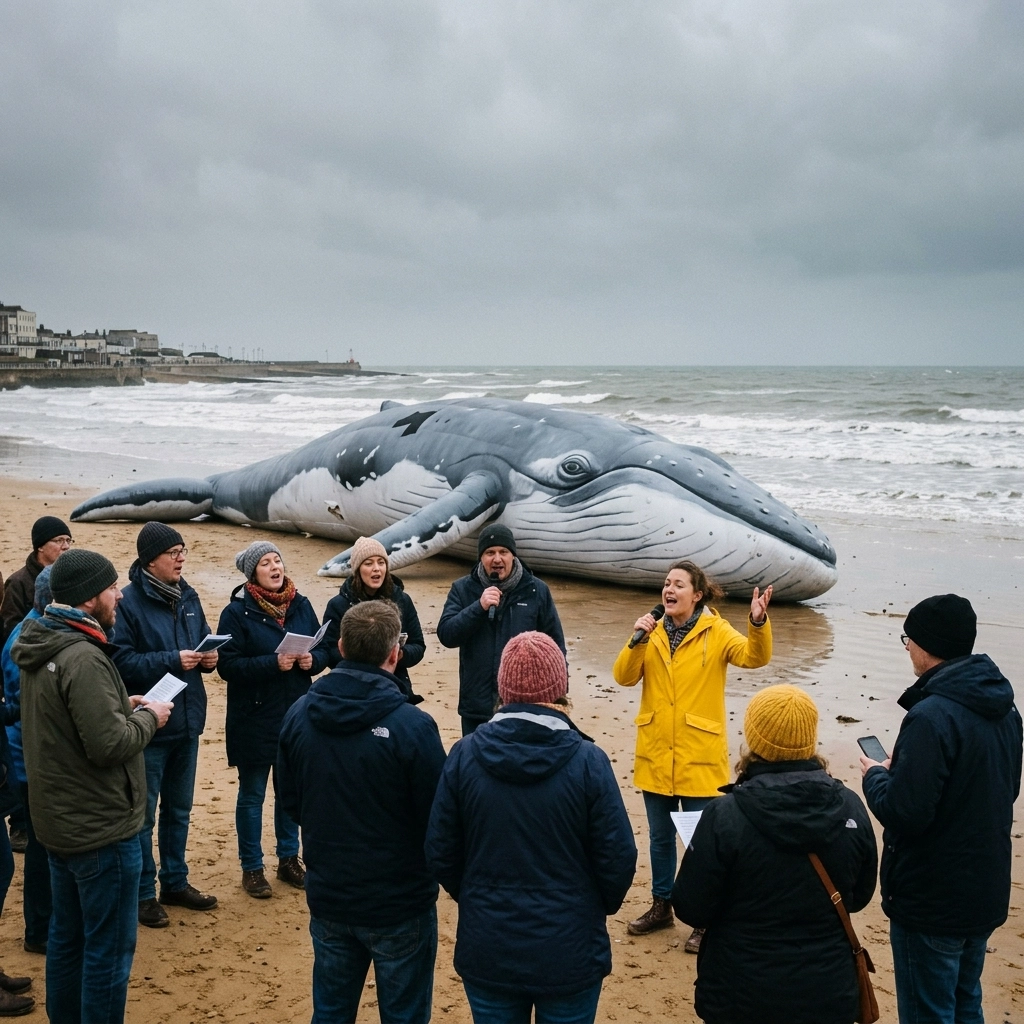
If you happened to be wandering along the Margate Sands this morning, you might have heard something a bit more harmonised than the usual squawk of a seagull eyeing up your chips. There is a specific kind of magic that happens when a community decides to stop talking about the environment and starts singing to it. The Margate Whale Choir has officially debuted their new ocean song, 'Wash Over Me', and it is exactly the kind of bold, eccentric, and deeply moving spectacle that makes this town the beating heart of Kent’s creative coastline.
Q: So, what exactly is the Margate Whale Choir? Is it a choir for whales, or a choir of people pretending to be whales?
A: It is a bit of both, though thankfully the members are human. The Margate Whale Choir is a collective of vocalists, activists, and locals who have decided that the traditional ways of protesting climate change are a bit too loud and not nearly melodic enough. Instead of shouting, they are leaning into the deep, resonant frequencies used by marine life. They describe themselves as a "cross-species bridge-building exercise." It is a quintessential example of the untold stories we love to uncover, the kind of thing that doesn’t always make the front pages of national broadsheets but defines the cultural fabric of independent news uk.
Q: Why 'Wash Over Me'? It sounds like a spa treatment.
A: It certainly isn't a spa treatment, unless your idea of a spa involves standing in a biting North Sea wind while your toes go numb in the sand. 'Wash Over Me' is a complex, multi-layered composition designed to mimic the infrasonic sounds of whale song. The lyrics are sparse, focusing instead on the vowel sounds and the resonance of the chest. The title refers to the idea of human accountability, allowing the reality of our ecological impact to wash over us rather than hiding from it. It is bold, it is unapologetic, and when forty people hit that low C together, you can feel the vibration in your shins.
Q: Does it actually work? Are the whales listening, or is this just a bunch of hipsters in woolly jumpers?
A: Whether or not a Humpback is currently nodding along somewhere off the coast of Ramsgate is up for debate, but that isn’t entirely the point. The choir worked with marine biologists to ensure the frequencies they use are compatible with the auditory range of cetaceans. More importantly, it works on the people listening on the shore. There is something primal about hearing a human voice try to imitate a creature that has existed for millions of years. It’s an artistic statement on our place in the natural world. And yes, there were some very nice woolly jumpers involved. Margate in May is still Kent in May, after all.
The Acoustic Science of Interspecies Serenading
Q: How do you even begin to write a song for a whale?
A: You don't just sit down with a guitar and some rhyming couplets. The creation of 'Wash Over Me' involved months of research into bioacoustics. The choir leaders collaborated with experts to understand the rhythmic patterns of the 'song', the repeated sequences that whales use to communicate over thousands of miles. They discovered that whales don’t just make noise; they have dialects and trends. They change their songs over time, much like we change our pop charts. 'Wash Over Me' incorporates these shifting patterns, using a technique called 'looping' where different sections of the choir repeat phrases at different intervals, creating a wall of sound that mimics the vastness of the ocean.
Q: Is there a political edge to this, or is it purely artistic?
A: In the world of independent news uk, nothing is purely artistic. Margate has a long history of being a place where the fringe becomes the mainstream. By choosing to sing for the sea, the choir is making a very clear statement about marine conservation and the health of our local waters. They are highlighting the noise pollution caused by shipping and industrial activity, which interferes with the very songs they are trying to emulate. It’s a bold way to frame a political argument, using beauty and harmony to point out the discord we’ve created in the deep.
Q: What was the atmosphere like on the beach during the performance?
A: It was strangely quiet, despite the singing. Usually, a performance on the beach involves a PA system and a lot of fuss. This was unplugged. The choir stood in a semi-circle, facing the horizon, and the sound just carried on the wind. For the onlookers, it was one of those untold stories that you feel lucky to stumble upon. There were dog walkers who stopped in their tracks, tourists who forgot their ice creams were melting, and a general sense of awe. It wasn't a concert; it was an invocation.
Margate’s Resurgence as an Artistic Powerhouse
Q: Why does this kind of thing always seem to happen in Margate?
A: Margate has always been a bit of an outlier. It’s a town that has survived the decline of the British seaside holiday by reinventing itself as a sanctuary for the avant-garde. From the Turner Contemporary to the tiny galleries tucked away in the Old Town, there is a sense that anything is possible here. The Whale Choir fits perfectly into this narrative. It’s a community that isn’t afraid to look a bit ridiculous if it means saying something meaningful. This resurgence isn't just about gentrification; it's about a genuine, grassroots commitment to creativity that you don't find in many other places.
Q: Does 'Wash Over Me' have a future beyond the beach?
A: There are plans to record the track using hydrophones, underwater microphones, to see how the sound translates beneath the surface. The choir is also looking into a series of 'guerilla' performances at various points along the UK coast. They want to turn 'Sing for the Sea' into a nationwide movement, encouraging other coastal towns to develop their own local anthems for the water. It’s an ambitious goal, but given the reception in Margate, it’s far from impossible.
Q: How does this project reflect the values of NowPWR?
A: We are all about the stories that get missed when everyone is looking in the same direction. The Margate Whale Choir represents the intersection of climate awareness, community spirit, and unapologetic creativity. It’s an untold story that reminds us that there are still plenty of ways to engage with the world that don't involve a screen or a keyboard. As a voice in independent news uk, we think it’s vital to highlight these moments of human connection, especially when they involve trying to chat with a whale.
The Ecological Message Behind the Melody
Q: What is the main takeaway for someone who wasn't there to hear it?
A: The main takeaway is that the environment isn't just a set of statistics or a series of terrifying headlines; it’s something we are intimately connected to. When the choir sings 'Wash Over Me', they are asking us to stop seeing the ocean as a resource or a dumping ground and start seeing it as a living, breathing entity that we can communicate with, even if we don't speak the same language. It’s a message of humility. We are not the only singers on this planet, and it’s about time we started listening to the others.
Q: Are there any plans for a follow-up? Maybe a song for the seagulls?
A: The choir director laughed when that was suggested, but she didn't say no. For now, the focus remains on the deep sea. There is talk of a winter performance involving bioluminescent lights, which would certainly be a sight to behold on a dark January evening. The goal is to keep the conversation going: to ensure that the plight of our oceans remains in the public consciousness, even after the tide goes out.
Q: How can people get involved?
A: You don't need to be a professional singer. You just need to have a set of lungs and a willingness to stand in the cold for a good cause. The choir holds open rehearsals, and they are always looking for new voices to add to the swell. It’s about collective action through collective song. If you find yourself in Margate, look for the group of people staring intently at the water and making sounds like a submarine: they’ll likely be happy to have you join in.
The performance of 'Wash Over Me' marks a significant moment in the local arts calendar, blending environmentalism with a unique choral tradition. As the Margate Whale Choir continues to develop its repertoire, the project serves as a reminder of the power of community-led initiatives in raising awareness for global issues. The group remains committed to its mission of using sound to bridge the gap between humanity and the marine environment.
The Margate Whale Choir will continue their series of coastal performances throughout the summer months, with dates and locations expected to be announced shortly. Through their music, they continue to provide a unique perspective on the relationship between our coastal communities and the natural world.