In the world of independent news uk, we often find ourselves sifting through political squabbles and economic forecasts, but every so often, a story breaks that is quite literally universal. While most of the country was busy checking the weather or brewing the morning’s third cup of tea, a group of dedicated scientists: many of them based right here in the UK: were celebrating a breakthrough that has been two decades in the making. They haven't just found a needle in a haystack; they’ve found a new type of hay that changes how we understand the entire stack.
The discovery of the Ξcc⁺ (pronounced ‘Xi cc plus’) at CERN’s Large Hadron Collider (LHC) is the kind of untold stories success that usually stays buried in academic journals, but this one is a genuine smash hit for British science. It’s a heavy subatomic particle, a sort of beefier, more exotic cousin to the humble proton that sits inside every atom in your body. But while the proton is stable and reliable, this new cousin is a fleeting, heavy-duty marvel that tells us a lot about the ‘glue’ that holds the universe together.
This wasn’t a lucky accident. It was the result of a massive upgrade to the LHCb experiment, a project where the UK didn't just participate: it led the charge. With the University of Manchester at the helm of the international collaboration, British engineering and physics have proven that when it comes to the subatomic world, we are still very much heavy hitters.
The Quest for the Xi cc Plus
To understand why this discovery is causing such a stir in the physics community, you first have to understand the family tree of subatomic particles. Most of us are familiar with protons and neutrons, the building blocks of the atomic nucleus. These are made of smaller bits called quarks. Protons have two ‘up’ quarks and one ‘down’ quark. They are the lightweights of the family, relatively speaking, and they stay around forever.
The Ξcc⁺ is a different beast entirely. It belongs to a group called baryons, but unlike the proton, it contains two ‘charm’ quarks and one ‘down’ quark. Charm quarks are much heavier than the up and down quarks that make up normal matter. Because of this, the Ξcc⁺ is significantly more massive: a ‘heavy cousin’ that exists only for a fraction of a second before decaying into other particles.
For more than twenty years, this particle was the Loch Ness Monster of particle physics. Back in the early 2000s, an experiment called SELEX at Fermilab in the United States claimed to have seen glimpses of it. However, no other experiment could replicate the result. In the world of high-stakes physics, if you can’t see it twice, it might as well not exist. It became a lingering mystery, a ghost in the machine that theoretical physicists insisted should be there, but experimentalists couldn’t find.
The breakthrough finally came after the LHCb detector underwent a massive upgrade, completed in 2023. This upgrade allowed the detector to sift through proton collisions at an unprecedented rate, looking for the tell-tale signs of heavy quarks. The team observed approximately 915 events that matched the signature of the Ξcc⁺. Even more impressively, the discovery reached a statistical significance of 7 sigma. In plain English, that means the chances of this being a fluke are less than one in a hundred billion. It’s about as certain as science gets.
British Engineering at the Heart of the Smash
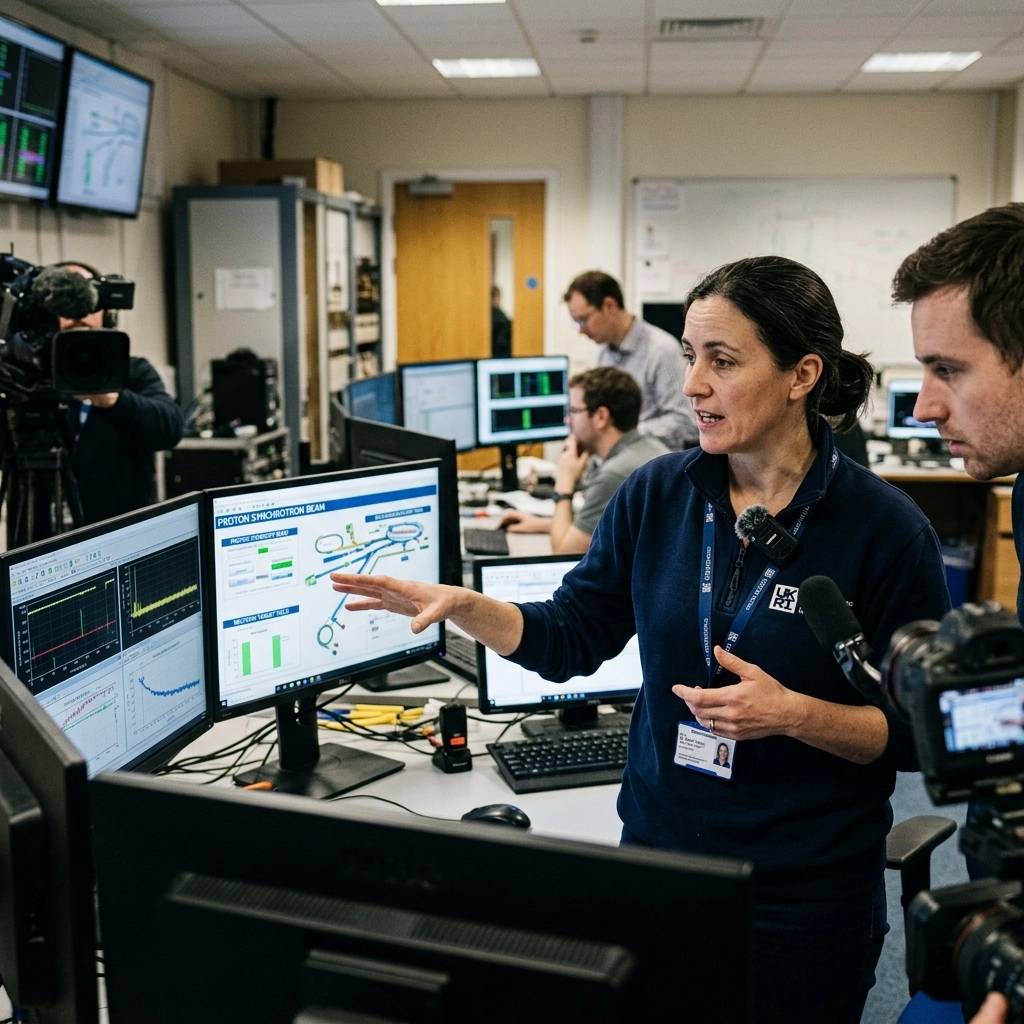
While CERN is located on the border of France and Switzerland, this particular victory has a distinct British accent. The United Kingdom contributed more to the LHCb upgrade than any other nation, and the leadership of the project was centred at the University of Manchester. Professor Chris Parkes led the international collaboration, overseeing more than 1,000 researchers from 20 different countries.
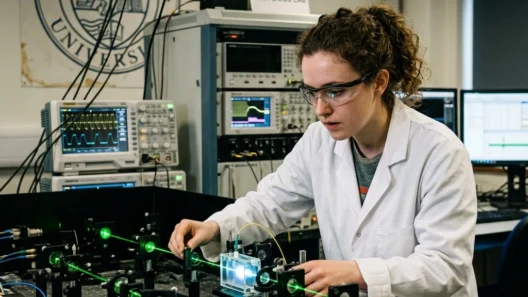
The ‘eyes’ of the experiment: the parts that actually see the particles flying away from the collisions: were largely designed and built in the UK. The Manchester team was responsible for the silicon pixel detector modules. These are incredibly sophisticated pieces of kit, capable of taking ‘snapshots’ of particle tracks with micrometre precision. Without these modules, identifying the Ξcc⁺ would have been impossible. The particle decays almost instantly, travelling only a tiny distance before it disappears. You need the world’s fastest and most accurate camera to catch it in the act.
This level of involvement highlights a side of the UK that often goes unmentioned in the headlines. We are a nation of world-class engineers and ‘brainboxes’ who are literally building the future of human knowledge. The silicon modules built in Manchester had to survive an environment of intense radiation and operate with a reliability that makes your smartphone look like a Victorian steam engine.
The success of the Ξcc⁺ discovery is also a testament to the long-term thinking that scientific research requires. This wasn’t a project that happened overnight; it took over a decade of planning, building, and testing. It’s a reminder that when we invest in fundamental science, the rewards aren’t just a new line in a textbook: they are the development of technologies and expertise that keep the UK at the forefront of global innovation. This is the essence of why we cover these untold stories; they remind us of the quiet brilliance happening in labs across the country while the rest of the world is looking elsewhere.
Decoding the Secrets of the Strong Force
So, why does any of this matter to the average person on the street? Aside from the bragging rights of a UK-led discovery, the Ξcc⁺ helps us solve one of the biggest puzzles in physics: the Strong Force. This is the force that holds quarks together inside protons and neutrons. It is the strongest force in nature, yet it is also the one we understand the least.
The Strong Force is described by a theory called quantum chromodynamics, or QCD. While QCD works well for simple particles, it gets incredibly complicated when you start dealing with heavy quarks. By studying a particle like the Ξcc⁺, which has two heavy charm quarks, physicists can test the QCD mechanisms in a ‘heavy’ environment. It’s like testing a car’s suspension on a smooth motorway versus a rocky mountain path; the mountain path (the heavy quarks) reveals flaws and details you would never see on the motorway.
One of the most fascinating aspects of this discovery is that the particle’s mass didn't actually match the old claims from the SELEX experiment. It did, however, align perfectly with modern theoretical predictions. This suggests that our understanding of how matter is constructed is becoming more accurate. We are moving closer to a ‘Grand Unified Theory’ that explains how all the forces in the universe interact.
The Ξcc⁺ also has a very short lifetime: up to six times shorter than its previously discovered partner particle. Observing something so ephemeral is a technical triumph that opens the door to finding even more ‘exotic’ matter. We are now entering an era where we can create and study particles that haven't existed in large numbers since the first few seconds after the Big Bang.
This isn't just about small dots on a screen; it’s about understanding the recipe for reality. Every time we find a new particle, we are adding a new piece to the cosmic jigsaw puzzle. And for now, the most important piece has been fitted into place by a team of scientists in Manchester and across the UK, proving that when it comes to smashing atoms and breaking records, we are still leading the way.
As we look forward to more data coming out of the upgraded LHC, this discovery is just the beginning. It sets the stage for a new decade of exploration where the ‘untold stories’ of the universe will finally be heard. For the UK science community, this isn't just a win; it’s a clear signal that our contribution to the global scientific stage remains as vital and vibrant as ever.