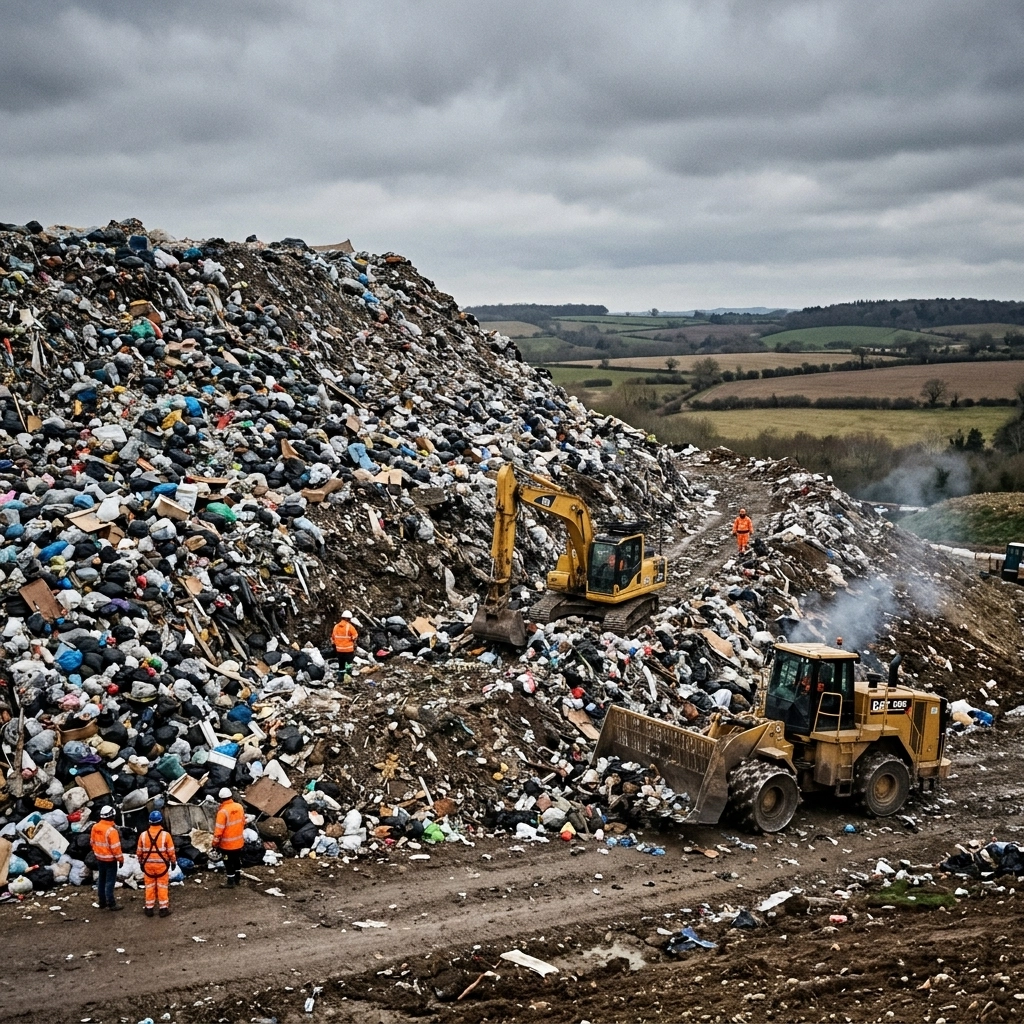
If you were to take a leisurely drive along the A34 near Kidlington, you might expect the usual Oxfordshire vistas: rolling greens, perhaps a glimpse of the River Cherwell, and the standard British grey sky. What you probably wouldn't expect to see: unless you were looking through the right gap in the trees: is a topographical anomaly that wasn’t there a year ago. It isn't a new hill for local hikers, and it certainly isn't an artistic installation. It is a massive, stinking, 150-metre-long monument to human greed and systemic failure. It is, quite literally, a mountain of trash.
In the world of independent news uk, we often talk about "untold stories," but this one is hard to miss if you know where to point the drone. This isn't just a bit of fly-tipping by a rogue builder with an old transit van. This is industrial-scale waste crime, a booming sector of the UK’s shadow economy that is currently laughing in the face of local authorities and environmental regulators. The Oxfordshire site has become the poster child for a national epidemic that is costing the taxpayer a fortune while poisoning the land we walk on.
The sheer logistics of this eyesore are staggering. We are talking about a mound that stretches up to 150 metres in length and towers at least 10 metres high in some sections. To put that into perspective, that is longer than a professional football pitch and taller than two double-decker buses stacked on top of each other. It occupies a three-acre site that, until recently, was just another patch of Oxfordshire greenery. Now, it is a dense, compacted mass of shredded waste, plastic, and gods-know-what-else, sitting precariously close to the riverbank.
The Three-Month Transformation of a Local Landmark
The most terrifying aspect of the Kidlington trash mountain isn't just its size; it’s the speed at which it appeared. Satellite imagery provides a damning timeline of how quickly waste criminals can move when they smell a profit. In April 2024, the site was almost entirely grass. By March 2025, it was still relatively clear. However, by September 2025, the transformation was complete. Within a window of just about three months, thousands of tonnes of waste were trucked in, dumped, and piled high.
This wasn't a slow accumulation. This was a tactical, high-speed operation. It requires a level of coordination that suggests organized criminal involvement. Think about the number of lorries required to move that much material. We are talking about hundreds, if not thousands, of trips. Yet, because the site was strategically positioned behind a screen of trees and tucked away from the direct line of sight of the main road, the "mountain" grew in relative peace. While local residents went about their business and commuters sat in traffic on the A34, a criminal enterprise was reshaping the landscape.
Local politicians have described the situation as an affront to the community. For those who use the nearby paths for dog walking or angling along the Cherwell, the discovery of the dump was a shock. It highlights a massive vulnerability in how we monitor our land. If a three-acre, 10-metre-high mountain of rubbish can appear in three months without immediate intervention, what else is being hidden in the British countryside? This is where action-needed becomes more than just a tagline; it becomes a desperate plea for a regulatory system that actually has teeth.
The Billion-Pound Business of British Waste Crime
To understand why Oxfordshire is currently hosting a festival of filth, you have to follow the money. Waste crime is often called the "new narcotics" because the risk-to-reward ratio is incredibly skewed in favour of the criminal. When a legitimate business disposes of waste, they have to pay landfill taxes, environmental fees, and haulage costs. It’s expensive, and rightly so: managing the planet's leftovers shouldn't be cheap. However, if you are a criminal gang, you can charge a company a "discounted" rate to take their waste away, then simply dump it in a field you’ve illegally occupied or rented under a false name.
The profits are astronomical. By skipping the legal disposal routes, these gangs pocket millions of pounds in pure profit. Meanwhile, the UK loses an estimated £1 billion every year to waste crime. This isn't a victimless crime. That £1 billion is money that could be going into schools, hospitals, or, ironically, better environmental protection. Instead, it’s being used to fund other criminal activities, from drug trafficking to human smuggling. Waste crime is the engine room for a lot of the nastiness that happens in the UK's underworld.
The Environment Agency is currently investigating the Oxfordshire site, but they are playing a permanent game of catch-up. These gangs are mobile, sophisticated, and often disappear the moment a site reaches capacity. By the time the authorities have built a case, the perpetrators have moved on to the next county, the next field, and the next mountain of trash. It’s a game of "whack-a-mole" where the mole is a 20-tonne lorry filled with shredded plastic. The House of Lords has even called for an inquiry into the matter, recognizing that the current system is effectively a "free-for-all" for those willing to break the law.
The Environmental Debt and the Cleanup Crisis
So, who pays to move a mountain? That is the multi-million-pound question facing Oxfordshire. Clearing a site of this scale isn't as simple as bringing in a few diggers. The waste is often mixed, potentially hazardous, and highly compacted. The cost of legal disposal for a site this size could easily exceed the annual budget of a local council. There is a very real possibility that the taxpayer will end up footing the bill because the criminals who created the mess are long gone, leaving behind nothing but a trail of shell companies and fake IDs.
Beyond the financial cost, there is the environmental toll. The Kidlington dump is situated near the River Cherwell. As rainwater filters through a mountain of unregulated waste, it creates a toxic soup known as leachate. This liquid can seep into the groundwater or runoff into the river, devastating local ecosystems and killing fish and plant life. We are essentially looking at a ticking ecological time bomb. The longer the mountain sits there, the deeper the poison goes.
This is a story of a system that is being exploited at every turn. From the lack of real-time monitoring of rural land to the insufficient penalties for those caught, the UK has inadvertently created a paradise for waste criminals. Oxfordshire’s literal mountain is a wake-up call. It is a visible, stinking reminder that our current approach to waste management is broken. If we want to protect the "green and pleasant land" we’re so fond of singing about, we need to start taking the trash business a lot more seriously.
The investigation into the Oxfordshire dump continues, with officials scouring for evidence that might lead back to the source. It is a painstaking process of forensic accounting and physical evidence gathering. But while the bureaucracy grinds slowly, the mountain remains: a shadow on the landscape and a testament to the fact that in the UK, crime doesn't just pay; it builds landmarks.
The situation in Oxfordshire is a stark reminder of the challenges facing environmental enforcement in the 21st century. As waste production continues to rise and the costs of legal disposal climb, the incentive for criminal activity only grows stronger. Without a fundamental shift in how we monitor, report, and penalize waste crime, the "mountain" near Kidlington will likely not be the last one we see. It remains a waiting game to see if the authorities can reclaim the site before the environmental damage becomes permanent.