If you have ever spent a frustrating afternoon chasing a common fruit fly around your kitchen with a rolled-up newspaper, you already know they are surprisingly evasive. You might have even questioned how something with a brain the size of a poppy seed can outsmart a human with a brain weighing three pounds. Well, science finally has an answer, and it is much more complex than "it is just fast."
For the first time in history, researchers have mapped the entire brain of an adult fruit fly (Drosophila melanogaster). We are talking about every single neuron and every single connection. This is not just a win for the flies; it is a seismic shift for neuroscience, offering one of the most compelling untold stories of modern biology. In a world of loud headlines, this tiny breakthrough is the quiet revolution we have been waiting for.
As an independent news uk source, NowPWR is here to break down why this microscopic achievement is actually a massive deal for our understanding of the human mind, AI technology, and the future of medicine. Here are five things you absolutely need to know about the fruit fly connectome.

A Digital Blueprint of Biological Chaos
The first thing to understand is the sheer scale of the "tiny" fly brain. While it might look like nothing more than a speck to the naked eye, the fly's brain is a dense, hyper-connected jungle. Scientists have successfully mapped approximately 130,000 neurons and a staggering 50 million synapses. To put that in perspective, the previous record for a complete brain map was held by a larval fruit fly, which had about 3,000 neurons, and before that, a tiny soil worm with just 302.
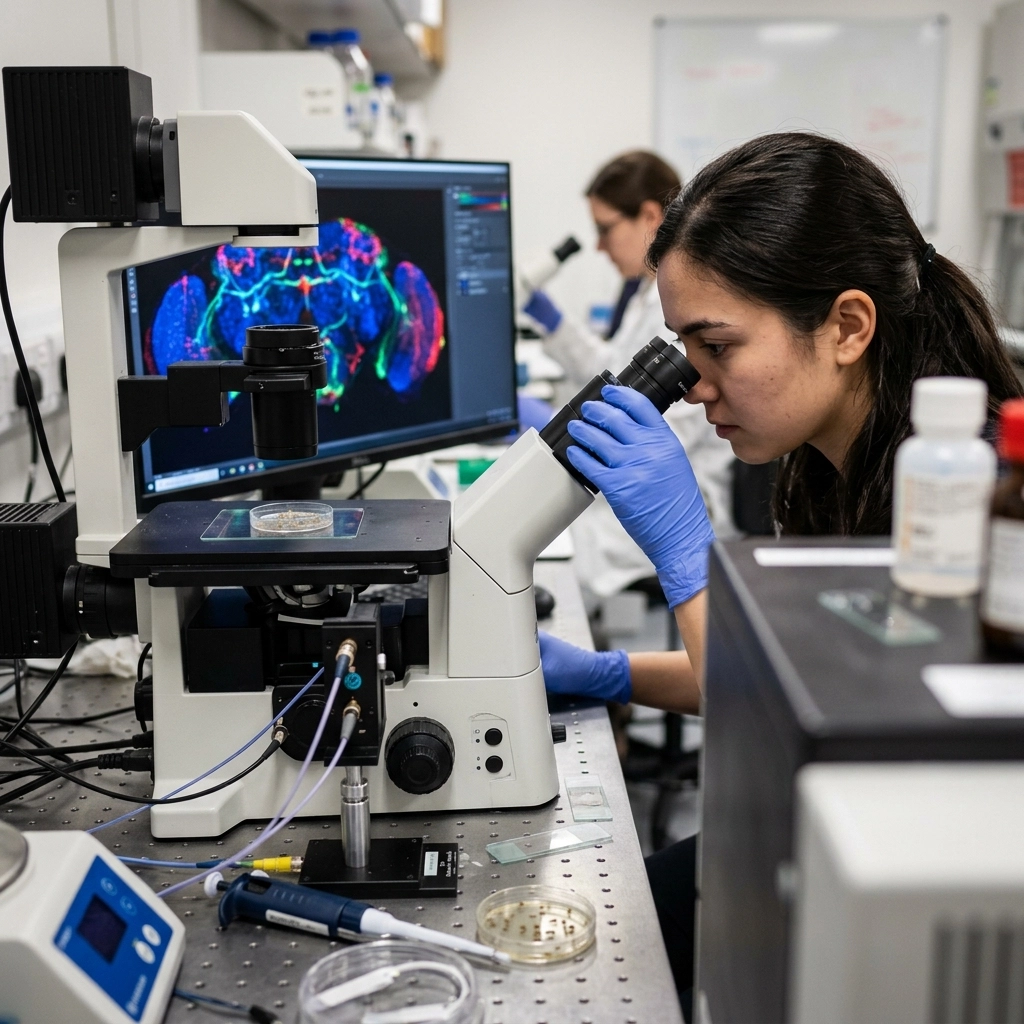
This jump from 3,000 to 130,000 is not just a linear increase; it is an exponential leap in complexity. Mapping the adult fly brain meant slicing the organ into 7,000 ultra-thin sections, imaging them with an electron microscope, and then using highly advanced AI technology to stitch those millions of images back together. Think of it as the world’s most difficult jigsaw puzzle, where every piece is invisible to the human eye and the final picture is a three-dimensional map of consciousness.
But the AI could not do it alone. This project, known as FlyWire, involved a global community of "citizen scientists" and researchers who spent years manually proofreading the AI’s work. It turns out that while machines are great at processing data, they still struggle with the messy, tangled reality of biological wiring. This collaboration between human intuition and machine speed is a landmark in how we conduct big science in the 21st century. It is a testament to what happens when we stop looking for shortcuts and start looking for the truth in the details.
The Unexpected Mirror: Fly vs Human
You might be wondering why we are spending millions of pounds and thousands of hours on an insect that lives for about 30 days and enjoys rotten bananas. The answer lies in our DNA. Believe it or not, humans and fruit flies share about 60% of the same genetic code. More importantly, roughly 75% of the genes that cause diseases in humans have a functional parallel in the fruit fly.
When we look at the fly brain, we are essentially looking at a "stripped-back" version of our own. Flies exhibit complex behaviours that we recognise: they have internal clocks, they sleep, they learn, they remember, and they even get aggressive or social depending on their environment. By mapping their brain, we are creating a Rosetta Stone for the human mind. We can finally see the "wiring diagram" for behaviours like walking, grooming, and even the "startle" response that makes them so hard to swat.
This map allows scientists to "close the loop." In the past, we knew which parts of the brain were active during certain tasks, but we did not know exactly how the signal moved from neuron A to neuron B to produce action C. Now, we do. This is vital for understanding neurological conditions. If we can see exactly how a fly’s brain malfunctions when its "circadian rhythm" neurons are damaged, we gain invaluable insights into human sleep disorders and even neurodegenerative diseases like Alzheimer's and Parkinson's. This is more than just a map; it is a diagnostic tool for the future.

From Fruit Flies to the Human Frontier
The mapping of the fruit fly brain is not the finish line; it is the starting gun. Now that we know it is possible to map an organism of this complexity, the race is on to map larger brains. The next major milestone is the mouse brain, which contains about 100 million neurons: nearly 1,000 times more than the fly. Beyond that lies the ultimate prize: the human brain, with its 86 billion neurons and trillions of connections.
If the fly brain is a map of a small village, the human brain is a map of the entire planet. While we are still decades away from a full human connectome, the techniques developed during the fly project: the AI algorithms, the imaging processes, and the collaborative proofreading: are the foundation upon which that future map will be built. We are learning how to read the language of the mind, one neuron at a time.
This project also highlights a shift in how we view "intelligence." By simulating the fly brain in a computer, researchers were able to predict how the fly would respond to certain stimuli with 90% accuracy. This suggests that much of what we consider "instinct" or "choice" is actually the result of very specific, physical pathways. It challenges our notions of free will and opens up new debates in the art of philosophy and ethics. If we can perfectly model a fly’s mind, when will we be able to do the same for a dog, a monkey, or a person?
The work being done at NowPWR aims to bring these complex scientific narratives to the forefront. In an era where news cycles move at breakneck speed, the story of a decade-long effort to map a fly’s brain serves as a reminder that some of the most important wins for humanity happen on a microscopic scale. We are finally peering into the engine room of life, and what we are finding is more beautiful and complex than we ever imagined.
This breakthrough is a massive win because it proves that the "impossible" is just a matter of perspective and processing power. The humble fruit fly, once a mere nuisance in our kitchens, has become the most important pilot in our journey to understand the most complex object in the known universe: the brain.
The completion of the fruit fly connectome marks a fundamental shift in neuroscience, moving the field from speculative observation to precise, data-driven simulation. By bridging the gap between artificial intelligence and biological reality, researchers have provided a foundation for future discoveries that could redefine our approach to mental health, genetic research, and the very nature of consciousness. As science progresses toward more complex organisms, the lessons learned from this tiny brain will undoubtedly serve as the primary guide for exploring the vast landscape of the human mind.