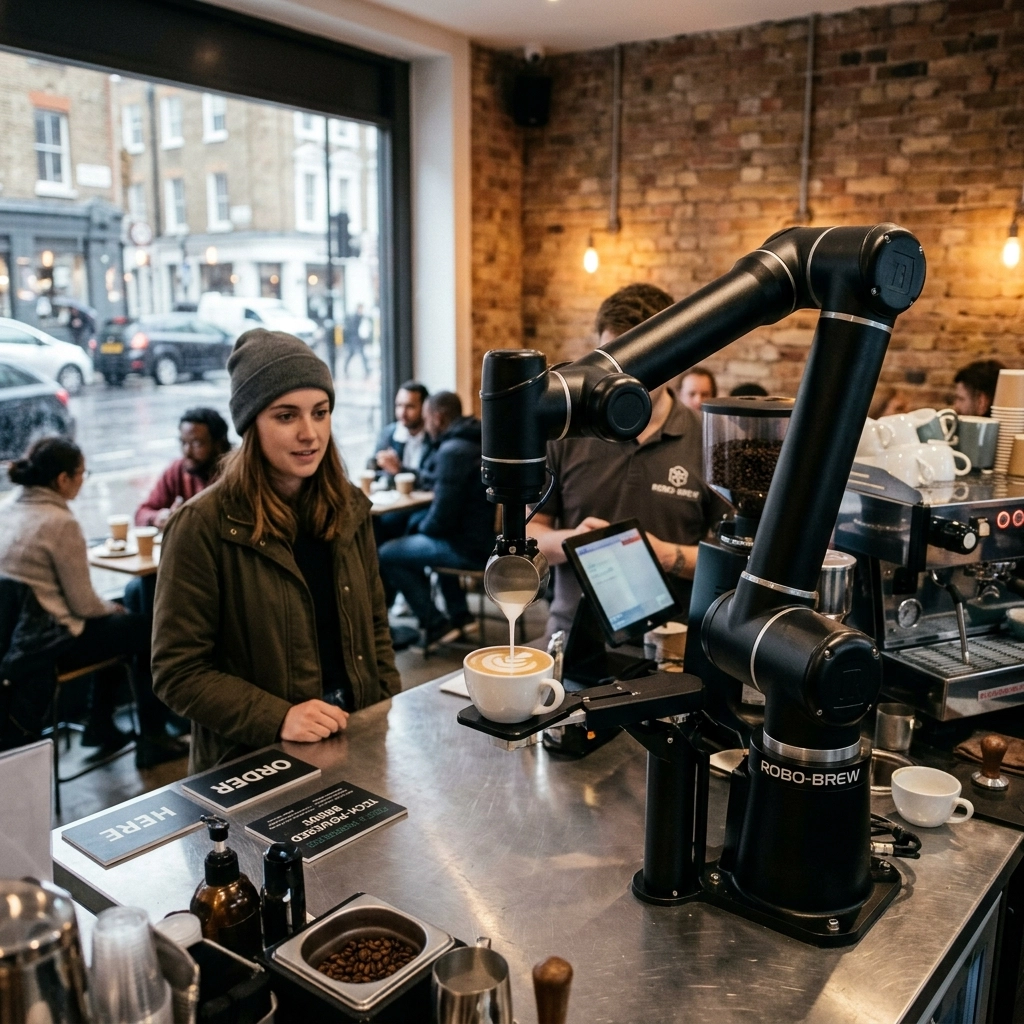
The morning commute in London has long been defined by a specific set of sensory cues. There is the rhythmic thrum of the Tube, the frantic clicking of heels on wet pavement, and the ubiquitous hiss of a milk wand in a crowded café. But lately, in certain corners of the City and the tech-heavy corridors of Shoreditch, that hiss is being accompanied by the precise, silent whir of servo motors. The barista isn’t wearing a flannel shirt or sporting an ironic moustache; instead, it consists of a gleaming white articulated arm and a set of sensors that never need a holiday.
London’s relationship with coffee is storied. From the 17th-century coffee houses where insurance markets were born to the modern artisanal explosion, the city has always treated its caffeine with a mixture of reverence and caffeine-fuelled urgency. However, we are entering a new chapter in the capital’s brewing history: one where the human element is being surgically removed in favour of silicon-grade consistency. In this landscape of independent news UK reports, the rise of the robot barista is one of those untold stories that sits at the intersection of extreme efficiency and slightly awkward social evolution.
For the average Londoner, the appeal is obvious. We are a people who generally prefer to avoid unnecessary eye contact before 9:00 AM. The robot barista offers the ultimate sanctuary: a world where your name is never misspelled as ‘Pany’ instead of ‘Penny’, and where the machine doesn’t judge you for ordering an extra pump of sugar-free vanilla syrup.
The Mechanical Waltz of the Morning Brew
Watching a robotic arm prepare a flat white is a hypnotic experience. It moves with a grace that suggests it has spent its entire existence studying the fluid dynamics of micro-foam. Unlike a human barista, who might be distracted by a colleague’s gossip or a particularly difficult customer, the robot is singularly focused. It picks up a cup with the delicacy of a diamond thief, positions it under the hopper, and executes a pour that is mathematically perfect every single time.
In the UK, startups like Starbot are leading this charge, proving that automation doesn’t have to mean a loss of quality. These systems are programmed to handle over 50 different types of drinks, adjusting for sweetness, ice levels, and milk alternatives with a level of precision that would make a laboratory chemist blush. It is a far cry from the vending machine coffee of the nineties, which usually tasted like a mixture of wet cardboard and regret.
The interaction is purely transactional, which is exactly how many busy professionals like it. You tap an app, a QR code flashes, and the mechanical arm delivers your beverage with a flourish that borders on the theatrical. There is no small talk about the weather, no pressure to discuss your weekend plans, and: crucially: no lingering feeling that you ought to drop your spare change into a jar. This is the new face of London’s high street: a place where the technology is the star, and the service is invisible.
A Gratuity-Free Revolution on the Streets
One of the most fascinating aspects of this shift is the cultural divergence between London and its international peers. Recent reports from across the Atlantic have highlighted an ironic trend where robotic kiosks in the US have begun prompting customers for tips. It is a move that has left many scratching their heads: who exactly is the tip for? Does the robot have a mounting electricity bill? Is it saving up for a more advanced sensory array?
In London, the approach is refreshingly different. The philosophy behind our automated coffee scene is “No Tips, Just Tech.” The price you see on the screen is the price you pay. There is no social pressure to add a 20% gratuity for a machine that is literally incapable of feeling the benefit of your generosity. This aligns perfectly with the British sensibility of straightforwardness. We want our coffee fast, we want it good, and we want to avoid the awkward dance of the digital tipping screen.
This shift isn’t just about saving a few quid, though. It’s about the transparency of the service. When you remove the tipping culture from the equation, the focus shifts entirely to the value of the product and the efficiency of the delivery. It challenges our traditional notions of the service industry. If a robot can provide a “perfect” service without the need for an emotional or financial incentive, it forces us to reconsider what we are actually paying for when we visit a traditional café. Are we paying for the beans, or are we paying for the human warmth that comes with the cup? In the heart of London’s financial district, the answer often leans toward the former.
The Untold Stories of Our Automated Future
Beyond the novelty of a robot arm making latte art lies a deeper narrative about how London is adapting to the post-pandemic world. As labour shortages continue to affect the hospitality sector, these silicon servers are filling a gap that would otherwise leave many commuters decaffeinated and disgruntled. But this isn’t just a story of replacement; it’s a story of evolution.
Independent news UK outlets are beginning to look closer at the human-robot interaction taking place on our streets. It isn’t as cold as one might imagine. There is a certain charm in seeing children pressed against the glass of an automated kiosk, mesmerised by the robot’s movements. Even the most cynical city worker can be spotted cracking a smile as the arm does a little celebratory “dance” after completing a pour. It’s a new kind of urban theatre, a piece of performance art that just happens to result in a caffeinated beverage.
However, the “untold stories” of this transition also involve the people behind the machines. For every robot barista on the frontline, there is a team of London-based engineers, roasters, and technicians ensuring the beans are sourced ethically and the software remains bug-free. The human element hasn’t vanished; it has simply moved behind the scenes. We are witnessing a shift from manual labour to technical oversight. The barista of the future might not need to know how to froth milk by hand, but they will certainly need to know how to calibrate a hydraulic actuator.
As we look toward the future of the London high street, the presence of these robots serves as a reminder of our city’s resilience and its willingness to embrace the new. Whether you find the idea of a mechanical barista exciting or a little bit eerie, there is no denying the convenience of a high-tech brew that asks for nothing but a bit of your time and a tap of your card.
The rise of robot baristas in London represents a significant shift in the urban landscape, blending cutting-edge technology with the city’s historical love for coffee. By removing the complexities of tipping and the inconsistencies of human service, these machines offer a glimpse into a future where efficiency is paramount. While the traditional coffee house will always have its place for those seeking conversation and community, the robot barista caters to the fast-paced, tech-savvy heart of the capital, proving that sometimes, the best service is no service at all.