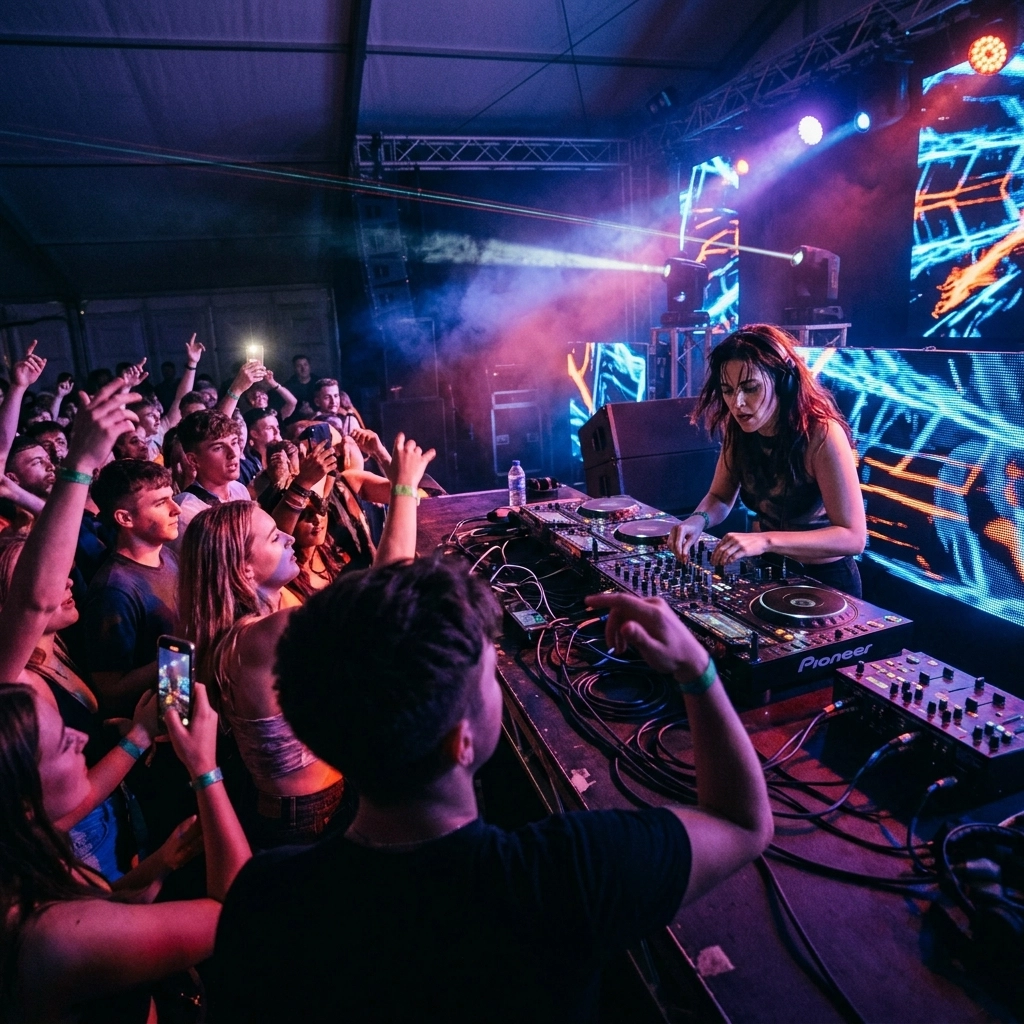
Ipswich isn't exactly the first place people think of when they imagine a global tech revolution or a world-class music festival that rivals the giants of the summer circuit. Usually, the conversation revolves around the local football club’s latest performance or the scenic but quiet life by the Waterfront. However, as we approach July 2026, the narrative is shifting. There is a buzz in the air that smells less like fresh-cut grass and more like high-end circuitry and bass-heavy speaker systems.
Enter the Halo Festival. It is the music bash that nobody saw coming, primarily because it is being spearheaded by the very people you’d usually find behind a coding terminal rather than a mixing desk. This isn't just about loud music in a field; it’s a calculated, tech-infused effort to resuscitate a local music scene that was, quite frankly, on its last legs. As part of our commitment to independent news uk and bringing you the untold stories that mainstream outlets often miss, we sat down with the organizers to figure out how a bunch of software engineers and tech moguls ended up becoming the patrons of Ipswich’s sonic future.
The Silicon Valley of the East Meets the Stage
NowPWR: Let’s be real for a second. When people think of Ipswich, they think of history and maybe a bit of agriculture. They don’t think of a high-tech music extravaganza. How did this even happen?
Halo Organizers: It’s a fair point. We’ve always been the "Silicon Valley of the East" in some circles, but that stayed behind closed office doors. The untold stories here are about the local venues. Over the last five years, Ipswich lost three of its most iconic small stages. The "scene" was essentially a couple of pubs with a guy and an acoustic guitar. We looked at the talent in this town, real, raw talent, and realized they had nowhere to go. We’re techies, so our natural instinct was to optimize the problem. We didn't just want to throw money at a problem; we wanted to build a platform.
NowPWR: So, the tech firms are essentially playing the role of the modern-day Medici family?
Halo Organizers: Maybe a bit less flamboyant, but yes. The local tech sector has been booming, and frankly, we were tired of our employees leaving for London or Cambridge every weekend to find something decent to do. We decided to build the festival we wanted to see. Halo is sponsored by a consortium of Suffolk-based tech firms. They aren’t just putting their logos on the cups; they are providing the infrastructure. We’re talking about 5G-enabled stages, immersive AR experiences for the crowd, and sound systems that use AI to balance acoustics based on the wind speed and crowd density.
NowPWR: That sounds like a lot of jargon. Does it actually make the music better, or is it just fancy window dressing?
Halo Organizers: It makes the experience seamless. There’s nothing more "uncool" than tech that gets in the way. But when you’ve got a local indie band playing on a stage where the visuals are being generated in real-time by their own heart rates, it creates a connection that traditional festivals can’t touch. We’re saving the music scene by making it future-proof.
Not Your Average Field and a Guitar
NowPWR: Let’s talk about the lineup. Usually, when a tech firm sponsors something, it’s a bit… corporate. How are you keeping the "bash" feeling like a bash?
Halo Organizers: We aren't choosing the bands based on their LinkedIn profiles, if that’s what you mean. We’ve stayed away from the corporate vibe by giving total creative control to the local artists. The tech firms provide the playground, but the musicians provide the soul. We’ve got everything from grime artists from the estates to folk singers who’ve been playing the same three pubs for twenty years. The difference is, we’re putting them on a stage that looks like it fell out of a sci-fi movie.
NowPWR: There’s a rumour that the festival is also acting as a bit of a "rescue mission" for local grassroots venues. Is there any truth to that?
Halo Organizers: Absolutely. That’s the untold story behind the headlines. A significant portion of the ticket sales from Halo Festival is being funneled directly into a trust to buy back a derelict warehouse in the town centre. We want to turn it into a permanent, tech-forward music venue that stays open all year round. The festival is the launchpad, but the goal is a permanent revival. We’re using our project management skills and our capital to ensure that when the festival ends on July 4th, the music doesn’t stop.
NowPWR: Is there a danger that the "tech-fueled" aspect might alienate the traditional festival-goer? You know, the one who just wants a warm beer and a muddy boot?
Halo Organizers: We’ve still got the warm beer, well, actually, we have an automated pouring system that ensures the beer is perfectly chilled, but you get the point. We’re not trying to replace the soul of a music festival. We’re trying to enhance it. If you want to ignore the VR headsets and the interactive light shows, you can. You can just stand in the middle of Trinity Park and enjoy the bass hitting your chest. But if you want to see how technology can take a local artist’s vision and amplify it to a global scale, that’s where the magic happens.
Why Binary Beats are Good for the Soul
NowPWR: What has the reaction been from the local community? Surely there were some eyebrows raised when a bunch of software companies announced they were taking over Trinity Park?
Halo Organizers: There was definitely some skepticism. People thought it was going to be a trade show with a DJ. But once they saw the commitment to local talent, the mood changed. We aren't flying in ten global superstars and ignoring the local kids. We have a "Next Gen" stage that is entirely populated by students from local colleges. These kids are being given access to equipment that usually only the top 1% of the industry gets to touch. That’s how you build a scene: not by importing culture, but by growing it.
NowPWR: It sounds like you’re trying to prove that Ipswich can be a cultural hub as well as a technical one.
Halo Organizers: Precisely. For too long, the UK’s music scene has been London-centric. We’re part of a movement of independent news uk stories that show the regions are where the real innovation is happening. Ipswich has the space, it has the talent, and now, thanks to the tech sector, it has the resources. Halo Festival is just the beginning. We’re showing that you don’t need a billion-pound label to create something world-class. You just need a bit of imagination and a very fast internet connection.
NowPWR: Final question. If there is one thing people take away from the Halo Festival, what do you want it to be?
Halo Organizers: That the local music scene isn't dying; it's just upgrading. We want people to leave Trinity Park on July 4th feeling like they’ve seen the future of how a community can support its artists. It’s not about charity; it’s about investment. When the tech sector and the creative sector collide, everyone wins. And maybe, just maybe, people will stop asking "Why Ipswich?" and start asking "When is the next one?"
The Halo Festival represents a fascinating intersection of industry and art. By leveraging the financial and technical might of the local tech scene, Ipswich is finding a way to preserve its musical heritage while embracing the tools of the future. It is a bold experiment in community-led cultural revival, proving that even in an age of digital dominance, there is nothing quite like the power of a live performance. As the countdown to July begins, all eyes are on Trinity Park to see if this tech-fueled bash can truly strike a chord.
The integration of technology within the local arts scene provides a sustainable model for other towns facing similar declines in traditional venues. By focusing on local talent and providing them with high-level resources, the Halo Festival is doing more than just putting on a show; it is building an ecosystem. This approach ensures that the "untold stories" of Ipswich’s musicians continue to be heard for years to come. Regardless of whether one is a tech enthusiast or a music lover, the festival offers a unique glimpse into a future where innovation and creativity are two sides of the same coin.