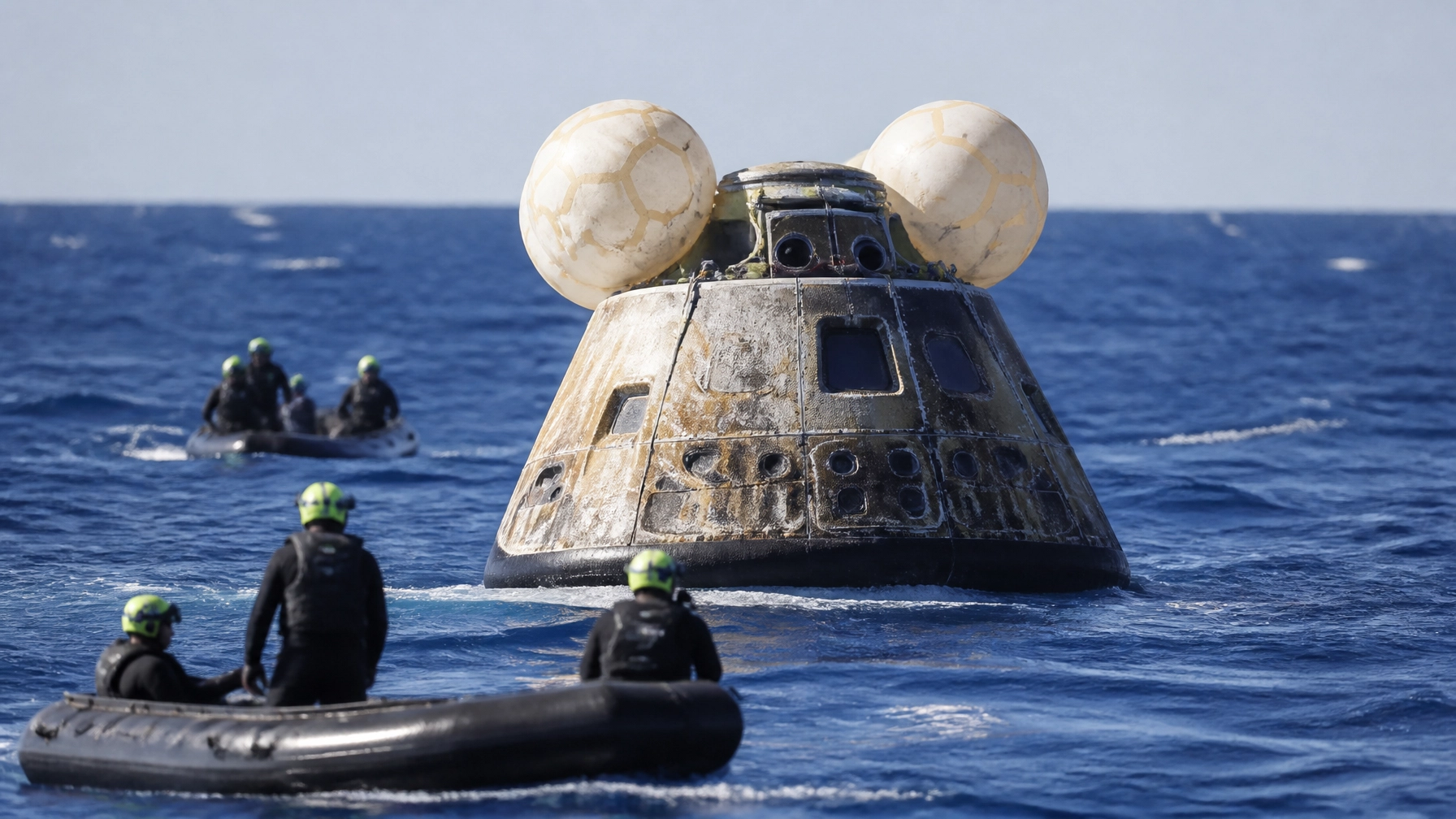
The Artemis II mission concluded this week as the Orion spacecraft performed a flawless splashdown in the Pacific Ocean, marking the end of the most significant human spaceflight in more than half a century. The four-person crew, led by Commander Reid Wiseman, successfully navigated a journey that took them further from Earth than any human being in history. After ten days of rigorous deep-space operations, the capsule safely re-entered the atmosphere at speeds exceeding 25,000 miles per hour, shielded by advanced thermal protection systems before descending under three massive parachutes.
This mission serves as a critical bridge between the uncrewed testing of Artemis I and the eventual landing of humans on the lunar surface during Artemis III. Throughout the duration of the flight, the crew tested essential life-support systems, communication arrays, and manual navigation techniques that will be vital for long-term habitation in lunar orbit. The successful return of the spacecraft confirms the flight-readiness of the Space Launch System and the Orion programme for future crewed expeditions.
The journey was not merely a technical exercise but a demonstration of international cooperation and human endurance. On board were NASA astronauts Reid Wiseman, Victor Glover, and Christina Koch, alongside Canadian Space Agency mission specialist Jeremy Hansen. Together, they navigated a trajectory that pushed the boundaries of modern exploration, proving that the hardware and the humans behind it are capable of sustaining life in the harsh environment of deep space.
The Magnitude of a Record-Breaking Flight
During the mission, the crew reached a maximum distance of 406,771 kilometres from Earth. This monumental achievement officially broke the record for the farthest distance travelled by humans, a record previously held by the crew of Apollo 13. Unlike the Apollo missions of the 1960s and 70s, Artemis II utilised a hybrid trajectory that allowed the crew to swing around the far side of the Moon using its gravity as a slingshot to return home. This free-return trajectory ensured that even in the event of a total propulsion failure after the initial trans-lunar injection, the spacecraft would naturally pull back toward Earth.
The view from the capsule at this distance provided the crew with a perspective few have ever witnessed. While orbiting the lunar far side, the astronauts experienced periods of radio silence as the Moon blocked communication with Earth. In these moments of profound isolation, the crew documented the lunar surface with unprecedented detail, capturing high-resolution imagery of the rugged terrain that remains hidden from terrestrial telescopes. The data gathered during these flybys will be essential for identifying future landing sites and understanding the geological history of the lunar South Pole.
The technical performance of the Orion spacecraft remained exceptional throughout the high-radiation environment of the Van Allen belts and the deep-space void. Engineers on the ground monitored thousands of data points, ensuring that the radiation shielding protected the crew from solar flares and cosmic rays. This successful validation of deep-space habitats is a significant milestone for the broader goal of establishing a permanent lunar base and eventually sending humans to Mars.
A Heartfelt Tribute in the Lunar Shadows
Beyond the scientific and technical triumphs, the mission carried a deeply personal significance for the crew. As the Orion spacecraft passed over the lunar horizon, the astronauts took a moment to honour a late member of the NASA family. Commander Reid Wiseman’s wife, Carroll Wiseman, passed away in 2020 after a courageous battle with cancer. In a moving tribute broadcast back to Earth, the crew proposed naming a newly identified lunar crater in her honour.
The crater, located on the boundary between the near and far sides of the Moon, was described by Jeremy Hansen as a "bright spot" on the lunar surface. The gesture was met with emotional responses worldwide, as the crew shared a moment of silent reflection while floating 250,000 miles above the Earth. This act of remembrance served to humanise the immense scale of the mission, reminding audiences that behind every great leap in exploration are families and individuals who support the journey.
The naming of the crater, alongside a second feature dubbed "Integrity" after the spacecraft, is currently under review by the International Astronomical Union. Regardless of the official designation, the tribute stands as a symbol of the resilience and sacrifice inherent in the pursuit of the stars. It highlights the close-knit nature of the astronaut corps and the collective memory that drives the exploration community forward. For the Wiseman family, the tribute provides a lasting legacy in a place that will be visited by many future generations of explorers.
Paving the Way for a Permanent Presence
The return of the Artemis II crew marks the beginning of a new phase for the Artemis programme. With the data retrieved from the Orion’s flight computers, NASA and its international partners will now focus on the final preparations for Artemis III. This upcoming mission will see the first woman and the next man step foot on the lunar surface, specifically targeting the resource-rich regions of the lunar South Pole where water ice is believed to exist in permanently shadowed craters.
The success of the flyby has also boosted confidence in the development of the Lunar Gateway, an orbital outpost that will serve as a staging ground for surface missions. British aerospace companies and European partners have been instrumental in developing components for the Gateway, and the success of Artemis II ensures that these international contributions remain on schedule. The lessons learned about long-duration communication and life support will be directly applied to the assembly of the station over the coming years.
As the crew undergoes post-flight medical evaluations and de-briefings, the global scientific community is already beginning to analyse the thousands of photographs and sensor readings brought back from the deep-space void. The Artemis II mission has proven that the journey to the Moon is no longer a historical footnote but a living, breathing reality of modern science. The path back to the lunar surface is now clearer than ever, and the successful return of Wiseman, Glover, Koch, and Hansen ensures that the next steps will be taken with confidence and a renewed sense of wonder.
The Orion capsule is being transported to the Kennedy Space Centre for a detailed forensic analysis of its heat shield and internal systems. This data will be vital for refining the spacecraft design for the Artemis IV and V missions, which aim to establish sustainable infrastructure on the Moon. The conclusion of this mission is not just an end but a definitive signal that humanity has returned to deep space to stay. Over the next few months, the crew will tour the country to share their experiences and inspire the next generation of scientists, engineers, and dreamers who will follow in their footsteps.