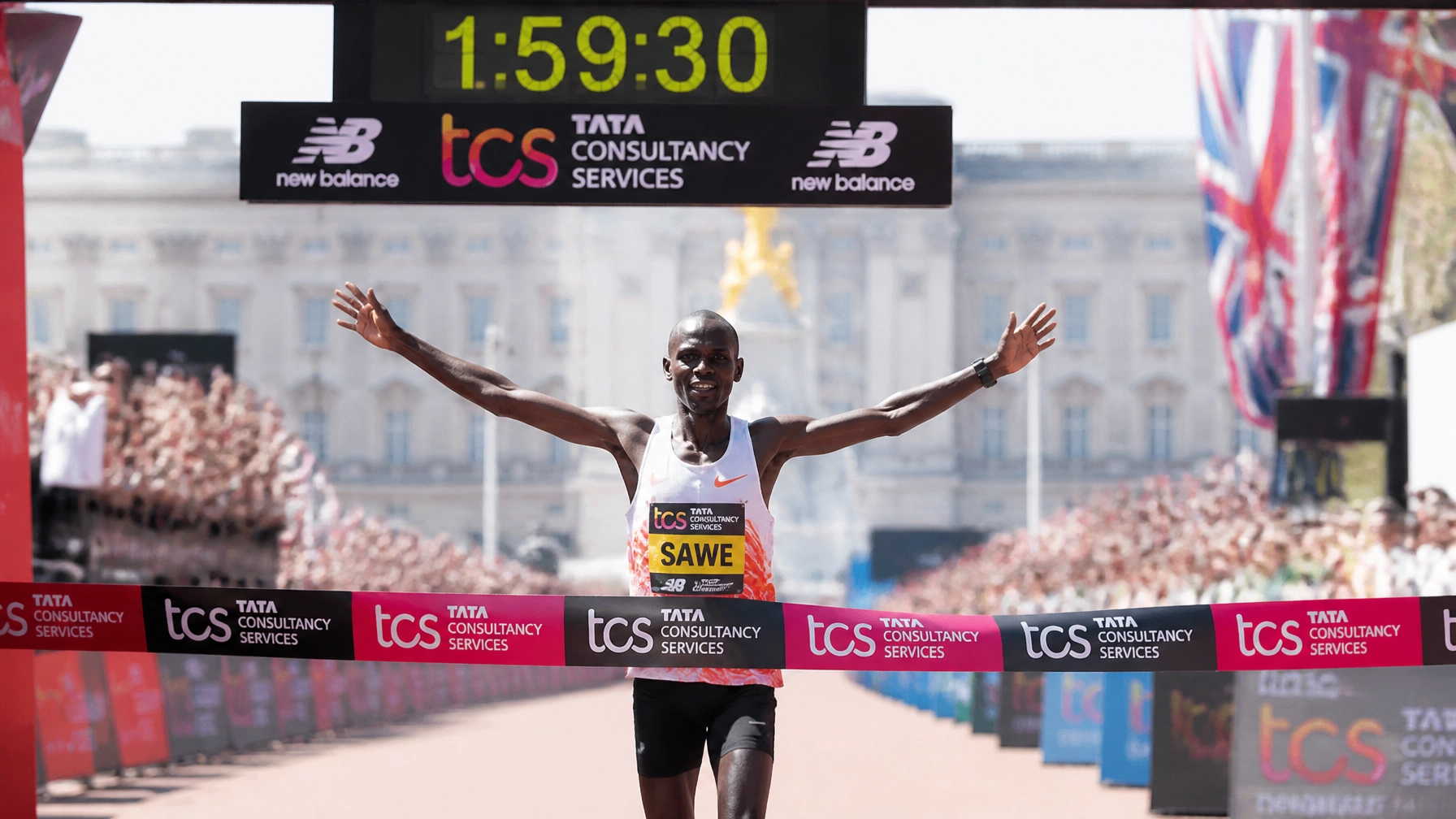
The streets of London bore witness to a feat once deemed physically impossible on a crisp Sunday morning in April 2026. Sabastian Sawe, the Kenyan distance running sensation, etched his name into the annals of sporting history by becoming the first person to break the two-hour marathon barrier in an official, sanctioned race. Crossing the finish line on The Mall with a staggering time of 1:59:30, Sawe did more than just win a race; he redefined the boundaries of human endurance. The atmosphere in the capital was electric, a mixture of disbelief and roaring jubilation that echoed from Greenwich to Buckingham Palace.
The journey to 1:59:30 began long before the starting gun fired at Blackheath. For years, the “Sub-2” project had been the Holy Grail of athletics. While Eliud Kipchoge had previously broken the barrier in a controlled, non-sanctioned exhibition in Vienna in 2019, the sporting world had been waiting for a performance under strict race conditions. Sawe delivered exactly that, navigating the 26.2-mile course without the aid of rotating pace teams or specialised laser-guided vehicles. The conditions were near-perfect for a record attempt: a cool 10 degrees Celsius, negligible wind, and the high humidity that long-distance runners often favour for keeping the respiratory system hydrated.
As the elite men’s field set off, the pace was relentless from the opening kilometre. Sawe, known for his efficient stride and calm demeanour, tucked himself into the leading pack, which included several of the world’s most decorated runners. The early splits indicated that history was on the cards. They reached the 10-kilometre mark in 28:15, a pace that many expected would lead to a late-race burnout. However, Sawe looked remarkably comfortable, his face a mask of focus as he glided past the historic Cutty Sark, where thousands of spectators had gathered to catch a glimpse of the record-breaking attempt.
The Technical Perfection of the Pace
The middle stages of the London Marathon are often where the mental battle begins, but for Sawe, it was a showcase of technical mastery. Crossing Tower Bridge just before the halfway point, the lead group had been whittled down to a handful of contenders. Sawe reached the 13.1-mile mark in 59:40. At this stage, the possibility of a sub-two-hour finish moved from a theoretical dream to a tangible reality. The crowds in the Docklands and Canary Wharf provided a wall of sound, their cheers acting as a mechanical force pushing the runners forward. Sawe’s cadence remained metronomic, never wavering even as the course wound through the tighter turns of the business district.
Sports scientists and coaches had long debated whether the London course, with its various twists and occasional cobblestones, could ever host a sub-two-hour time. Unlike the flat, straight stretches of Berlin or Chicago, London demands a more tactical approach to pacing. Sawe’s team had meticulously studied the topography, identifying exactly where to conserve energy and where to apply pressure. He utilised the slight downhill sections near the 30-kilometre mark to regain momentum, looking as fresh as he had at the start. His ability to maintain a sub-2:51 minute-per-kilometre pace through the most gruelling sections of the race left commentators and former athletes in awe.
By the time the race reached the Embankment, the battle had narrowed to a two-horse race between Sawe and the Ethiopian star Yomif Kejelcha. Kejelcha, a fierce competitor with incredible closing speed, remained glued to Sawe’s shoulder. The presence of a rival pushed Sawe further; it was no longer just a race against the clock, but a tactical duel for the ages. Every stride was a testament to the years of “invisible work”: the thousands of miles run on the red dirt roads of Iten, the rigorous recovery sessions, and the unwavering mental discipline required to sustain such a high level of performance.
A Duel for the History Books
The final five kilometres of the 2026 London Marathon will be remembered as one of the greatest spectacles in athletics. As the runners turned onto the Victoria Embankment with the London Eye as their backdrop, the pace actually quickened. Yomif Kejelcha launched a series of surges, attempting to break Sawe before the final turn at St James’s Park. Kejelcha’s performance was itself historic; he would go on to finish in 1:59:41, a time that also shattered the previous world record and would have been the headline story on any other day. The two men ran side-by-side, their breathing synchronised with the rhythmic thud of their carbon-plated shoes hitting the tarmac.
The energy from the crowd along the Thames was unprecedented. People had travelled from across the globe to witness this moment, and the roar was deafening as the duo approached Westminster. Sawe’s kick came at the 40-kilometre mark. He found a gear that seemed impossible after nearly two hours of maximum effort. He began to pull away from Kejelcha, centimetre by centimetre, his eyes fixed on the digital clock on the lead vehicle. The gap widened as they passed Big Ben and headed toward Birdcage Walk. It was here that Sawe truly realised the record was within his grasp.
Entering the final stretch on The Mall, with Buckingham Palace standing as a silent witness to the occasion, Sawe unleashed a final sprint. The clock ticked past 1:59:10, 1:59:20, and as he broke the tape, it stopped at 1:59:30. The silence of the palace was replaced by a thunderous ovation. Sawe collapsed into the arms of race officials, overcome with emotion, as Kejelcha crossed just eleven seconds later. Both men had achieved what was once thought to be a century away. The magnitude of the achievement began to sink in as the official results were confirmed: the first official sub-two-hour marathon had been run in the heart of London.
Redefining Human Limits in London
The impact of Sawe’s 1:59:30 will be felt for generations. Much like Roger Bannister’s four-minute mile in 1954, this performance has broken a psychological barrier as much as a physical one. It proves that the human body, supported by modern nutrition, advanced footwear technology, and sophisticated training methods, is capable of extraordinary things. Sawe’s victory is expected to inspire a new wave of distance runners who no longer see the two-hour mark as a ceiling, but as a benchmark to be challenged. The sport of marathon running has entered a new era where the focus will shift from “if” someone can run under two hours to “how much faster” they can go.
Beyond the technical and physiological achievements, Sawe’s win brought a sense of unity to the capital. The London Marathon has always been a celebration of human spirit, featuring tens of thousands of mass-participation runners who follow in the footsteps of the elites. This year, every amateur runner who crossed the finish line did so knowing they had shared the same tarmac as a man who had just changed the world. The historic sub-two-hour win has cemented the London Marathon’s reputation as the premier race for both elite performance and public engagement.
Sabastian Sawe’s name is now synonymous with a turning point in history. His humble post-race remarks focused on the collective effort of his team and the inspiration he drew from the crowds. He spoke of the miles of lonely training and the belief that anything is possible with dedication. As the city of London returned to its usual rhythm on Monday morning, the echoes of Sawe’s footsteps remained. The two-hour barrier has fallen, and the world of athletics will never be the same again. Sawe has not only won a marathon; he has written a new chapter for humanity, proving that our potential is limited only by our willingness to chase the impossible.