While most university students in Bournemouth are currently worrying about their dissertations or where to find the cheapest pint on a Tuesday night, Tom Liggett has his head in the clouds. Actually, he has his head significantly higher than the clouds. Tom is a pioneer in a field most of us didn't even know existed: cosmic ray photography. By hitching a ride on high-altitude balloons and using the very particles that bombard our planet from deep space, he is creating abstract art that is literally out of this world.
As part of our commitment to independent news uk, we love finding these untold stories that bridge the gap between hard science and creative expression. Tom’s work isn’t just about taking a pretty picture; it’s about capturing the invisible ghosts of the universe. We sat down with him to figure out how a student from the south coast ended up collaborating with the cosmos.
The Science of the Stratosphere
So, Tom, let’s start with the basics for those of us who didn’t pay enough attention in physics. What exactly is a cosmic ray, and how on earth, or off earth, are you taking photos with them?
"It’s a bit of a wild process, honestly. Cosmic rays are essentially high-energy particles, mostly protons, that come from outside our solar system. They’re zooming around at nearly the speed of light, born from things like supernovae or black holes. When they hit Earth’s atmosphere, they collide with atoms and create a shower of secondary particles.
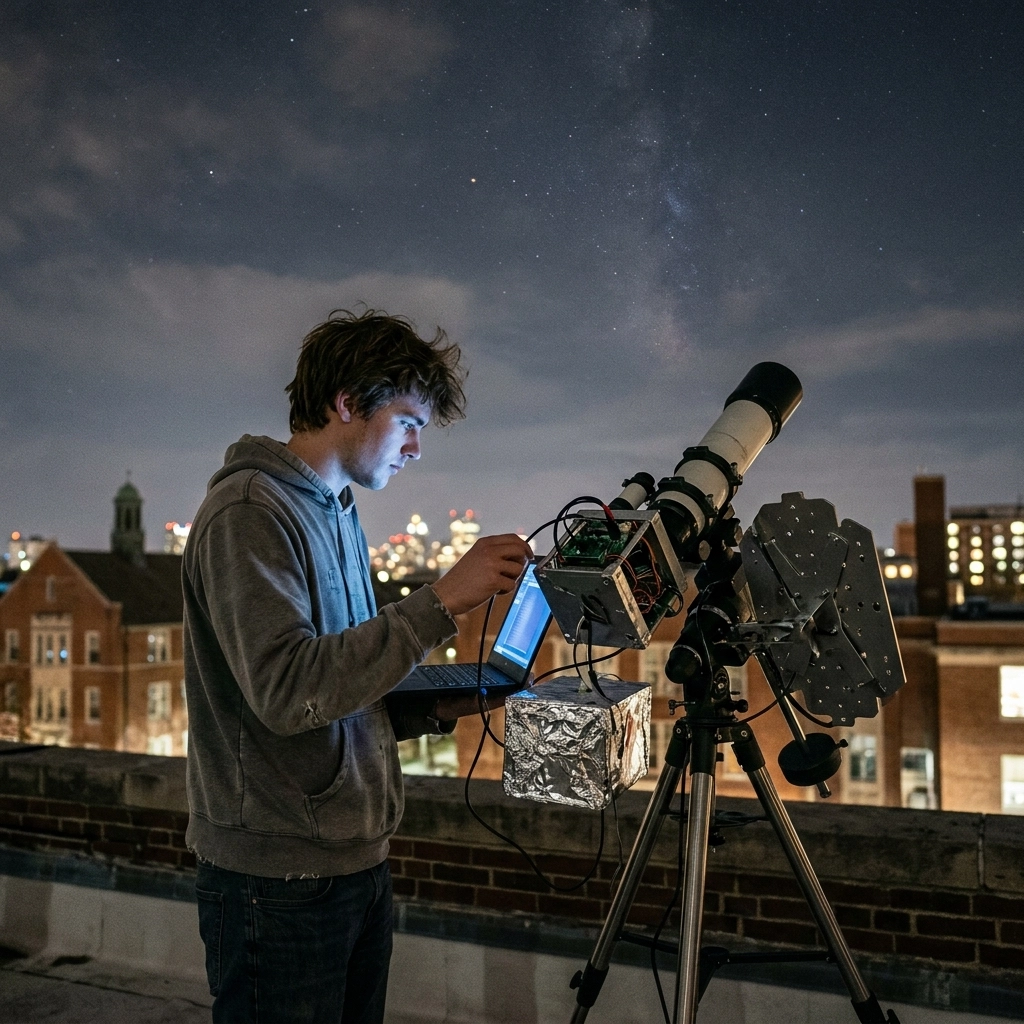
Usually, our atmosphere protects us from the worst of it, which is great for our health but bad for my photography. To get the 'clean' shots, I need to get high up. I use helium-filled high-altitude balloons to carry a custom-built camera rig into the stratosphere, about 30 kilometres up. At that height, the radiation is much more intense. Instead of using light to expose the sensor, I’m looking for the digital 'noise' and interference caused when these cosmic rays strike the camera’s hardware. It’s like a digital art project where the universe is the one holding the brush."
That sounds incredibly technical. Did you have to build the equipment yourself, or is there a 'Space Photography for Dummies' kit we don't know about?
"I wish! It was a lot of trial and error. I had to strip down digital sensors and remove the filters that are usually there to keep the images 'clean.' For most photographers, digital noise is the enemy. For me, it’s the entire point. I also had to build a housing that could survive the extreme cold and the pressure changes. If the battery freezes at 20,000 feet, the whole mission is a bust. It’s been a steep learning curve involving a lot of soldering and even more caffeine."
What does a 'cosmic ray photo' actually look like? Are we talking about stars and galaxies, or something else entirely?
"It’s very abstract. Because I’m not focusing on light, you don’t see the curvature of the Earth or the blackness of space in the traditional sense. What you see are streaks, dots, and iridescent 'glitches' across the frame. Each streak is the path of a single particle that has travelled millions of light-years just to smash into my sensor. It’s a visual record of a high-energy event. Some people look at them and see static; I look at them and see the fingerprints of a dying star. It’s a way of making the invisible, visible."
When Physics Meets Fine Art
You’re a student at Bournemouth, a place known more for its beaches than its space programme. How has the local community reacted to your 'mad scientist' hobby?
"People are generally pretty curious. I think it fits into that category of untold stories where people realise that science doesn't have to stay in a lab. When I’m prepping a launch on the coast, I get a lot of dog walkers coming up to ask if I’m tracking the weather or looking for aliens. When I tell them I’m taking photos with radioactive particles from space, they usually give me a bit of a wide berth! But once they see the prints, they get it. There’s something humbling about holding a physical photo of something that shouldn't be seen."
Does this overlap with modern AI technology at all? Are you using algorithms to process these space-born glitches?
"In a way, yes. I use some custom software to isolate the cosmic ray strikes from the background thermal noise of the sensor. The camera gets hot, and that creates its own kind of interference. I have to teach the computer to distinguish between 'boring' heat noise and 'exciting' cosmic particles. But I try to keep the artistic side as raw as possible. I don’t want to over-process it. The beauty lies in the randomness of the universe. If I used AI to 'fix' the image, I’d be losing the very thing that makes it special, the pure, unadulterated chaos of outer space."
What’s been the biggest disaster so far? Surely sending expensive cameras into the stratosphere doesn't always go according to plan.
"Oh, I’ve had my fair share of heart attacks. On my third launch, the GPS tracker failed just as the balloon popped. I had to spend two days trekking through a forest in the middle of nowhere, following a hunch and some very basic radio pings. I eventually found the rig tangled in a tree. The camera was fine, but the footage was incredible. It had captured a massive solar flare event that just lit up the sensor. That’s the risk you take with independent news uk style projects: you don’t have a NASA budget, so when things go wrong, you’re on your own."
A New Lens on the Universe
Where do you see this going? Is this a career path, or just the world’s most expensive university project?
"I’d love to take it further. I’m currently looking at ways to launch smaller sensors on commercial satellites. The higher you go, the more 'pure' the particles are. I also want to exhibit the work in a way that educates people about the environment above us. We talk a lot about climate change and the atmosphere, but we rarely think about the radiation environment we live in. These photos are a reminder that Earth isn't an island; we’re constantly being 'touched' by the rest of the galaxy. If I can spark someone’s interest in physics through a cool-looking abstract photo, then I’ve done my job."
What advice would you give to other students or creators who want to tell their own untold stories but don't know where to start?
"Don't be afraid to break things. My best results came from taking apart things that were supposed to stay closed. We live in an era where the tools for high-level exploration are actually quite accessible if you’re willing to learn. You don't need to be a genius; you just need to be persistent. And maybe get used to the idea that your gear might end up in a tree 50 miles away."
Is there a specific 'holy grail' shot you’re chasing?
"I want to capture a clear signature of a Muon: a specific type of particle: decaying in real-time on the sensor. It’s incredibly rare to catch it perfectly, but it would be the ultimate 'click.' It’s like trying to photograph a ghost in a dark room, except the ghost is moving at the speed of light and the room is 30,000 metres in the air. It’s a challenge, but that’s what makes it fun."
Tom’s work reminds us that even in a world where everything seems to have been photographed, there are still layers of reality waiting to be captured. It isn't just about the technology; it's about the curiosity to look at a "glitch" and see a masterpiece. By turning the radiation of deep space into art, he is proving that the most interesting stories often happen where we aren't looking.
The intersection of science and art has always been a fertile ground for innovation. Tom Liggett’s cosmic clicks represent a unique fusion of high-altitude physics and abstract aesthetics, challenging our perceptions of what photography can be. As he continues to refine his techniques and reach higher into the stratosphere, the results offer a rare glimpse into the invisible forces that shape our universe. This project highlights the importance of independent creative exploration and the potential for students to contribute meaningfully to both scientific and artistic dialogues through unconventional methods.