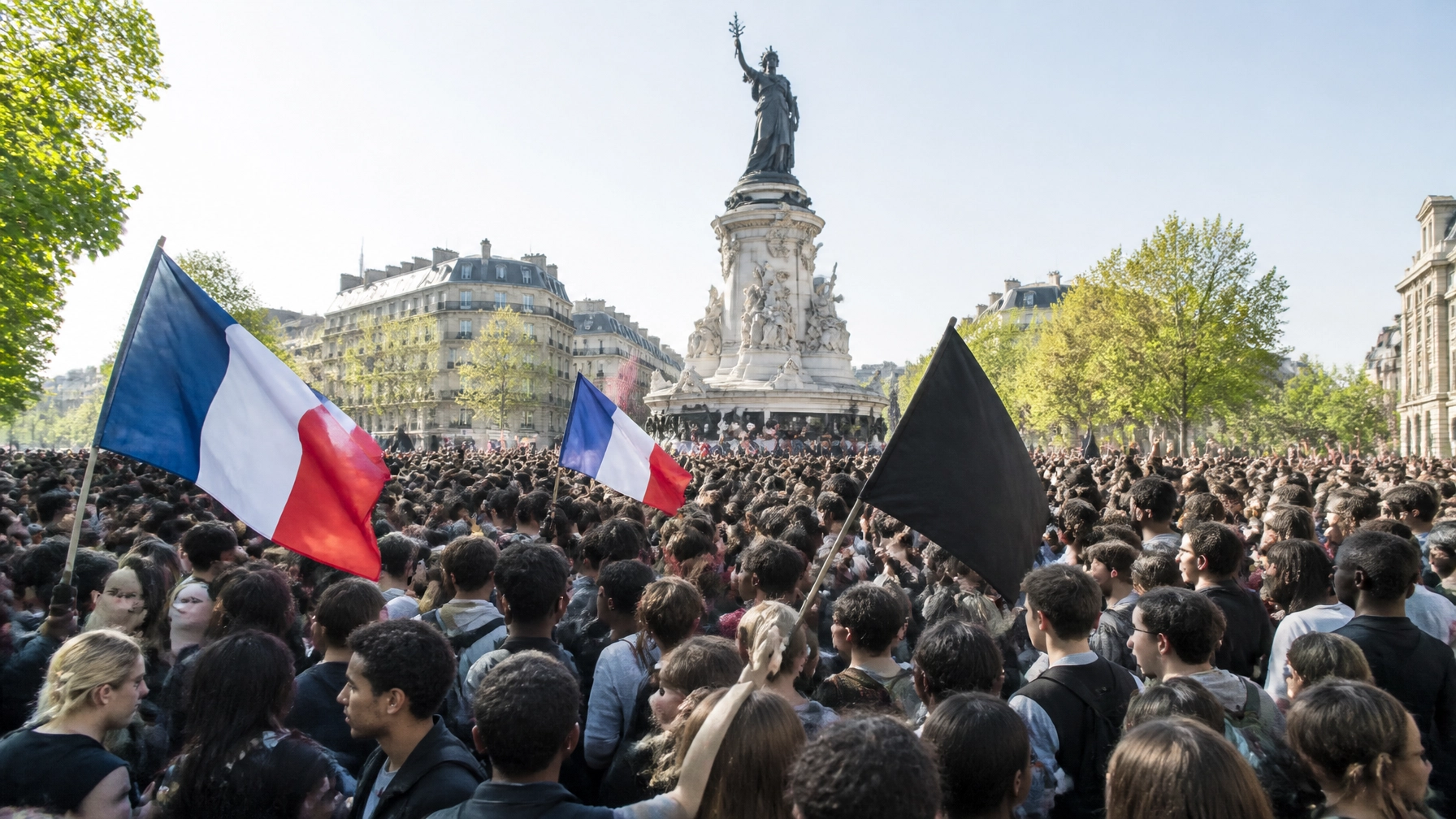
The streets of Lyon and Paris have become the front lines of a deepening ideological chasm in France, as thousands of protesters continue to mobilise following the death of a young activist. The unrest, which began as local vigils, has rapidly escalated into a national crisis, forcing the French government to confront the volatile intersection of street politics and radicalised youth movements. At the heart of the turmoil is the death of Quentin Deranque, a 23-year-old student whose fatal injuries during a political clash have sparked a firestorm of accusations, counter-protests, and a significant security crackdown across major urban centres.
The initial incident occurred in mid-February, when Deranque, associated with nationalist circles, was involved in a violent confrontation outside a political event. Reports indicate that he was part of a security detail for a right-wing group when a fight broke out with counter-demonstrators. The ensuing brawl left the young man with severe head trauma, leading to his collapse and subsequent death in a local hospital. Since then, the narrative of his death has been seized upon by various political factions, transforming a personal tragedy into a symbol of a broader struggle for the soul of the Republic. The streets, once dominated by the usual rhythm of French life, are now frequently blocked by cordons of CRS riot police as the authorities struggle to maintain order between competing groups.
A Nation Divided by Political Violence
The violence that claimed the life of Quentin Deranque did not occur in a vacuum. For months, political tensions in France have been simmering, driven by a hyper-polarised atmosphere that has pit radical left-wing activists against burgeoning far-right movements. In Lyon, a city with a long history of both revolutionary fervour and conservative strongholds, the friction has reached a breaking point. Following the announcement of Deranque’s death, several thousand people gathered for a "white march" to pay their respects. However, what was intended as a solemn memorial quickly shifted in tone as radical elements within the crowd began chanting nationalist slogans and performing gestures associated with extremist ideologies.
This mobilisation was met with immediate resistance from anti-fascist organisations, who argued that the memorial was being used as a recruitment tool for radicalisation. In the weeks that followed, the cycle of protest and counter-protest has become a weekly occurrence. In cities like Marseille, Nantes, and the capital, the presence of heavy police units is now a standard feature of the weekend. The authorities have reported dozens of arrests, with charges ranging from the possession of prohibited weapons to acts of aggravated violence. The internal security services have voiced growing concern over the "militiarisation" of political discourse, noting that activists on both ends of the spectrum are increasingly coming prepared for physical confrontation, equipped with helmets, shields, and protective gear.
The legal fallout has been equally intense. Prosecutors in Lyon have moved forward with charges against several individuals believed to be directly involved in the fatal altercation. Among those under investigation are activists linked to left-wing organisations, leading to claims from right-wing politicians that the "far-left" is responsible for a climate of impunity. Conversely, left-wing leaders have pointed to the provocative nature of the nationalist groups, suggesting that the presence of such organisations in public spaces is an inherent threat to democratic order. This tit-for-tat rhetoric has effectively stalled any meaningful dialogue, leaving the public to witness a series of increasingly aggressive demonstrations that show no signs of abating.
The Ripple Effect Across European Borders
While the unrest is centred in France, the shockwaves are being felt across the European continent. The death of Deranque has been adopted as a cause célèbre by various nationalist and identitarian movements in neighbouring countries. From Rome to Dresden, small-scale solidarity rallies have been organised, echoing the slogans heard on the streets of Lyon. This transnational coordination has raised alarms within European intelligence circles, who fear that the French unrest could serve as a catalyst for a broader wave of political instability across the Eurozone. The ease with which these groups share information and coordinate logistics via encrypted platforms has made it difficult for national authorities to anticipate the scale of these "flash" demonstrations.
The international dimension took an unexpected turn when the United States administration weighed in on the situation. By labelling the death of the activist as an act of "terrorism," Washington directly challenged the French government’s handling of the crisis. This intervention sparked a diplomatic row, with the French Foreign Ministry summoning the US ambassador to express its "deep dissatisfaction" with what it described as interference in a domestic criminal investigation. The friction highlights how local incidents can quickly escalate into international incidents in an era where political violence is a globally sensitive issue. For many observers, the US involvement was seen as a strategic move to bolster conservative narratives abroad, further complicating President Macron’s efforts to present a unified and stable front to the world.
Inside the European Union, the situation has forced a difficult conversation about the regulation of political activism. Several member states have called for a more robust framework to tackle "violent political extremism," though there is little consensus on which groups should fall under such a definition. In France, the government has already begun the process of reviewing the legal status of several high-profile activist groups. The threat of dissolution hangs over several organisations, a move that critics argue would only push these movements further underground and increase the risk of clandestine violence. As the summer progresses, the focus remains on whether these groups can be brought back into the fold of democratic participation or if the rift has become permanent.
Government Response and the Road to 2027
President Emmanuel Macron has found himself in an increasingly difficult position as he attempts to navigate the crisis. His public statements have consistently called for "Republican order" and a rejection of all forms of political violence, yet he faces criticism from both sides of the aisle. The National Rally, led by Jordan Bardella, has leveraged the unrest to argue that the current administration has lost control of the streets and failed to protect its citizens from "left-wing terror." Meanwhile, the far-left France Unbowed party has accused the government of using the unrest as a pretext to curtail civil liberties and suppress legitimate dissent against economic policies.
With the 2027 presidential election appearing on the horizon, every move by the Élysée Palace is being scrutinised for its political implications. The decision to increase police presence in sensitive urban areas has been welcomed by those seeking stability, but it has also led to accusations of heavy-handedness. Footage of tear gas being deployed in historic squares has become a common sight on news broadcasts, painting a picture of a nation in a state of perpetual tension. The government’s challenge is to restore a sense of normalcy without appearing to favour one political faction over the other, a task that becomes more difficult with each new demonstration.
As the investigations into the death of Quentin Deranque continue, the broader questions facing French society remain unanswered. The unrest is a symptom of a deeper malaise, a sense of disconnection and frustration that transcends simple political affiliations. For the residents of Lyon and other cities, the hope is for a return to the quietude of daily life, but the political reality suggests that the path to reconciliation will be long and arduous. For now, the boulevards remain the stage for a dramatic and often violent rehearsal of the political battles that will define the coming years. The world watches as France, a historical beacon of democratic thought, struggles to contain the fires of its own internal divisions.