On a cold February night in 1997, the Atlantic Ocean was in a particularly foul mood. About 20 miles off the coast of Land’s End, the cargo ship Tokio Express was struck by a rogue wave that tilted the vessel 60 degrees one way, then 40 degrees back. In the chaos of the storm, 62 shipping containers slid into the dark, churning depths. One of those containers held something that would, decades later, become the stuff of local legend and international intrigue: nearly five million pieces of Lego.
In an ironic twist of fate, a vast majority of the Lego sets inside that container were ocean-themed. While the world moved on from the news of a minor shipping mishap, the Cornish coastline was about to be transformed into a giant, salt-crusted toy box. For nearly thirty years, beachcombers, environmentalists, and curious locals have walked the sands of Cornwall, eyes peeled for tiny plastic flippers, miniature spear guns, and the most elusive prize of all: the Lego octopus. This is one of those untold stories that bridges the gap between environmental disaster and a whimsical community quest, proving that even in the face of ecological concerns, the human spirit finds a way to seek out wonder.
As an independent news uk source, we often look for the narratives that slip through the cracks of mainstream reporting. The story of the "Plastic Grail" is not just about a lost toy; it is a story of patience, the power of the tides, and the relentless curiosity of a young boy who refused to give up on a dream.
The Night the Sea Turned to Toyland
The statistics of the Tokio Express spill are staggering. Among the 4.8 million pieces of Lego lost to the Atlantic were 353,760 pairs of divers' flippers, 97,500 scuba tanks, and 92,400 miniature sharks. There were also thousands of dragons: specifically 33,941 black dragons and 514 green ones. Yet, despite these high numbers, the sea does not give up its treasures easily. The currents of the Atlantic are complex, and for years, these pieces have been distributed far and wide, showing up on beaches from the north of Scotland to the shores of Ireland, and even as far as the Netherlands.
However, Cornwall remains the heart of the "Lego Lost at Sea" phenomenon. The geography of the Cornish coast acts as a natural net, catching the plastic remnants of 1997 in its rugged coves and sandy bays. For the local community, beachcombing transitioned from a casual hobby into a dedicated pursuit. It became a way to clean the beaches while simultaneously participating in a decades-long treasure hunt. Every piece found is a data point, a small plastic witness to the power of ocean currents and the terrifying longevity of modern materials.
The octopuses, however, occupied a tier of their own. Only 4,200 of these black, multi-limbed creatures were in the container. Compared to the hundreds of thousands of flippers and flowers, the octopus was a rarity from the start. To find one was to achieve a level of "beachcomber royalty." For years, the sightings were so infrequent that many wondered if the remaining octopuses had finally been buried deep in the seabed or carried off to the mid-Atlantic gyre, never to be seen again. The rarity transformed a simple piece of plastic into the "Plastic Grail," a symbol of the enduring mystery of the 1997 spill.
A Thirteen-Year-Old’s Quest for the Holy Grail
The narrative of the Lego octopus took a heartwarming turn recently when 13-year-old Liutauras Cemolonskas stepped onto the sands of Marazion. Liutauras is not your average teenager; he possesses the kind of focused determination that would make a seasoned archaeologist proud. For two years, he and his parents had been scouring the Cornish coastline, specifically searching for the remnants of the Tokio Express spill. In that time, they had amassed a collection of nearly 800 pieces of Lego, ranging from tiny yellow flowers to the more common flippers. But the octopus remained out of reach.
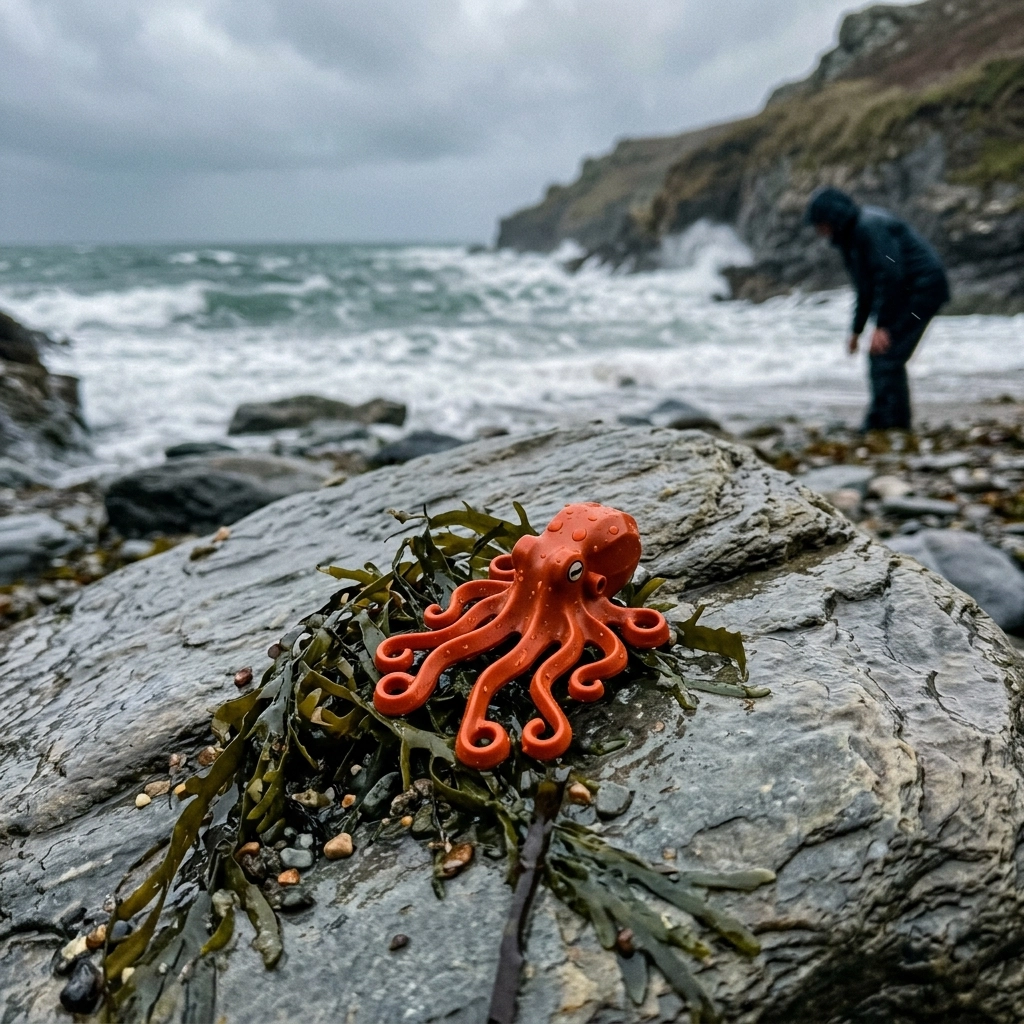
The search for the octopus is not merely a matter of walking and looking. It requires an understanding of the tides, the winds, and the specific way the sand shifts after a storm. Liutauras had spent countless hours studying the beaches, learning where the "wrack line": the debris left by the high tide: was most likely to hide small treasures. His dedication paid off in a spectacular fashion when he spotted something dark and tangled in the seaweed near Marazion.
Finding the octopus was a moment of pure, unadulterated joy. For a young boy who had dedicated two years of his childhood to this specific goal, the discovery was more than just finding a toy; it was the validation of his persistence. His father noted that they had almost given up hope, acknowledging that the rarity of the octopus made the odds of finding one incredibly slim. Yet, there it was: a black, plastic octopus, slightly weathered by nearly thirty years in the salt water but otherwise perfectly intact.
The news of Liutauras’s find sent a ripple of excitement through the beachcombing community. It served as a reminder that the "Lego Lost at Sea" project was far from over. Just two days after his discovery, another octopus was found in Porthleven. Experts believe that a combination of high spring tides and powerful onshore winds had disturbed the older layers of the sand dunes, finally releasing these plastic prisoners back into the arms of the Atlantic. It highlights the "untold stories" hidden beneath our feet, waiting for the right conditions: and the right pair of eyes: to be brought back into the light.
The Legacy of the Lego Lost at Sea
While the discovery of an octopus is a cause for celebration, it also carries a more somber message about the state of our oceans. The "Lego Lost at Sea" project, spearheaded by researcher Tracey Williams, has spent years documenting these finds to highlight the issue of marine plastic pollution. The fact that a piece of Lego can survive in the ocean for 29 years and still look almost brand new is a testament to the durability of plastic: and the danger it poses to marine ecosystems.
The project has turned a local curiosity into a global case study for oceanographers. By tracking where different pieces of the Lego spill wash up, scientists can better understand the movement of surface currents. The Lego pieces act as non-toxic tracers, providing a map of the ocean’s "conveyor belt." It is a rare instance where a pollution event has provided a wealth of scientific data, all while engaging the public in a way that traditional environmental reports often fail to do.
The community in Cornwall has embraced this duality. They are protectors of their coastline, tirelessly cleaning the plastic that washes ashore, yet they have also found a way to celebrate the strange, whimsical history of the Tokio Express. The hunt for the Lego octopus has brought families together, sparked the imaginations of children like Liutauras, and created a shared history that defines the modern Cornish beach experience. It is a story of how a community can take a piece of corporate misfortune and turn it into a narrative of resilience and wonder.
As we look toward the future, the Lego octopuses will likely continue to wash up, one by one, over the coming decades. Each find will be a small victory for a beachcomber and a small reminder of the work that remains to be done in protecting our seas. For now, Liutauras Cemolonskas holds his Plastic Grail, a 13-year-old boy who proved that if you look long enough and hard enough, even the most elusive treasures can be found. The sea still holds many secrets, but for the people of Cornwall, the mystery of the 1997 Lego spill remains one of the most captivating chapters in their coastal history.
The enduring appeal of this story lies in its simplicity. In an age of digital distractions, there is something profoundly moving about a child finding joy in a piece of plastic found in the sand. It reminds us that the world is still full of mysteries, and that sometimes, the most valuable things we find are the ones we have to wait nearly thirty years to discover. The search continues, the tides continue to turn, and somewhere out there, the next octopus is waiting for its moment in the sun.